Comments
  Print
Print  Mail
Mail  Large Medium Small
|
 |
|
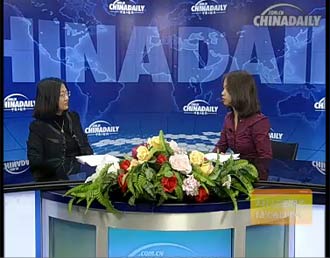
Satu Limaye (left), director of East-West Center in Washington, answers questions in the plenary session of the three-day EWC 15th biennial international alumni conference in Beijing on Sunday. Zou Hong / China Daily |
A constructive US-China relationship is crucial to stability and development in the Asia-Pacific region as the United States will continue to focus on its relationship with countries in this region, analysts said on Sunday.
The US is increasingly an Asia-Pacific nation, said diplomat James F. Moriarty - a former senior director at the US National Security Council and one-time ambassador to Bangladesh and Nepal - at a panel discussion focused on US-Asia policy on the second day of the three-day East-West Center's 15th biennial international alumni conference in Beijing.
Even after the US presidential election in November, when new people will take over key posts, including secretary of state, US interests in the Asia-Pacific region won't change, Moriarty said. "They will come to the similar conclusion that the Asia-Pacific is more and more important," he said.
US Secretary of State Hillary Clinton has said she will step down at the end of President Barack Obama's four-year term, even if Obama is re-elected.
US trade in the Asia-Pacific region was more than $320 billion in 2011, and two-thirds of foreign students in the US are from Asia. The Asia-Pacific has become the largest source of immigrants to the US.
According to Reuters, Clinton said at the Pacific Islands Forum on Friday that the US will reinforce security partnerships across the Pacific as it strengthens ties with island nations, and also hopes to work more closely with China as Beijing expands its own influence in the region.
Clinton told the gathering that the US is in the region for the long haul, but she also played down growing perceptions of a US-China rivalry there, declaring "the Pacific is big enough for all of us" while dismissing the notion that expanded US activity in the region was "a hedge against particular countries".
Ralph Cossa, president of the Pacific Forum CSIS in Honolulu, Hawaii, noted that Taiwan, the South China Sea and the Korean Peninsula are the three areas that US-China relations should focus on for the sake of stability of the region.
US arms sales to Taiwan have repeatedly resulted in troubles in China-US relations. China also has criticized US intervention in the South China Sea disputes between China and some Southeast Asian countries.
Satu Limaye, director of the East-West Center in Washington, outlined four challenges for the US in its pivot toward Asia, including how to sustain attention in this region and make multilateralism work and stretch all the way to the Asian subcontinent.
Although it's widely believed countries in this region depend on the US mainly for security, the countries actually have complex ties to its economy, too, Limaye said.
Limaye noted that the US should keep balance in its foreign policy, including its relationship with China, which should be "not too hot, not too cold".
"If we don't have constructive US-China relations, we cannot have constructive relations with our allies and partners because our allies and partners depend on US-China stability," Limaye said.
As the US repeatedly stressed that it has had a presence in Asia-Pacific for hundreds of years, Chinese opinions on the US "coming back" to this region are divided, according to Jin Canrong, deputy dean of the School of International Studies at Renmin University of China.
Some held the critical view that defines the US pivot toward Asia-Pacific as containing China and blame the US for the recent intensified territorial disputes between China and some counties in this region, Jin said.
But the mainstream view is that of the realist, who believes the US pivot is related to but not fully focused on China, and the US will face difficulties with staff changes in key foreign-policy positions. In addition, the US has weaker economic ties with countries in this region than China does, Jin said.
The two countries need to fulfill their agreement to forge a new type of big-power relationship, an initiative that was put forward by China and to which the US has responded positively, Jin said.
chengguangjin@chinadaily.com.cn
 Railway attendant spends her fifth Spring Festival on train
 Top 11 provinces with ambitious growth targets
 Alternative yardsticks show upbeat signs in Chinese market
 Suning hires expats as couriers on Chinese New Year holiday
 Top 10 most valuable startups in the world
 A job to help people release pressure by chatting
 Millions spread their wings on overseas travel taking off
 Top 10 industries with the highest salary

 Lanterns decorate temple to celebrate Chinese New Year
 Charity event for Chinese Lunar New Year held in Vietnam
Copyright 1995 - . All rights reserved. The content (including but not limited to text, photo, multimedia information, etc) published in this site belongs to China Daily Information Co (CDIC). Without written authorization from CDIC, such content shall not be republished or used in any form. Note: Browsers with 1024*768 or higher resolution are suggested for this site.
License for publishing multimedia online 0108263 Registration Number: 20100000002731