Comments
  Print
Print  Mail
Mail  Large Medium Small
|
 |
|
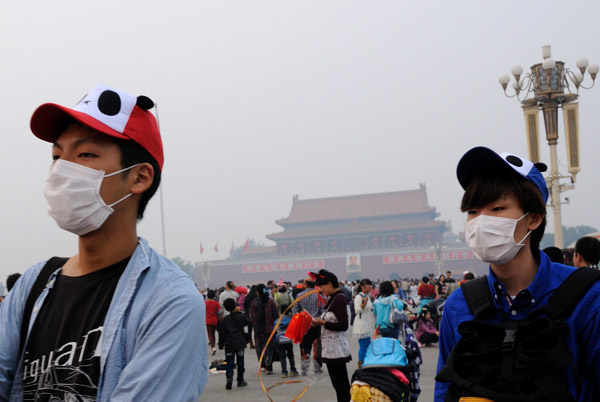
Tourists wear face masks to protect them from heavy smog as they visit Tian’anmen Square in Beijing on Saturday. Wen Bao / For China Daily |
Establishing a long-term system to guarantee funding for air quality monitoring will show China's resolve to fight pollution, environmental officials and experts say.
In a national action plan to combat airborne pollution released on Sept 12, all 338 provincial-level cities are required to start monitoring six airborne pollutants, including PM2.5 — fine particles smaller than 2.5 microns in diameter that can cross the membranes of the lungs — and release the readings by the end of 2015.
Seventy-four cities have started the preparatory work as required since Jan 1, and another 116 are expected to follow suit by the end of this year.
However, 26 of the 116 cities had not started the bidding process for the monitoring appliances by mid-July.
A major reason for the delay is a lack of funding, according to China Environmental News, a newspaper run by the Ministry of Environmental Protection.
In September, four cities in the Ningxia Hui autonomous region received 9.73 million yuan ($1.59 million) from the ministry. The money will be used to build an air pollution monitoring system.
Operating costs for the national monitoring network have been incorporated in the central budget since the 1990s.
"But the amount is already out of date, as it cannot keep pace with the growing requirements of a larger-scale monitoring network, more stations and a variety of new targeted pollutants," said Li Guogang, deputy director of the China National Environmental Monitoring Center.
"To solve the problem, we need a long-term system to cover the cost of running monitoring stations in the budget of governments at various levels."
Li said the government provides a varying amount of financial subsidies to build monitoring sites in different regions. For example, in the western part of the country, the subsidies cover 80 percent of the cost, while in eastern cities, only 40 percent of the local costs are covered.
"But there has not been a stable source of funding for operational costs," Li said.
Zhang Jianhui, director of the ambient air monitoring department at the monitoring center, said that by the end of 2012, daily air quality monitoring was conducted mainly by 661 stations in 113 cities, covering three major pollutants: sulfur dioxide, nitrogen dioxide and PM10.
The State supports the operational costs with an annual subsidy of 20,000 to 50,000 yuan for each station, usually only half of the amount needed, he said.
"We have to monitor six types of pollutants after the new air-quality standard was released on Feb 29 last year," Zhang said, adding that the list now includes PM2.5, ozone and carbon monoxide.
"This raises the operational costs to about 200,000 yuan a year for each station, but the 2013 national subsidy for the first group of monitoring stations in the 74 cities was still the same as before."
Li, at the national monitoring center, said running costs mainly consist of wear and tear on equipment, which accounts for about 80,000 yuan a year because all the equipment has to operate round-the-clock. Other costs include buying standard reference gases, electricity, and Internet communication fees.
Also, most cities that have started to release readings of six pollutants, instead of three, did not have a quota to recruit new staff for the extra work.
Normally, for a medium-sized city with six to eight monitoring stations, about 20 staff members are needed to complete routine inspection and maintenance, the air quality report, and data analysis, said Li Jianjun, an expert with the monitoring center. "The current situation is that the work is usually shared by 12 to 15 people, or even fewer," he said.
 4th World Internet Conference concludes
 Starbucks Reserve Roastery set to open in Shanghai
 Smile to get discounts in Tmall's unmanned supermart
 Top 10 richest Chinese women in 2017
 World leading internet sci-tech achievements released in Wuzhen
 Top tech CEOs take to the stage as Wuzhen Summit opens
 Major topics at 4th World Internet Conference
 'Made in China' dinosaurs amuse the world

Copyright 1995 - . All rights reserved. The content (including but not limited to text, photo, multimedia information, etc) published in this site belongs to China Daily Information Co (CDIC). Without written authorization from CDIC, such content shall not be republished or used in any form. Note: Browsers with 1024*768 or higher resolution are suggested for this site.
License for publishing multimedia online 0108263 Registration Number: 20100000002731