Automakers urged to target basic R&D


 |
|
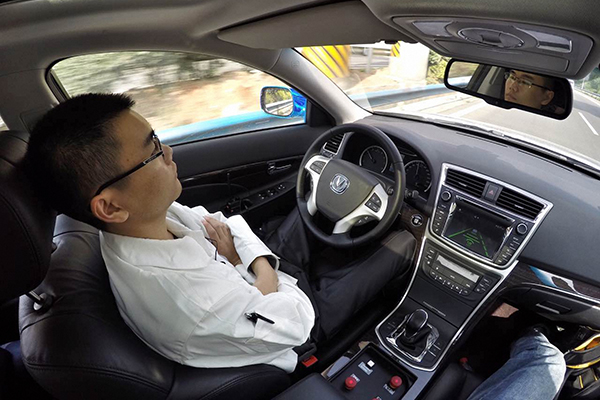
A man uses autonomous driving mode while on his way from Xi'an, capital of Shaanxi province, to Zhengzhou, capital of Henan province. [Photo/China Daily] |
Changes in cars in next years will exceed those of past five decades
Insiders called on Chinese carmakers to emphasize workable, fundamental research and development on advanced intelligent innovations. At the same time, the leading global companies are trying to localize their connected technologies for China.The consensus of automotive authorities is that every carmaker needs to transform itself into a smart mobility solutions provider since the industry is changing rapidly thanks to the introduction of disruptive technologies.
"An immense evolution is coming, we should accelerate developing the technology and transform the industry from big to strong," said She Weizhen, director of the equipment industry division at the Ministry of Industry and Information Technology.
Wang Ruixiang, president of the China Machinery Industry Federation, agreed with the future direction of intelligence and digitalization, but pointed out that the Chinese automotive industry "is weak in independent innovation."
However, the automotive intelligence competence of China lags behind the world's auto powers in terms of development level, professional expertise and other related criteria.

German firm Roland Berger Strategy Consultants' Automated Vehicles Index Q3 2016 indicated that China and Italy ranked the lowest in research expertise in autonomous driving, among nine countries including Germany, the United States, Sweden, the United Kingdom, South Korea, Japan and France.
Germany and United States are way ahead in the state of automated driving development, according to the Roland Berger index. Many international carmakers have been working on autonomous driving, including Mercedes-Benz, Audi and BMW. Volvo Cars tested autonomous driving on highways in 2015 and Nissan did so in January.
Zheng Yun, principal at Roland Berger Greater China, said: "It is important that this growth be driven by Chinese OEMs in coordination with a whole system that includes automotive suppliers.
"The government should take on a supportive role in guiding the industry's development. Once established, a sound legal framework and greater acceptance of the technology by consumers will rapidly accelerate the growth of China's automated-vehicle industry."
An enclosed environment for intelligent connected vehicles' non-highway tests in the National Intelligent Connected Vehicle Testing Demonstration Base in Shanghai opened in June. China's first national-level demonstration base is expected to facilitate R&D and help formulate standards and policy, in addition to testing the technology itself.
China's auto industry regulator warned automakers in July against conducting public highway trials before the country releases regulations, as many companies and individuals conducted road tests in the country.
The country released on Oct 26 its blueprint for intelligent and connected vehicle development to guide and standardize the burgeoning sector and help local car makers and related companies progress speedily.
The term "intelligent and connected vehicle" used in the Chinese industrial blueprint is equivalent to Europe's autonomous driving vehicles or the US' automated vehicles.
The Ministry of Industry and Information Technology expects those with semi-autonomous functions, such as driving assistance and autonomous parking, to account for 50 percent of cars by 2020.
Fu Yuwu, president of the Society of Automotive Engineers of China, told China Daily: "The Chinese auto industry is learning intelligence and connectivity technologies from scratch, and demanding specialty support. An alliance, formed by almost every related company, is developing industrial standardization."
According to the ministry's roadmap, China will aim for 10 to 20 percent of vehicles to be highly autonomous by 2025, with 10 percent of cars to be fully autonomous in 2030.
"The transformation during the next 10 years in the automotive industry may overtake that of the past five decades," said Wang Xia, chairman of the automotive committee of the China Council for the Promotion of International Trade.
He said: "The connected intelligence technologies have been developing much faster than people's expectations. The cars are becoming more and more powerful, and autonomous driving vehicles are now a reality ... intelligence, connection and electrification have evolved to be a clear trend."
The automotive industry is experiencing radical innovation and internet giants are making inroads into the automotive industry. For instance, Baidu Inc is working on autonomous driving, Alibaba Group is joining hands with SAIC Motor Corp Ltd to produce internet-based cars, and Tencent Holdings Ltd is partnering with Foxconn Technology Group to produce electric, connected cars.
Marco Fischer, director of automotive and customer practice at PwC China's Experience Center, said: "The challenge remains for the auto industry to adopt the right mix of technology that is fit for China's driving conditions and moves toward dominating the global share of intelligent connected cars."
MIIT has progressively participated in the related global regulations and standards being established through the United Nations Forum for Harmonization of Vehicle Regulations. And, the Automotive Branch of the China Standardization Association and related ministries have held international forums to discuss the standards and regulations on intelligent connected vehicle technology this year and last year.
Experts recognize that the systems in mass products currently on the market are far from truly autonomous driving.
Jia Xinguang, a seasoned auto analyst in Beijing, said that the piloted driving or autopilot systems are not even close to real autonomous driving technologies, which require heavy investment in radars, lidars, sensors, maps and more.
"Automated driving is still in its infancy. Those found in mass products are advanced driver assistance systems, a kind of proactive safety technology," said Jia.