The coming clean energy revolution


 |
|
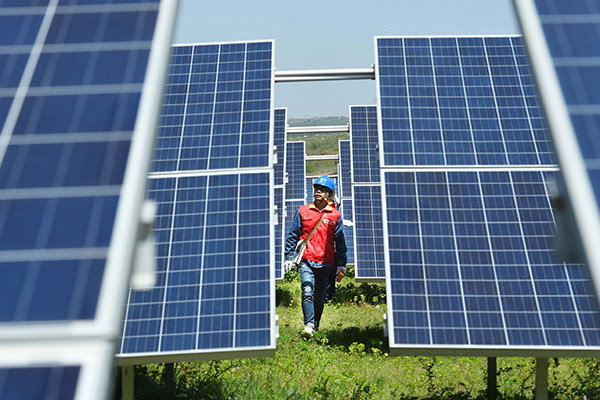
A technician inspects a solar power farm in the remote mountains of Dingyuan county, Anhui province, which has helped alleviate poverty in the region. [Song Weixiong/for China Daily] |
China is expected to invest $3 trillion in power generation over the next 25 years, according to a recent report released by Bloomberg New Energy Finance or BNEF.
Some 75 percent of the expected investment will flow into the renewable energy sector.
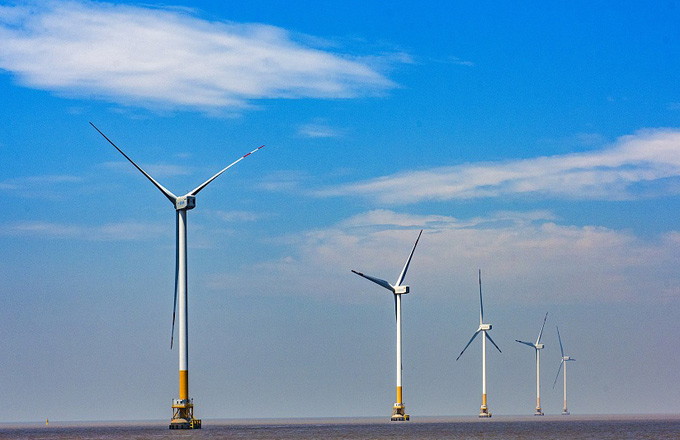
The report said that the investment in the wind power sector will reach $1 trillion. And the solar and nuclear power sectors will attract $700 billion each.
BNEF estimated that between 2030 and 2040, building wind and solar plants will be cheaper than building coal plants or even operating existing coal plants.
As a result, China will retire coal plants whose collective power generation capacity would be 360 gigawatts, 145 GW of which will be forced out of system, because operating wind and solar plants will be less expensive.
"There had been three consecutive years that the global carbon emission remained stable. The biggest reason behind that is what China had done in the past years. China has become the world's largest country producing and consuming renewable energy, and its carbon emission dropped in both 2015 and 2016," said Spencer Dale, BP Group chief economist.
The report from BNEF also shows that by 2026, more than half of China's installed capacity will come from zero carbon emissions energy, including nuclear, biomass, large hydro, wind and solar energy, and the figure will rise to 63 percent by 2040, doubling China's current level.
In 2015, the National Energy Administration issued a "Front Runner" project to encourage the research and development of photovoltaic products which have the highest energy efficiency, by building demonstration bases as well as launching innovative projects in the field.
JA Solar Holdings, one of the world's largest producers of solar energy products, offered the largest volume of modules to the "Front Runner" project. In the first phase of the project, it supplied 422 megawatts of modules, accounting for about 50 percent of the total volume in the phase.
"The Chinese government is supportive of developing clean energy, and the market potential in the field is huge. Therefore, we grasp the opportunity to continue our research and development in high-performance solar power products," said Xie Jian, president of JA Solar.
"In the first quarter of this year, we started mass production of Bifacial PERC (passivated emitter rear cell) modules with double-glass structure. The module can produce 16 percent more power than the conventional PERC modules. It provides new solutions to achieve PV grid parity where PV power costs are similar to those for fossil fuels."
Xie said that in the first half of this year, JA Solar signed a strategic agreement with Peking University to establish the first "Summer School" in the photovoltaic field. Through their collaboration, JA Solar aims at cultivating a batch of photovoltaic talents with both creative ideas and innovative abilities.
"China's installed photovoltaic power capacity ranks first among the world. Photovoltaic power, especially distributed photovoltaic power, enjoys favorable government policies," said Han Xiaoping, chief information officer at Beijing-based industry consultancy China Energy Net Consulting Co.
Han explained that families from the rural regions in China install distributed photovoltaic power systems on their roofs and make money from the power generated, and each of the farmers can earn 3,000 yuan to 5,000 yuan ($450 to $750) every year. So, photovoltaic power not only saves the planet but alleviates poverty.
"We have 11 production facilities around the globe. The new production facility launched this June in Baotou, Inner Mongolia autonomous region, will further increase the capacity of silicon wafers. It is estimated that by the end of this year, our PERC technology will raise the solar cell efficiency from 20.5 percent to 21.2 percent," Xie said.
Bloomberg contributed to this story.