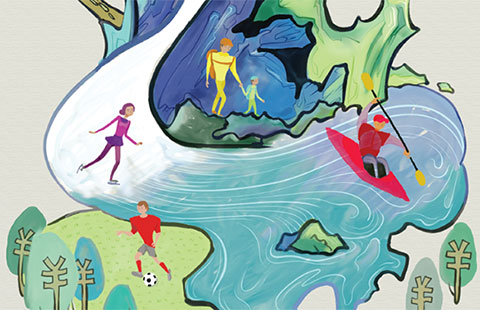
China draws red line around vital ecospace


BEIJING - A new central document on natural areas in need of protection demonstrates China's desire for environmental progress.
Demarcation of the exact boundaries of natural areas with important ecological functions will be completed by the end of 2020, according to the document released Tuesday by the Central Committee of the Communist Party of China and the State Council.
The regions include those important to water and soil conservation, biodiversity, wind-breaking and sand fixation, as well as ecologically fragile zones prone to soil erosion, desertification and salinization.
Functions and acreage will be maintained, and their protected status will remain in place indefinitely, the document reads, describing the strategy as a "lifeline guaranteeing ecological security."
Evolution of the concept
The Chinese phrase "hongxian" (red line) is frequently used in China to describe a limit that should not be crossed.
In 2005, Guangdong province used the phrase to demarcate areas for protection in a document on the environment of the Pearl River Delta.
"The Ministry of Environmental Protection (MEP) started to explore the environmental red line scheme in 2012," said Lu Jun, deputy head of the Chinese Academy for Environmental Planning.
A document on overall reform released in November 2013 listed "drawing up the environmental red line" as a major task.
Clear definition of the red line in environmental protection was given in the Environmental Protection Law that was amended in 2014 and went into force in 2015.
To guide local governments in drawing the red line, the MEP compiled a handbook in 2015, without setting any timetable.
Existing local practices
Most provincial level regions have already started the work. Ten provinces, including eastern China's Jiangsu and Jiangxi, have already published their plans.
Qiangyuan district of Ji'an city, Jiangxi province, has put about 23 percent of its total area within the red line.
The most stringent controls will be implemented in the restricted area and no project unrelated to environment protection will be allowed, said Wang Zhaorong, deputy head of the local environment protection bureau.
In the environment versus economy trade-off, Zixi county in Jiangxi made a similar decision, saying no to some 100 industrial projects involving total investment of more than 30 billion yuan ($4.4 billion) during the last three years.
With fiscal revenue of a mere 600 million yuan, Zixi is determined not to pursue growth at the cost of its environment.
Future prospects
At present, China has more than 10,000 protected natural areas covering about 18 percent of the country, including nature reserves, forests, geological parks and drinking water sources. Those areas are frequently used for other purposes, causing some severe environmental degradation.
As current boundaries are unclear and ineffectively managed, specifying the exact boundaries and reinforcing supervision are crucial to the security of China's environment.
Lu Jun compared the environmental scheme to a similar approach in protecting arable land. The country will retain a minimum of some 1.2 million square kilometers of arable land regardless of other land use requirements.
Drawing up a clear line for natural space is only the first step in effective management. The new guidelines asked Beijing, Tianjin and Hebei, and regions along the Yangtze River Economic Belt to draw up their red line by the end of 2017, while other areas should complete the task before the end of 2018.
By the end of 2020, the demarcation of the border and calibration of the protected regions should be completed and the fundamentals of an environmental protection red line system will be established.
By 2030, the red line strategy will be firmly in place, the environmental function of the areas defined and national environmental security guaranteed, according to the document.
Local government officials will be held accountable for violations of the red line policy and damage to the environment.