|
|
WANG QIFENG / FOR CHINA DAILY |
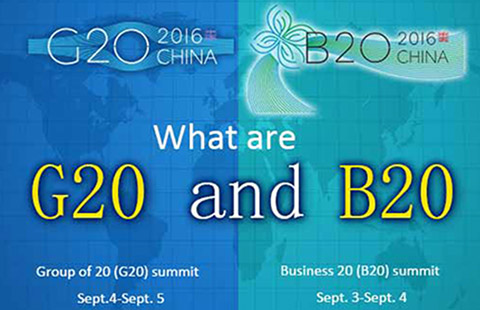
The G20 Summit in Hangzhou is expected to set records for both the number of participants and the number of meetings, as some non-G20 members have been invited as guests and BRICS leaders will hold an informal meeting on the sidelines of the summit.
As host to such a significant forum, China needs to better play its role as a flag-bearer for free trade. The United States was the initiator and has been the leading advocator of the world's multilateral and liberal trade system after the end of World War II.
But while exerting a huge influence on the development of international trade rules, it has not gone all-out to advance inclusive, non-discriminatory liberalization of multilateral trade or further reduced its trade barriers. Instead it has been dragging its feet on the Doha Round of the World Trade Organization talks and spared no efforts in seeking to create regional economic groups exclusive of those major trading powers such as China that it believes threaten its leading status.
The most typical case is the US' unconcealed attempt to push for a Trans-Pacific Partnership Agreement without China. Besides, calls for protectionism have increased in the US to an unprecedented level.
In sharp contrast, China has chosen an evidently different approach from the US. As the world's leading trading country, China has not only been striving to advance the Doha Round of trade talks, it has also been continuously and voluntarily lowering its trade barriers. Despite its efforts to push for bilateral and regional free trade agreements, or FTAs, and advance its Belt and Road Initiative, China has not used its advantages to cozy up to smaller trading partners to form a closed or semi-closed trade circle to maintain its leading trading status.
All of China's efforts are aimed at pursuing a more open and competitive trading environment. It is with such an approach that China has prioritized imports expansion on its foreign trade agenda for the past few years. For example, the trading partners with which China has inked FTAs in the past two years are not less-developed emerging economies but developed or newly industrialized economies whose per capita GDP is much higher than that of China. On Dec 9, 2015, China announced its FTAs with the Republic of Korea and Australia will take effect on Dec 20, and it would expand the range of preferential taxes for imported consumer goods for daily use and cut duties on imported equipment, key components, energy and raw materials since Jan 1, 2016.
In contrast to the TPP, China has openly stressed that the Belt and Road Initiative should conform to WTO rules and proposed a free trade area with the European Union.
All these reflect China's willingness and determination to promote a more open trade environment. But to be an effective free trade flag-bearer, China should first maintain its own domestic economic stability and pursue sustainable development. And since it believes in open and fair competition, instead of obstructing the TPP, it should better promote the broader and more inclusive Regional Comprehensive Economic Partnership.
Also, China should push for coordination among major countries on fiscal and monetary policies to maintain their own (and the world's) economic stability to prevent them from resorting to trade protectionism. And in its effort to reform the international economic coordination mechanism and improve global governance, China should take into consideration both equity and efficiency.
China attaches great importance to the G20 platform, but the participation of a number of countries with huge political, economic and ideological differences also means difficulties and low efficiency in the group's efforts to promote policy coordination. Thus, the G20 should only be viewed as a venue to reach principled consensuses not as a place to perform concrete decision-making functions and prescribe a panacea for all problems.
The author is a researcher at the International Trade and Economic Cooperation Institute of the Ministry of Commerce.


Copyright 1995 - . All rights reserved. The content (including but not limited to text, photo, multimedia information, etc) published in this site belongs to China Daily Information Co (CDIC). Without written authorization from CDIC, such content shall not be republished or used in any form. Note: Browsers with 1024*768 or higher resolution are suggested for this site.
License for publishing multimedia online 0108263 Registration Number: 130349