Local GDP data indicates China economic resilience


 |
|
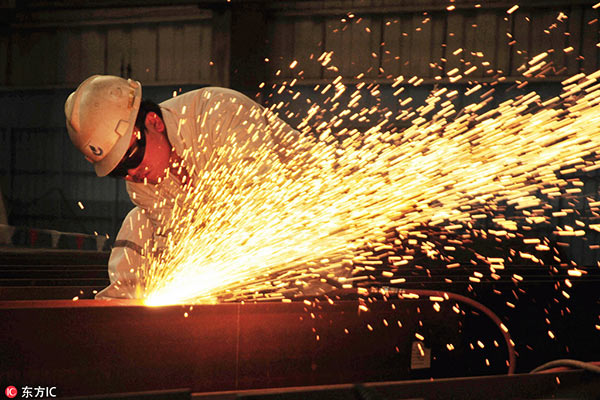
A Chinese worker processes steel products at a factory in Qingdao city, East China's Shandong province, October 1, 2015.[Photo/IC] |
BEIJING - China's local economies are showing resilience as the country attempts a transformation to more quality growth.
Of the 28 provinces, municipalities and autonomous regions that have released GDP growth figures for the first three quarters of the year, 18 reported faster or equal growth to that in the first half.
"The growth gap between regions has narrowed," said Zhang Liqun of the State Council's development research center. "The economic pressure in regions like the Northeast and Shanxi has eased and their economies are recovering."
Shing up the rust belt
Jilin, a province in China's northeast industrial heartland, announced on Saturday that its GDP grew 6.9 percent year on year in the January-September period, exceeding the national average for the first time since the first quarter of 2014.
While restructuring and reinvigorating traditional industries, the province has invested in new industries to help the recovery. A hi-tech industrial park to pool photoelectric and intelligent manufacturing firms is under construction in capital Changchun, targeting 20 billion yuan ($3 billion) in output by 2020.
Of the other two provinces in the old industrial rust belt, Heilongjiang seems likely to report 6.7 percent growth. Liaoning is expected to show some improvement after shrinking in the first two quarters.
Liu Yuanchun, president of the national academy of development and strategy at Renmin University of China, believes the figures show pro-growth policies taking effect. The steel and coal sectors are back in the black and prices of both commodities have risen alongside efforts to reduce overcapacity.
This has helped economies like coal-rich Shanxi, he said.
Shanxi, struggling to overcome its reliance on coal, saw its GDP grow 4 percent in the January-September period, better than 3.4 percent in the first six months.
Good performers
Central and western regions with good industrial bases and more room for fixed asset investment are among the best performers, with Chongqing continuing to race ahead with a staggering 10.7 percent growth, with Guizhou not far behind on 10.5 percent.
In 2014, Chongqing announced it was developing 10 new industries, including electronics, intelligent equipment, new-energy vehicles and bio-medicine. The output of these sectors is expected to double, having grown by 150 percent last year.
"When an economy is big but still needs to grow fast, it requires innovation and an extended value chain," said Tu Xingyong, deputy director of Chongqing municipal commission of economy and information technology.
In Guizhou, fixed asset investment expanded 21.7 percent in the first three quarters, 13.5 percentage points higher than the average and contributing 70 percent of growth in the impoverished mountainous province.
Central China's Henan province achieved 8.1 percent growth in the nine months. "Our service sector will soon surpass the industrial sector so the quality of growth is improving, but the economic transformation is at a key juncture and there is still considerable downward economic pressure," said Gu Jianquan, director of Henan's development research center.
Two more developed provinces, Guangdong and Jiangsu, also did fairly well, expanding 7.3 percent and 8.1 percent, respectively.
"China is shifting gears towards mid-to-high growth," Zhang Liqun said. "This not only calls for stabilization of growth, but for supply-side structural reform to improve the quality of growth."