 |
|
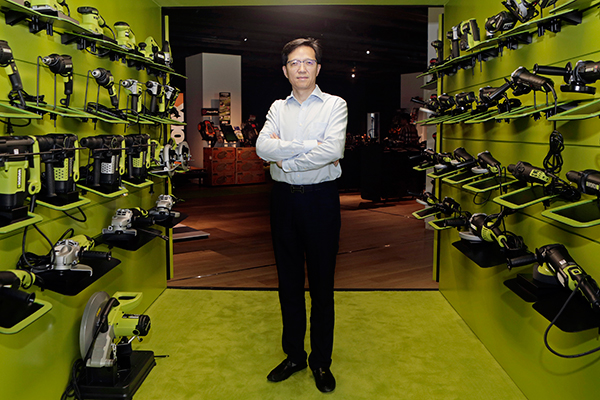
Don Gao, president of Positec, stands in a showroom for the Chinese company's Worx-branded tools, which are now gaining traction in the US and European markets. [Photo provided to China Daily] |
China's Positec, whose Worx brand has hit pay dirt, is strong in 13 countries and expanding
Chances are high that on your next visit to a hardware store in the United States, you may notice that Chinese fall clean-up tools are among the best-selling products, giving Germany's Bosch, the world's top power-tool maker, stiff competition.Before you attribute the sales to presumably lower prices of made-in-China goods, take a reality check: Worx products are costlier than Bosch's.
That's not all. The cordless, lightweight Worx grass-trimmer won an award from the US Electronic Retailing Association in 2010 for its quality and innovation.
There's more. GFK, a European research and consulting company, said in a report that some costlier Worx products outsell Bosch in the latter's home market Germany.
The person behind the brand is Don Gao, president of Positec, a leading Chinese maker of power tools, lawn and garden equipment, and accessories.
"It's not very easy to make inroads into some well-established markets such as the US, Germany and the UK because customers are very loyal to local brands. But we did it, step by step," he said.
When it was founded in 1994, Positec was simply a trading company engaged in exports of power tools, including hand drills, trimmers, chainsaws and mowers.
Business was good, spurred by the country's foreign trade. But Gao knew the company had to grow beyond simple trading. For the long run, Positec had to have its own products.
So, in 1995, Gao set up a factory in Suzhou in Jiangsu province, East China. The plant made products for large home improvement retailers overseas such as Sears, B&Q and OBI.
Positec was clearly not aiming to be a glorified original equipment manufacturer. OEMs typically dream of making products for industry leaders such as Bosch and Black & Decker. But Gao was aiming higher. Not for him an OEM at the bottom of an industrial value chain.
"We have no say in pricing because you always find someone sets prices lower than yours. The cut-throat competition in China squeezed profits of many traditional producers," he said.
He asked himself: "Why can't we have our own brands?"
In 1999, he decided to create his own brand of power tools. "The shift meant that your old partners became your competitors, so you faced a huge risk of losing orders."
The risk was real and, to be sure, huge: turnover that year plunged by $50 million. Some erstwhile partners even threatened to withdraw their existing orders. "We said, 'Go ahead'."
After several years' efforts and research, Gao finally launched a brand called Worx in 2004. In the same year, Positec acquired Rockwell, a well-known US brand founded in 1945.
Yin Jie, an expert in brand management and a consultant to many consumer goods makers, said that Positec, in order to avoid direct competition with local brands, took a shortcut to gain local resources in the US market. "The Rockwell acquisition was a quick way to squeeze into a foreign market and help the company build up reputation and a distribution network.
"Sometimes, we've good products but we don't know how to promote them in a new market."
But Positec probably knew. It spent some 15 percent of its annual revenue on TV commercials and online social media promotions.
The campaigns worked so well US sales almost doubled, even during the housing crisis from 2008 to 2010. Gao said the key to winning a marketing battle lies in what he calls product innovation.
"Consumers don't care about the technologies you are putting into products. They only care about whether it works well when they are cleaning up their gardens or assembling their own bookshelves," he said.
A Forbes report said Positec now spends 6 percent of its revenue on innovation, much higher than Black & Decker's less than 2 percent and Bosch's 1.8 percent.
In recent years, it has invested 1 billion yuan on innovation and launched more than 100 products every year, most of them complete with smartphone applications that allow remote control as well as access to product information and after-sales service.
To keep up with the latest trends in power-tool products, Gao spends one-third of his time every year travelling around in the US and Europe and attending various fairs.
"If there's a new launch of a product in the marketplace, I want to know," he said.
The company has a distribution network and operations in 13 countries and three research and development centers in China, Italy and Australia.


Copyright 1995 - . All rights reserved. The content (including but not limited to text, photo, multimedia information, etc) published in this site belongs to China Daily Information Co (CDIC). Without written authorization from CDIC, such content shall not be republished or used in any form. Note: Browsers with 1024*768 or higher resolution are suggested for this site.
License for publishing multimedia online 0108263 Registration Number: 130349