 |
|
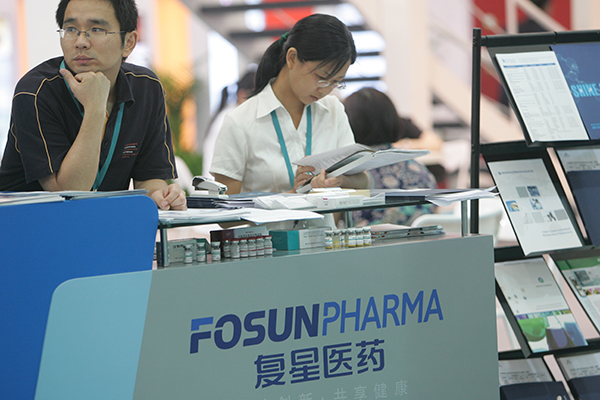
Shanghai Fosun Pharmaceutical Group Co made a non-binding offer to buy 96 percent of India's Gland Pharma Ltd in May. The country's pharmaceutical industry is likely to continue pushing overseas. [Photo/China Daily] |
China's health-care companies are on an acquisition tear, attempting to buy their way into international markets like never before.
Chinese firms have announced more than $3.9 billion in overseas acquisitions in the pharmaceutical, biotechnology and health-care sectors this year, a pace on track to exceed last year's record total and a tenfold increase from the amount spent in all of 2012, data compiled by Bloomberg show.
That surge is driven by Chinese tycoons and businesses seeking to diversify in the face of slowing growth at home and a government push to upgrade the "Made in China" brand. In the domestic market, many of these companies are grappling with a fragmented drug industry with close to 5,000 manufacturers and aggressive competition that is pushing down generic drug prices. Success overseas would allow them to expand their portfolios, find new areas of growth and provide a ready-made entry into developed markets that have high regulatory standards.
Among recent deals, China's Creat Group Corp, founded by businessman Zheng Yuewen, agreed in May to acquire Bio Products Laboratory Ltd, a maker of human blood plasma products in the United Kingdom, for $1.2 billion in the largest international pharma acquisition by a Chinese company, according to the Bloomberg-compiled data. Also in May, Shanghai Fosun Pharmaceutical Group Co, backed by billionaire Guo Guangchang, made a non-binding offer to buy 96 percent of India's Gland Pharma Ltd, which is focused on injectable drugs.
The Chinese industry is likely to continue pushing overseas. "There are a few Chinese companies that have been investing in pharmaceutical products that are getting close to being approved in the United States and Europe," said George Lin, head of Asia consumer, retail and healthcare investment banking at Bank of America Corp. "If those are approved, then the Chinese are likely to be much more interested in pursuing overseas targets in similar areas that have a strategic alignment."
Chen Qiyu, chairman of Fosun Pharma, one of the most active buyers in China's health-care sector, said in an interview last year that he hoped to increase overseas revenue to as much as 40 percent of the total over the next five years via acquisitions.
Last year, Fosun Pharma was part of a consortium that acquired Ambrx Inc, a protein therapeutics R&D company in the United States for an undisclosed amount. In its May statement it said its Gland offer was still part of a bidding process and a deal wasn't guaranteed. But if successful, it could improve the company's "degree of internationalization."
Indian drugmakers with strong generic drug expertise and commercial presence in developed markets offer a good platform for globalization for Chinese firms, said Franck Le Deu, a senior partner at McKinsey & Co.
While Chinese companies are emerging more often on the list of bidders for health-care businesses, they also face fierce competition for prime assets. In March, people familiar with the matter said Luye Group Ltd, which controls a Chinese drugmaker and health-care provider, was among bidders for French pharmaceutical company Ethypharm SA. Ultimately, another bidder, European private equity firm PAI Partners ended up agreeing to buy the French drugmaker.
In a March interview, Luye Group Chairman Liu Dian Bo said the group is also looking for hospital deals in overseas markets including Australia, Singapore, Southeast Asia, the US and Europe, and is putting a special focus on those with treatment specialties that can be useful for China.
In July last year, people familiar with the matter said the China Grand group, controlled by businessman Hu Kaijun, was among bidders for Belgium's UCB SA's US generics business. UCB eventually sold the business to US-based Lannett Co.
Lin at Bank of America said Chinese companies can fit in very well when there's no big logical strategic player and buyers are down to private-equity firms in an auction.
"The really attractive products, the biotech products, those are going to be highly sought after by the mega caps," said Lin. "So the Chinese are not going to be competitive."
China's pharma industry is still lagging far behind other sectors and multinational peers on the size of international acquisitions. China National Chemical Corp, also known as ChemChina, in February agreed to buy Swiss pesticide and seeds maker Syngenta AG for about $43 billion. And the global health-care industry has seen mammoth deals like Allergan Plc's $40.5 billion agreement to sell its generic drug business to Teva Pharmaceutical Industries Ltd last year.
In health-care, the Chinese companies tend to target companies with $100 million to $300 million in sales and valued at about $300 million to more than $1 billion, said John Wong, chairman of Greater China at Boston Consulting Group.
Chinese companies also tend to look at businesses that complement their existing areas of expertise. Creat's chairman also jointly controls Shanghai RAAS Blood Products Co, a blood plasma company and the largest listed health company in China. Among other deals, China's Humanwell Healthcare Group, which makes anesthetics and contraceptive drugs, spent $550 million buying Laurelton, New York-based generic drug maker Epic Pharma LLC this year.
In rushing to get a foothold overseas, Chinese companies may run the risk of buying a company "that has a weak portfolio and the local management team disappears after the sale," said BCG's Wong. "Then the Chinese company is left with a declining asset."
Bloomberg


Copyright 1995 - . All rights reserved. The content (including but not limited to text, photo, multimedia information, etc) published in this site belongs to China Daily Information Co (CDIC). Without written authorization from CDIC, such content shall not be republished or used in any form. Note: Browsers with 1024*768 or higher resolution are suggested for this site.
License for publishing multimedia online 0108263 Registration Number: 130349