China's GDP grew at 6.7 percent year-on-year in Q1 for 2016, easing slightly from 6.8 percent in Q4 as expected, official data released on Friday showed.
However, other indicators show new loans, retail sales, industrial output, export, fixed-asset investment and CPI were all better than forecast.
China seems to not only have avoided the worst scenario that had many investors worried but also showed a recovery.
In fact, what we are seeing now is a stabilization of the old economy–although it can gain time for structural improvement, a real improvement in structure comes much slowly.
For the real economy, though fixed-asset investment climbed 10.7 percent year-on-year, slightly more than the 10.3 percent rise Reuters predicted. It much benefited from real estate investment, which rose 6.2 percent, a 12-month high and infrastructure investment, which climbed 19 percent, a 11-month high. Both are the main parts of the old economic growth model, which can bring problems.
Some may argue that for March alone industrial output rose 6.8 percent year-on-year, better than Reuters' 5.9 percent forecast and export surged 18.7 percent. But they ignore that the Spring Festival last year extended into the first 10 days of March and the holiday had an important impact on the economic data of March.
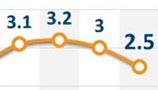
We can have clues in electricity consumption, which increased only 3.2 percent in Q1 and among the first, second and tertiary industries and residential electricity consumption, the second industry's (manufacture's) electricity consumption increased only 0.2 percent.
For monetary policy, at end-March, broad money (M2) balance was 144.62 trillion yuan, an increase of 13.4 percent. The first quarter's new loans exceeded 4.6 trillion yuan, a new high in the history.
Some may say that CPI is lower than expected, but this year there has been an adjustment in CPI basket, which had not been adjusted for past five years. Food's percentage decreased from 32 percent to about 20 percent. Actually, we know that in March, the pork price increased about 28 percent and vegetable price rose about 36 percent, which makes the CPI underestimate about 0.25 percent. The GDP growth in Q1 has benefited from real estate recovery, whose price and trading volume have had a substantial increase, but this event may simply reflect the worry of future inflation.
In fact, what we need to worry is the economy getting back to the old playbook used during the financial crisis, which is used each time when employment pressure becomes high.
It seems that workers laid off from the old economy can be difficult to be absorbed by new economy and there are hardly any other choices but providing jobs by government projects fueled by government banks' loans.
China's aggressive monetary stimulus can alleviate social unrest and hopefully the economy can gradually be engineered to a structural slowdown from manufacturing towards domestic consumption and services.
The first quarter's data seems to show that the old economy will not reduce sharply and the new economy will not come in the near future, but the strategy is doing its work in stabilizing market sentiments.
The stock market in recent weeks has ended the panic fluctuations in prices and recorded an impressive rise. The official manufacturing Purchasing Managers' Index has returned to growth for the first time since July 2015. Moreover, worries about the yuan's big devaluation have largely dissipated.
The Q1 economic data may knock out the worry of a hard landing of China's economy, it is the basis for the economy to transform to a new mode. But it's premature to think that the economy is bottoming out. It's far too early to start talking about a V-shaped or W-shaped recovery, as some experts are beginning to do so.
There are still two important economic issues on the way–dealing with the growing pile of corporate debt, which is estimated at around 160 percent of GDP by recent IMF report, and reducing overcapacity at state-owned enterprises.
As the earnings relative to interest expense begins to fall to an unbearable limit, sectors included real estate, manufacturing, retail, mining, and steel can be at risk.
Since confidence in the economy is gradually returning, it can be a precious opportunity for Beijing to push ahead with these reforms.
The author is a lecturer at the Management School of the Shanghai University and a research fellow at the China Europe International Business School Lujiazui International Finance Research Center.


Copyright 1995 - . All rights reserved. The content (including but not limited to text, photo, multimedia information, etc) published in this site belongs to China Daily Information Co (CDIC). Without written authorization from CDIC, such content shall not be republished or used in any form. Note: Browsers with 1024*768 or higher resolution are suggested for this site.
License for publishing multimedia online 0108263 Registration Number: 130349