 |
|
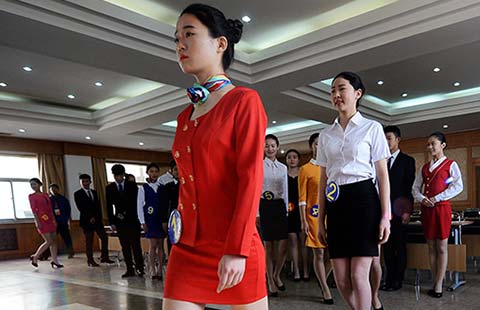
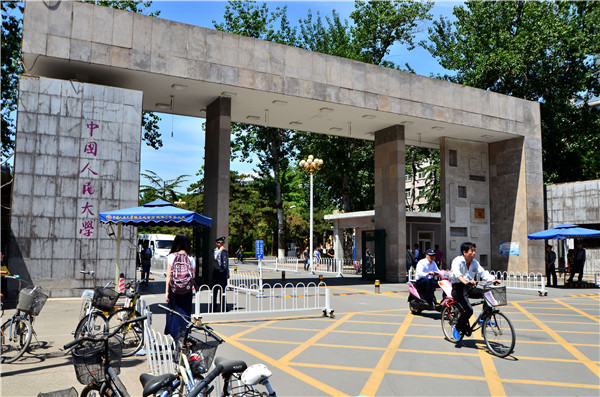
Professors at universities, like Renmin University of China in Beijing (above), were actively sought by listed firms to work as independent directors and offer advice and, in the process, earn fat pay checks for what are essentially part-time jobs. CHINA DAILY |
As academics quit as independent directors, China Inc appears set to purge corruption
Over the past few months, at least 270 college professors and university officials have resigned their part-time but highly-paid corporate jobs as independent directors with listed companies, according to media estimates based on filings to bourses.
Their exits came after the Ministry of Education last November banned high-ranking academics from holding corporate jobs, following the Chinese government's decision to widen the anti-corruption campaign to the education sector.
According to media estimates, university professors and academics make up more than 35 percent of around 7,800 independent directors serving some 2,800 listed companies in China.
Typically, an independent director's role is that of an internal watchdog, an objective expert who is expected to protect the interests of the company and all shareholders, especially minority shareholders, by preventing the company management from acting in a reckless, illegal or corrupt way.
But senior academics' close relations with listed companies are believed to have brewed corruption and bribery, instead of independent oversight responsibilities.
The director-management nexus could have its roots in the pay packets that the former receive from companies. On average, an independent director may take home 65,000 yuan per year from a company.
But remuneration varies greatly. Some listed companies offer annual compensation packages worth more than 400,000 yuan to their independent directors.
So, if an academic serves several companies at the same time-that is what some academics do, in fact-he/she stands to earn millions of yuan in additional income every year. This could act as a strong incentive for looking the other way when the managements commit wrongdoings, or, worse, aid and abet them.
A widely reported case was that of Song Chang, 51, a business professor at the top-ranking Renmin University of China in Beijing. He doubled up as an independent director on four listed companies. He was investigated by the securities regulator for alleged insider trading.
Another prominent case involved Liu Ya, former vice-president of the University of International Business and Economics in Beijing. He was sacked by the university in December for not intimating it about his corporate jobs.
The university said Liu violated rules that required him to disclose additional income of 1.27 million yuan ($193,100) between 2009 and 2014 from working as an independent director on six listed companies.
"On many occasions, the job (of an independent director) degenerated into a vehicle (of patronage) based on personal connections, which are leveraged for the mutual benefit of directors and companies," said Dong Dengxin, a finance researcher at the Wuhan University of Science and Technology.
Experts pointed out the root cause of the problem lies in the highly concentrated shareholder structure of Chinese companies. In China, many listed companies are either State-owned enterprises or family-controlled private businesses.
Under the current regulation, independent directors are elected by the general assembly of shareholders. But, in reality, what happens is, the majority shareholders, by virtue of their brute majority, dominate the assembly proceedings and wield undue influence, nominating their own candidates as independent directors.
Such a practice may not be contravening any rule or law but violates the spirit of fair play nevertheless.
"The existing shareholder structure is a major defect of the Chinese capital market, which results in power abuse by large shareholders," said Liu Jipeng, director of the Capital Research Center at the China University of Political Science and Law in Beijing.
"Independent directors, who are supposed to check the power of major shareholders, have become rubber stamps. How can they be truly independent if they are hired by the big shareholders?"
As more and more independent directors morphed into puppets whose strings were pulled by corrupt corporates, compromising the interests of minority shareholders, calls emerged for an overhaul of the system.
So, in 2013, the government banned government officials and Communist Party members from holding corporate jobs. But it exempted college professors and academics.
However, in 2014, the securities regulator issued a guideline to better regulate independent directors. It clarified on their obligations, and allowed independent directors to serve for a maximum term of six years at no more than five listed companies.
But experts said the existing guidelines are insufficient to address the problem fully. Detailed supplementary regulations are necessary to empower small shareholders to appoint independent directors and to hold them legally accountable when they fail to perform their job properly.
Liu Junhai, a professor of law at the Renmin University of China, said improvements to the system would have far-reaching implications for the Chinese capital market, which has been plagued by fraud and scandals.
"It is time to strengthen corporate governance at the micro level to help lift the market out of the tangle, especially as the recent market rout eroded investor confidence," Liu said.
"Ultimately, a healthy stock market depends on the quality of every listed company as investment value could only emerge when companies are profitable and have clean and strong corporate governance."
This is not lost on all listed companies. Some of them have realized the importance of having truly independent directors on their boards, which can be for their own good, Liu said.

Copyright 1995 - . All rights reserved. The content (including but not limited to text, photo, multimedia information, etc) published in this site belongs to China Daily Information Co (CDIC). Without written authorization from CDIC, such content shall not be republished or used in any form. Note: Browsers with 1024*768 or higher resolution are suggested for this site.
License for publishing multimedia online 0108263 Registration Number: 130349