There is a quote from the great philosopher Ludwig Wittgenstein which gives some insight into the strangely shocked response by many outside to the Chinese government's announcement that GDP growth in 2016 will be around 6.8 percent. "I went into the room expecting to be surprised," he said, "and wasn't – which surprised me."

The surprising thing now is not that Chinese growth is slowing down, but that there are so many who are surprised by this. Chinese leaders, and economists, have been saying for years that Chinese high levels of GDP were unsustainable. In the 2000s, the then Premier Wen Jiabao stated that producing double digit levels of growth could not go on forever. In many ways it is a miracle China has managed it as long as it has. Since 2012, this message has increased. The current Premier Li Keqiang spoke of 'fast, sustainable growth' when he came into office, and a figure of around 7 percent fits that bill. Alongside this there has been frequent talk of a new normal and a different growth model – lower in raw yield, but higher in quality.
There is also a structural reason why GDP of around the levels being talked about by the Chinese authorities now should not be surprising. From 1978 to the 2000s, the Chinese economy grew fast, but from a much smaller base. Delivering plus 10 percent GDP increases then was easier than now for the simple fact that these days the Chinese economy is five times larger than it was even as recently as 2000. Making even 1 percent of growth currently means much more activity and work than a decade and a half ago.
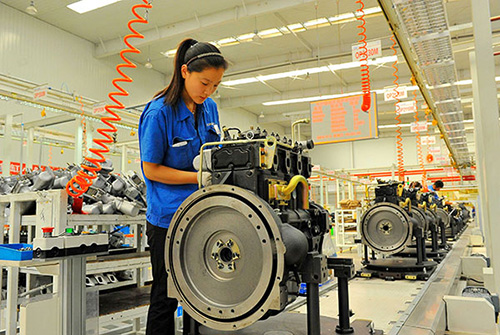
On top of this, is the simple issue of inevitable changing economic structure as a country develops. In the early and middle phase of reform and opening up, China remained a place with more than half its people living in rural areas, with a high dependence on manufacturing for exports, and fixed asset investment. All of this added up to a colossal amount of commitment to the future, with high amounts of economic activity in building improved infrastructure and human capital, things which China now has in place. China is moving beyond that investment phase now. It is, put simply, maturing.
Bearing all of this in mind, it is time to think of China as more than a place that can be summarized on the basis of one single GDP statistic. We will now need to look at the increase in services as a proportion of GDP, up 8 percent in terms of growth over the past year, and consumption, which has risen in the past two years from 36 percent of GDP to 38 percent. We will need to look at the diversification of China's energy consumption, shifting away from coal towards other forms of supply – and the ways in which wages are rising for the all important emerging middle class, making them different economic actors.
There is a very simple label for this – 'modernization'. The Chinese economy is entering a complex period, one in which it is seeking to undertake an immense transition toward fuller modernity, and developed status. Again, like the deceleration of raw GDP growth, this has been repeatedly referred to by Chinese politicians and officials over the past half a decade. The mission in their words is clearly to deliver a higher consuming, more innovative, more diverse, more domestically focused growth model – one where China is less the factory of the outside world and more an intellectual center in its own right, using the assets, for instance, of its 2,500 universities to create deeper linkages and more balanced, research led partnerships with the world, creating a modern healthcare system, modern cities, and an indigenous finance sector.

Copyright 1995 - . All rights reserved. The content (including but not limited to text, photo, multimedia information, etc) published in this site belongs to China Daily Information Co (CDIC). Without written authorization from CDIC, such content shall not be republished or used in any form. Note: Browsers with 1024*768 or higher resolution are suggested for this site.
License for publishing multimedia online 0108263 Registration Number: 130349