 |
|
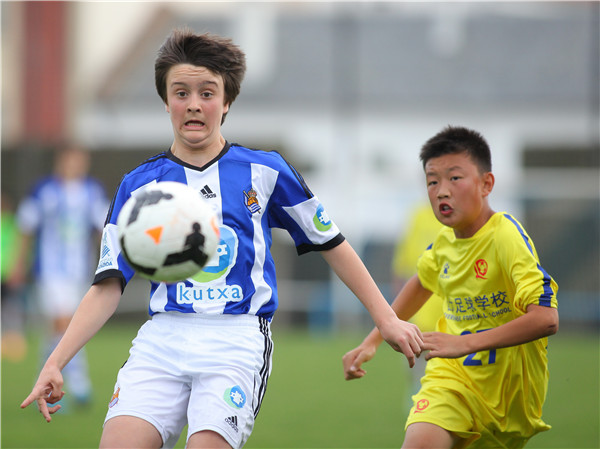
A Chinese boy takes part in a soccer training session with local juniors at the EFS Evergrande Football School in Madrid, Spain. Provided to China Daily |
Property giant Guangzhou Evergrande's $14-million deal to get teenaged Chinese players trained in Spain promises to yield big returns
In August 2014, China's property giant Guangzhou Evergrande Group, which also owns an eponymous Chinese professional soccer league team, agreed with Spanish sports management group Soxna to invest 13.34 million euros ($14.51 million) in a soccer training program for youngsters.
Under the program, Guangzhou Evergrande sends 25 of its elite young players each year to Soxna's academy in Madrid to receive professional training as well as international academic education for a period of at least three years.
For its part, Soxna would train the youngsters and, post-training, put them in touch with talent scouts of soccer clubs.
The plan was to fund a total of 125 players over a period of five years. The training project also employs 25 staff, including soccer coaches, translators and academic tutors.
At an estimated annual cost of more than 60,000 euros per youngster, the investment faced the prospect of cost overruns as the training program developed. But Guangzhou Evergrande did not flinch from its commitment.
For, investment in soccer academies can be very profitable, if they manage to find the right talent.
For instance, the youth soccer academy of Southampton in England was ranked the most profitable school in Europe last year after it earned 90.2 million euros since 2012 through sale of its young players to soccer clubs, according to a study by Swiss-based CIES Football Observatory, a center that specializes in the statistical analysis of soccer.
Guangzhou Evergrande is confident young Chinese talents such as Chen Zhengfeng, 14, could develop into world-class soccer players, and prove its investment decision was right.
The young player from Zhejiang province is one of the 50 talents that have been selected by Spanish coaches from more than 2,700 students enrolled in the Real Madrid Guangzhou Evergrande Soccer School in Qingyuan, Guangdong province.
The school opened in 2012, under cooperation with the leading Spanish soccer league club, which is known for its celebrity players such as Cristiano Ronaldo of Portugal.
Chen has been studying and playing soccer in Madrid, the capital of Spain, for two years now, following his dream of becoming a professional player like his Brazilian idol Kaka.
Chen, together with his teammates, kicks off his daily routine with a 90-minute soccer training in the morning at an upscale private sports club located on the outskirts of Madrid.
After the training session, the players attend classes at Liceo Europeo, Madrid's prestigious international school, where they learn Spanish, English and keep up to date with their Chinese school curriculum.
Chen said he sometimes misses home and does not particularly like the fish-heavy food served in the academy canteen, but has no misgivings as he feels he is getting closer to reaching his dream.
He is quick to add he and his teammates are aware their diet, planned by expert nutritionists, is for their own benefit. Occasional visits to local Chinese restaurants help beat the monotony.
"I would like to stay in Madrid until I finish my studies. I like training in Spain because it has a good soccer culture and I have the opportunity to play against many good local teams," Chen said, speaking in a mixture of Chinese and Spanish.
Chen's dream is to be signed by a professional team of the Spanish league when he turns 18, which would make him eligible to play in any European competition.
In this regard, association with Real Madrid may not help directly as the club has no role in the Madrid academy, due to international soccer governing body FIFA's limitations on training of foreign minors by clubs.
Instead, Soxna, which is also a partner in the Real Madrid Evergrande International Soccer School in China, is in charge of the training and development of the academy in Madrid.
"This type of training programs will definitely improve the quality of Chinese soccer," said Miguel Angel Hernandez, chief executive officer of Soxna. "The solution to the problem of (poor) quality (of soccer in China) does not lie in signing foreign stars, you need to generate your own players and improve the system from the grassroots."
Under FIFA rules, the Evergrande students cannot enter official youth soccer competitions in Spain. Nonetheless, they can play friendly matches against local youth academies such as those run by professional clubs Real Madrid, Atletico de Madrid and Rayo Vallecano.
"Our children are technically good but they lack the competitive edge that playing a tournament can give you. We don't have a strong youth league in China and that's why they needed to come here," said Zhang Kun, an assistant coach at the academy. "When our players first arrived, they were even scared to play against Spanish children. Nowadays, they are much more confident. That's the biggest change we have seen in them."
Evergrande's long-term plan is to produce strong Chinese players at the highest level who could play for major professional teams in the European and Asian leagues.
Should that come to pass, it would transform Evergrande into China's largest source of young talented players.
"The Evergrande investment will generate good returns in future, when many young players of this school will likely become part of Spanish teams or Chinese Super League clubs like the Guangzhou Evergrande," said Soxna's head coach Antonio Vilches.
Under FIFA rules, training clubs are entitled to a compensation fee when a player signs his first contract as a professional and again when he is transferred to other clubs until the end of the season of his 23rd birthday. The sum is calculated on a pro-rata basis according to the period of training at the youth academy.
"The important thing for us is to train the children to become professionals, so that the big teams would be interested in them," said head coach Vilches. "We are currently in contact with scouting teams of several European clubs that follow the progress of our players."
Vilches said the Evergrande students may have the opportunity to train with major clubs to test if they could be part of their squads in future, so that any transition to professional teams would not overwhelm the young players.
Despite all the hard work, it is still impossible to say who or how many of the young players would eventually be able to fulfill their dream of becoming a professional, the coaches said.
"We wake up at eight in the morning and finish school at seven in the evening every day. It is a very tiring routine, but we know it is all worth it," said Shi Jinshuai, 16, adding everyone is aware only a handful of them would make it to the top.
Camping in Europe for sporting fortunes
For many aspiring Chinese soccer players in their early teens now, summer is the time to head to Europe where famous clubs offer programs that combine soccer practice and foreign language learning.
Such programs are on offer in Spain, Italy and England. Top professional clubs such as FC Barcelona, Liverpool FC and FC Internazionale Milano are developing camps for young athletes who want to either become professionals in future or simply enjoy a summer overseas.
Summer camps also organize trips to nearby tourist attractions. Other activities include tours around the club's facilities such as the stadium and the museum.
Chinese children have become an important target for this type of education programs, given the increasing interest that the sport is generating in the country and the importance that Chinese parents place on learning a second language.
Last year, China unveiled an ambitious national soccer reform plan covering all aspects of the sport, including the transformation of professional clubs, professional leagues and the game at grassroots level.
By 2017, it is envisaged that 20,000 schools will have new soccer pitches and training facilities, creating 100,000 new players. All of this is part of President Xi Jinping's aim to turn China into a soccer powerhouse.
However, the lack of qualified professional soccer coaches in China and the heavy study workload of children during the academic year, have prompted parents to send children to international soccer academies during the summer holidays.
Last summer, Qiu Yi, a Beijing-based physical education teacher, decided to send his seven-year-old son Qiu Yu Hao to a soccer school in Huesca, a city in northeastern Spain.
"My child did not enjoy playing soccer in China, but he really liked playing in Spain. After that positive experience, we decided to enroll him in a soccer academy in Beijing that had foreign coaches," said Qiu.
He, however, faces a problem: most soccer academies in China train children only until the age of 12. Which is why, most parents prefer their children to concentrate on their studies.
"If my child has true potential, then I might consider sending him to Spain to train professionally, because there are limited options here for training," said Qiu.
Despite their increasing popularity, soccer training centers overseas can prove expensive for the average Chinese household.
For instance, prices start from 295 euros ($321 or 2,113 yuan) for a week-long campus experience program of Spain's Real Madrid FC. It involves half-day sessions each day of the week during the summer for students aged between nine and 15 years. The program is held at Real Madrid's youth training facilities, but excludes accommodation and airfare.
Some camps could cost as much as 1,850 euros where an intensive two-week training session and accommodation come in a package excluding airfare.

Copyright 1995 - . All rights reserved. The content (including but not limited to text, photo, multimedia information, etc) published in this site belongs to China Daily Information Co (CDIC). Without written authorization from CDIC, such content shall not be republished or used in any form. Note: Browsers with 1024*768 or higher resolution are suggested for this site.
License for publishing multimedia online 0108263 Registration Number: 130349