 |
|
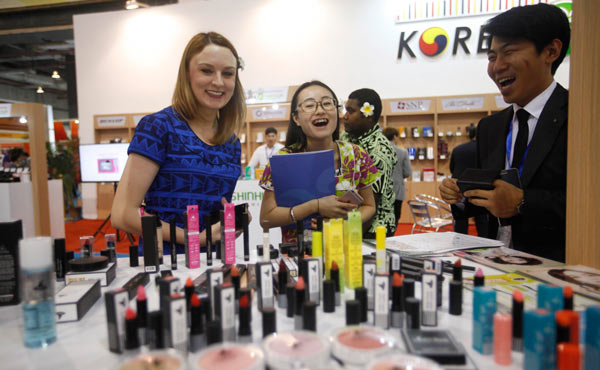
Business people check out South Korean cosmetic products at a trade expo in Dongguan, Guangdong province. [Fang Guangming/For China Daily] |
Under the new free trade agreement, South Korean cosmetics and appliances will get cheaper and ubiquitous in China
Popular South Korean cosmetic products like cushion foundation, facial masks and other food and consumer products are going to be cheaper and more widely available in China.
From Dec 20, South Korea and China started implementing their bilateral free trade agreement or FTA and reduced taxes on either side. There will be a further tax cut on Jan 1, the Ministry of Commerce in Beijing said.
 |
|
A woman in traditional outfit demonstrates kimchi preparation at a stall for South Korean products at the world food expo held in Beijing in November. [A Jing/For China Daily] |
In 20 years, China plans to eliminate tariffs on 91 percent of imports from South Korea. For its part, South Korea will remove taxes on 92 percent of imports from China, according to the FTA.
From Sunday, 20 percent of imports from South Korea have already become tariff-free. These include ginseng, gastrodia, oatmeal and soybean.
Only nine percent of imports from South Korea are not included in the FTA. These are mainly agricultural products like rice, peppers, garlic, apple and orange, since South Korea tends to protect its agriculture.

Nevertheless, processed foods that use these products as raw materials can still have tariff reductions and exemptions.
Kim Wook, a trade relations professor at Konkuk University in South Korea, told CCTV: "In the long term, the agricultural products in both countries will enjoy indirect benefits. China and South Korea will foresee significant room for growth in the agriculture sector."
Korean enterprises, he said, may import cheap agricultural products from China, and develop and process high-end products, and then sell them back to China.
"Both sides can benefit from such transactions," Kim said. "There will be more products for customers to choose from, and the competition between Chinese and Korean enterprises will intensify."
In recent years, growing demand for South Korean products in China has encouraged some Chinese people to become overseas shopping agents.
Iris Wong, a Hangzhou-based tour guide who often shuttles between China and South Korea, said the FTA would not affect her business.
In March 2015, fashion giant Chanel SA cut the prices of its three signature handbags in Asia while raising them in Europe. "Chanel lowered the prices in both China and South Korea. South Korea still has a slight price advantage over China. Some people asked me to buy the bags for them, so I can still make money," Wong said.
She said she also posts pictures of many South Korea-made clothes on WeChat, a social media platform operated by Tencent Holdings Ltd. "Most of them are fairly cheap, and customers buy them primarily for their styles. My job is to pick out those well-received styles. I don't think the free trade agreement will reduce my business."
Among fast-moving consumer goods, shampoo, body wash and skincare products will get 20 to 35 percent of their tariffs reduced in five years. Oral hygiene products, sea sedge, and 90 percent of seafood like codfish and frozen crab will be tariff-free in 10 years.
In addition, some household electrical appliances made in South Korea will become tariff-free in the next 10 years. They include refrigerator, rice cooker, electric frying pan, electric oven, electromagnetic furnace, microwave oven, massage apparatus and cosmetic apparatus.
Currently, well-known South Korean products like fermented food kimchi are subject to 25 percent import tariff in China. Clothing and hats invite 15 percent tariff. The tariffs will be gradually canceled in 20 years.
Under the FTA, more high-quality, reasonably priced Chinese products are expected to find access to the South Korean market, too.
Sung Jong-Un, 21, an exchange student from Seoul at Beijing Language and Culture University, said the FTA brought glad tidings for her as she has developed a liking for Chinese snacks and condiments.
"When I went back home this year, I found more and more Chinese food items at large Korean supermarkets. Hopefully, the FTA will mean I'll be able to buy more kinds of Chinese foods. That will make me really happy," Sung said.

Copyright 1995 - . All rights reserved. The content (including but not limited to text, photo, multimedia information, etc) published in this site belongs to China Daily Information Co (CDIC). Without written authorization from CDIC, such content shall not be republished or used in any form. Note: Browsers with 1024*768 or higher resolution are suggested for this site.
License for publishing multimedia online 0108263 Registration Number: 130349