 |
|
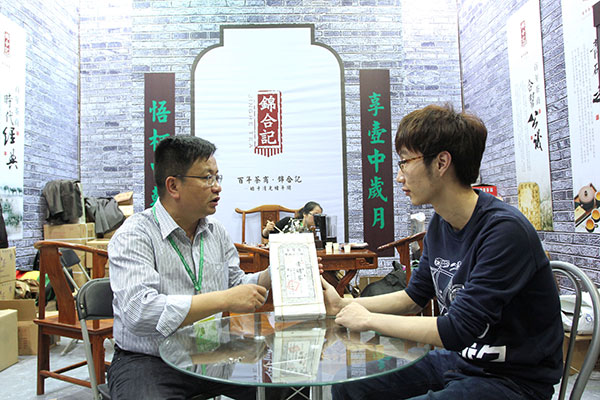
Tea bricks section of a tea expo in Wuhan, capital of Hubei province, in April. Wuhan dominated half of China's tea trade 300 years ago. [Photo provided to China Daily] |
Wuhan plans to invest 100 billion yuan in the industry as new business policies are rolled out to help sell products across the world
Before there were high-speed rail networks and airports, Wuhan used to be the epicenter of the tea trade. In the 19th century, camel caravans packed with an assortment of "tea bricks" would wind their way from the capital of Hubei province toward Moscow, Ekaterinburg and Irkutsk in Russia.
Back then, the journey could take months. Today, it takes just days as the camel caravans have been replaced by massive cargo jets and new rail services heading west.
"With the advantage of regional logistics and transport, the city once dominated half of China's tea trade 300 years ago," Wang Xueling, a professor of agricultural products consumption at Huazhong Agricultural University in Wuhan, said. "But because of development elsewhere, the city faces challenges from other tea-producing provinces in South China."
Even so, the key ingredients are still there as the climate is ideal for storing tea. Processing facilities are also extensive, while the Wuhan-Xinjiang-Europe international rail cargo terminal and new air routes from Wuhan Tianhe International Airport make it a vital transportation hub.
By speeding up the distribution network, tea growers such as Zhang Yuxin are starting to reap the benefits.
His Huazhishan village farm in Hubei's Enshi Tu and Miao autonomous prefecture is surrounded by a stunning mountainous landscape. But in the past he had limited access to sell his green tea to large companies that cater for the international market. Most of his crop was for domestic consumption, while the export sector tended to be for low-end teas.
"We also had to find outlets for the domestic market as one fifth of our profit was being swallowed up by middlemen," Zhang, 47, who cultivates around 13.5 hectares of land, said.
"They used to drive their trucks to various tea-producing villages during the picking season because major companies were not interested in dealing with small tea growers."
But times are changing as new business policies are rolled out to help tea growers sell their products and e-commerce platforms sprout up online. Major logistics operators are also moving into the sector to help farmers expand into global markets.
"Big tea companies now call us direct to buy our products," Zhang said. "They are keen to expand their export markets."
Funded by the Ministry of Commerce, local governments and large-scale tea companies, Wuhan plans to invest 100 billion yuan ($15.52 billion) in the industry during the next five years.
The aim is to expand exports via the old Russia-to-Western Europe trading route by increasing processing plants, logistics and storage capacity. Key to that will be the Belt and Road Initiative, proposed by China in 2013.
This trade and infrastructure network includes the Silk Road Economic Belt and the 21st Century Maritime Silk Road. The network connects Asia, Europe and Africa and passes through more than 60 countries and regions with a population of about 4.4 billion.
"As China promotes the Belt and Road Initiative, Wuhan will expand the ancient tea trading route with Russia and western Europe through well-developed rail and air transportation services," Wan Haiyang, head of the economic cooperation division at Hubei provincial agriculture department, said.
Last year, Hubei's global tea exports reached $90 million, up 33 percent from 2013. This year, it could climb to $100 million.
But overall, China's tea exports dropped by 7.5 percent to $1.27 billion last year, compared to 2013 because of falling demand in the European Union and Japan, two key overseas markets.
Surging production costs were also blamed for the decline, according to the Chamber of Commerce of Foodstuffs and Native Produce in Beijing.

Copyright 1995 - . All rights reserved. The content (including but not limited to text, photo, multimedia information, etc) published in this site belongs to China Daily Information Co (CDIC). Without written authorization from CDIC, such content shall not be republished or used in any form. Note: Browsers with 1024*768 or higher resolution are suggested for this site.
License for publishing multimedia online 0108263 Registration Number: 130349