The Chinese are considered masters of storage.
From odds and ends of sewing to used electrical appliances, from primary school and university textbooks, to New Year greetings cards-we do love to collect and then efficiently squirrel away everything related to our lives.
Day after day, year after year, we have expended huge amounts of energy to make sure our possessions are kept in perfect order.
Many have become slaves to collecting, storing and arranging, avoiding throwing out anything at all costs.
But a new generation of consumers could be moving away from this traditional attitude toward hoarding and possessions.
They believe less is more, and they have adopted a Japanese book as their mantra: The Life-changing Magic of Tidying.
This decluttering manifesto not only teaches people to cast off unwanted or unneeded possessions, but also guides them on how to buy only things they really love, no matter the cost.
The New York Times 2014 bestseller, written by Japanese tidying guru Marie Kondo, has been translated into Chinese and has been selling like mooncakes.
A current government priority in China is to encourage consumer spending, to stimulate economic growth.
Businesses are developing and designing new products catering to specific domestic consumers. Disposable incomes are increasing to keep up with demand.
It has become natural to enjoy the ability to have more physical possessions, often far beyond our needs.
During the first three months of this year, retail sales of consumer goods reached 7.07 trillion yuan ($1.14 trillion), a year-on-year growth of 10.8 percent, according to the National Bureau of Statistics.
Between 2006 and 2014, the average annual growth in retail sales remained above 14 percent annually, and even higher in key cities such as Beijing, Shanghai, Guangzhou and Shenzhen.
However, many have now started to question: "Are all my possessions necessary? Are we wasting natural resources? Do more possessions really bring us more happiness?"
This Chinese obsession with storage is deep rooted. It's based on the thinking that "one day this will be needed".
If we threw away something old and used, we were often wracked with guilt.
But just imagine life, free of such angst.
If we find an umbrella, which has been stowed away for 20 years, despite its broken handle-imagine not having to wonder whether we will ever use it again.
Decluttering of unneeded possessions is the solution, suggests Kondo.
A life not only simpler, but one in which we can genuinely appreciate the beauty of some of the things we own, if only because we don't have so many of them.
And there are implications for business.
This new attitude could encourage companies to genuinely consider a stricter set of questions on which marketing and production decisions could be based. Questions which better suit the changing tastes of the modern consumer.
? Is it green? They could favor environmentally friendly products, from food to clothes, from house appliances to cars. Organic food and hybrid automobiles would surely become the most popular items.
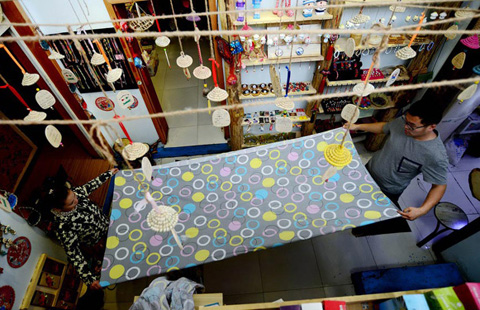
? Could it be considered vintage? The majority of consumers today are into age-old style, combined with modern quality. They cherish natural resources and love items made in the traditional way. Vintage markets, second-hand stores and folk items are often their favorites, even though most items on display are lowly priced.
? Is it niche? Mass brands are losing favor with this new group of consumers, because they yearn for individualism, products which show off their own characteristics and personalities. Modern buyers favor niche brands, creative designs, often tailored to suit the individual. For example, home decorations which have the authentic look, but which might actually be new and expensively priced.
It's time for us to embrace this new way of life, and become the masters of our possessions, not the slaves of them.

Copyright 1995 - . All rights reserved. The content (including but not limited to text, photo, multimedia information, etc) published in this site belongs to China Daily Information Co (CDIC). Without written authorization from CDIC, such content shall not be republished or used in any form. Note: Browsers with 1024*768 or higher resolution are suggested for this site.
License for publishing multimedia online 0108263 Registration Number: 130349