Beijing-Tianjin-Hebei area plans to create new innovation platforms for technology
 |
|
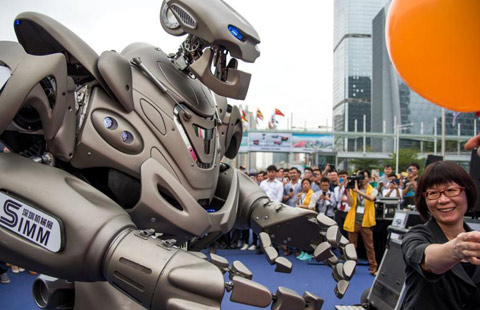
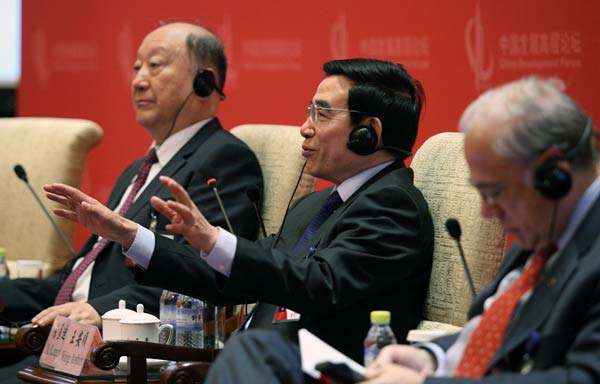
Beijing Mayor Wang Anshun vowed the capital will work with Tianjin and Hebei province to boost regional development and make the region a leading force for the country's economy.[WANG ZHUANGFEI/CHINA DAILY] |
Beijing Mayor Wang Anshun announced on Saturday that the capital will work with Tianjin and Hebei province to boost innovation, industrial upgrading and restructuring, so the three become a leading force for the national economy.
The Beijing-Tianjin-Hebei region is the third growth pole of China after the Pearl River Delta and the Yangtze River Delta. Its total gross domestic product accounted for about 10 percent of the country's GDP last year.
The Beijing municipal government will focus more on technological innovation and cooperate with the authorities in Hebei province and Tianjin to set up platforms for innovation, Wang said.
Wang made the remarks during the China Development Forum 2015, which is being held in the Diaoyutai State Guesthouse from Saturday to Monday. The forum, attended by senior Chinese officials, has attracted more than 400 foreigners from 19 countries and regions.
President Xi Jinping put forward the initiative for the integration and coordination of Beijing, Tianjin and Hebei province in February 2014 in a bid to balance development, the environment, population and resources, while building an economic zone surrounding Beijing.
More than 100 million people live in the region, which has a combined area of 216,000 square kilometers. Yet there is a big development gap between Beijing and Hebei. Heavily polluted Hebei still has several million people living in poverty, and it faces the challenge of cutting its excessive iron, steel, cement and glass capacity.
"Compared with Beijing residents, the average income of Hebei residents is only 55 percent in urban areas and 50 percent in rural areas," Wang said at the forum.
The Beijing municipal government will work hard with its counterparts in Tianjin and Hebei to narrow the income gaps in the region, he said.
The mayor pointed out that infrastructure, including the construction of subways and railways, will play a key role in integrating the three areas.
The capital will "lay out the annual task list for transportation infrastructure integration, ecological and environmental protection and industrial transfer, so as to make new progress as soon as possible", Wang said.
Beijing's subway system already carries approximately 10 million passengers a day on workdays. By 2020, the total subway length is expected to increase to 1,000 kilometers, according to the Beijing government work report. Construction on four new subway lines is due to start this year.
Beijing will also accelerate the transfer of non-essential functions, such as general manufacturing, downtown wholesale markets, as well as some educational and medical services this year, Wang said.
The mayor has also vowed to cooperate with his counterparts in Hebei and Tianjin to fight pollution and protect the environment.
To reduce pollution, Beijing closed 392 companies, including furniture and machinery factories, foundries and other polluters. The city also removed 470,000 old vehicles from the roads and strengthened its environmental law enforcement.
Angel Gurria, secretary-general of the Organisation for Economic Co-operation and Development, said at the forum that it has become more and more important for big cities to coordinate with each other in the policymaking process.
The new normal of China's urbanization is not about how big a city grows, but how well it functions, Gurria pointed out.

Copyright 1995 - . All rights reserved. The content (including but not limited to text, photo, multimedia information, etc) published in this site belongs to China Daily Information Co (CDIC). Without written authorization from CDIC, such content shall not be republished or used in any form. Note: Browsers with 1024*768 or higher resolution are suggested for this site.
License for publishing multimedia online 0108263 Registration Number: 130349