 |
|
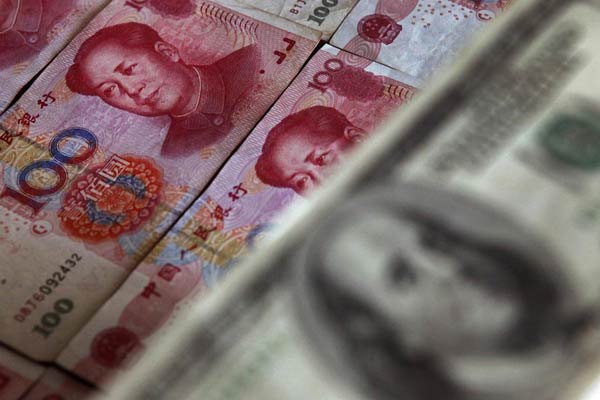
A photo illustration shows a $100 banknote placed above Chinese 100 yuan banknotes in Beijing in May 10, 2013. [Photo/Agencies] |
BEIJING - China's cross-border capital flows will remain volatile this year amid uncertainties both at home and abroad, the country's forex regulator said on Sunday.
As China gradually moves to make its foreign exchange mechanism more market-oriented, the structure of "trade surplus and capital outflow" will become increasingly normal, the State Administration of Foreign Exchange (SAFE) said in a report.
Meanwhile, easing monetary policies in some major economies will put emerging markets under growing pressure from capital outflows, SAFE noted.
China's capital account deficit widened sharply in the last quarter of 2014 to $91.2 billion, compared with the third quarter's $9 billion. The widening deficit fanned concerns of massive capital outflows from the country as economic growth slowed.
The SAFE reiterated that the capital outflow remains "moderate and within the limit" and the liquidity in the foreign exchange market remains "ample".
Related stories:
China capital account deficit widens in Q4, by Xinhua
BEIJING - China's capital account deficit widened sharply in the last quarter of 2014 as domestic companies expanded investment overseas.
The capital and financial account deficit was $91.2 billion for three months ending in December, compared with the third quarter's $9 billion, according to preliminary statistics released by the State Administration of Foreign Exchange (SAFE) on Feb 3.
China posted deficit on its capital and financial account for three consecutive quarters due to rapid increases in overseas investment and speculation of further depreciation of the yuan, the country's currency, analysts said.
Wen Bin, chief researcher at China Minsheng Bank, said capital and financial account deficit may become a "new normal" as the country faces pressure from capital outflows amid expectation of a weaker yuan.
China reported a current account surplus of $61.1 billion in the fourth quarter last year, narrowing from $72.2 billion posted in the third quarter, the SAFE said.
The country saw a $213.8 billion current account surplus for the full year and a deficit of $96 billion on the capital and financial account, it said.
Regulator says capital outflow fears unfounded, by Jiang Xueqing, China Daily
China is not at risk from large-scale capital outflows, although it experienced a net outflow under the capital account in the third quarter, which was in line with the nation's target of achieving equilibrium in the international balance of payments, the State Administration of Foreign Exchange said on Oct 23.
Preliminary estimates by the SAFE indicate that China saw deficits in the capital and financial accounts in the third quarter while posting a current account surplus.
During the same period, the trade surplus hit $128.1 billion, up 48 percent quarter-on-quarter and 111 percent year-on-year.
In the second quarter, despite an expansion in the trade surplus, China recorded a net outflow of $16.2 billion under the capital account, swinging back from a net inflow of $94 billion in the first quarter.
These shifts "will help China achieve equilibrium in the international balance of payments and will also create favorable conditions for the central bank to improve macroeconomic regulation and create more leeway for monetary policy operations", said Guan Tao, head of the SAFE's department of international payments, at a news conference in Beijing.
Fluctuations in the capital account are partly connected to reform of the exchange rate mechanism of the yuan. As part of the reform, the People's Bank of China, the central bank, doubled the daily trading band for the yuan against the dollar to 2 percent effective March 17.
Furthermore, the central bank is gradually reducing its intervention in the foreign exchange market, which means capital outflows will increase as the trade surplus widens.
The reform program has achieved the desired goals, Guan said.
On the whole, China maintained a net capital inflow in the first three quarters.
The foreign exchange settlement-sales surplus reached $172.3 billion, up 3 percent year-on-year, excluding the impact of the exchange rate.
In spite of a slowdown in property market, China still had a $520 million net inflow of funds from non-residents to buy houses and a $20.1 billion net inflow of foreign investment in the housing sector during the first three quarters.
Guan forecast that cross-border capital flows would approach a balance, with some fluctuations.
"China is moving toward a general equilibrium of current account balance. The yuan exchange rate is also approaching a reasonable and balanced level. Under these circumstances, two-way fluctuations of cross-border capital flows are likely to become the new norm due to increasing economic uncertainties in and outside China," he said.
According to the central bank, foreign exchange reserves totaled $3.89 trillion on Sept 30, dropping by $100 billion from June 30.
Guan said the decline was mainly caused by the strengthening of the dollar in the third quarter, which led to a reduction of assets in other currencies that were calculated in dollars. In essence, it was simply a paper loss rather than an actual loss.
"Exchange rate fluctuations of major currencies in the international market will cause China's foreign reserves to rise or fall, but the impact will be limited, considering the large size of the reserves, and it should not be over-analyzed," he said.

Copyright 1995 - . All rights reserved. The content (including but not limited to text, photo, multimedia information, etc) published in this site belongs to China Daily Information Co (CDIC). Without written authorization from CDIC, such content shall not be republished or used in any form. Note: Browsers with 1024*768 or higher resolution are suggested for this site.
License for publishing multimedia online 0108263 Registration Number: 130349