Prolonged slump in fortunes forces overdue but painful transitions in many sectors, report Zhong Nan and Du Juan.?
For Ji Fenghua, chairman of Jiangsu-based Nantong Mingde Group, 2014 brought a bitter fate. His heavily indebted shipyard was taken over by Sainty Marine Corp, a bigger shipbuilder in the same province.
Business was "not that bad" from 2010 to 2012, Ji said. The private shipyard, with about 4,000 workers, still had an order backlog for vehicle carriers, chemical tankers and bulk vessels that were placed by Singaporean and Norwegian clients attracted by the company's relatively low prices. But things began to change in 2013 and conditions worsened last year.
There have been many similar stories in other coastal provinces such as Zhejiang and Liaoning over the past three years.
Tight credit, low vessel prices and smaller advance payments from clients hurt the finances of many shipyards in China during the period, said Ji.
"Banks are unwilling to lend to shipbuilders as they are acutely aware of how sluggish the business is. Shipbuilding is classified as a high-risk industry by banks," said Wang Jinlian, secretary-general of the China Association of the National Shipbuilding Industry.
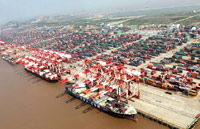
Low prices, generally combined with a preponderance of orders for low-value vessels, are undermining the sector. Chinese shipyards managed to complete projects for 28.47 million deadweight tons from January to October in 2014, down 18 percent on a year-on-year basis.
The shipyards' troubles are just one piece of evidence that heavy industry, which has long been at the center of the Chinese economy, is less relevant than it used to be.
Policy banks and commercial lenders such as the China Development Bank, the Export-Import Bank of China and Industrial and Commercial Bank of China Ltd have become more cautious in extending guarantees and loans, especially to small and medium-sized companies in the shipbuilding, steel, machine tool and construction machinery sectors.
Figures for the steel industry have lenders worried. Inventories have been building amid falling prices and weak orders.
As of Friday, stockpiles in 29 major cities stood at 9.49 million metric tons, up 303,400 tons in just one week, according to the Lange Steel Information Research Center, a Beijing-based industrial consultancy.
The government has been pushing in recent years to eliminate small steel producers as part of its effort to reduce carbon emissions and ease air pollution. But national steel output in 2014 still rose 0.9 percent to a record high of 822.7 million tons, according to the National Bureau of Statistics.
"Although the 2014 steel output growth rate was at a 30-year record low, the increase was not in line with China's economic slowdown," said Xu Liying, an analyst with the center.
The industrial slowdown in China has dealt a severe blow to global commodity suppliers such as Australia, Canada, Indonesia, South Africa and Nigeria.
Yu Bin, director of the department of macroeconomic research at the State Council Development Research Center, said that overcapacity has prompted a shift from traditional manufacturing in the steel, nonferrous metal, construction and shipbuilding sectors to new emerging industries, including carbon fiber, new energy vehicles, wind and solar power.
But Yu said: "Rapid new investment and increasing production capacity of industries with overcapacity problems are other key matters that affect the country's sustainable economic development."
"This lull may continue this year because there are no headwinds for higher economic growth," Yu said. "China's imports of natural resources and energy will not rise that much over the next three years because the country is readjusting its economic structure to be more green."
Eager to further cut overcapacity and seek new markets for the output of the country's heavy industries, especially in traditional manufacturing bases such as the northeastern and eastern regions, the State Council issued several directives last year aimed at upgrading and restructuring the troubled heavy industry sector.
These companies are being encouraged to develop high value-added products such as alloy steel, offshore engineering products and advanced machinery.
Qi Jun, president of the China Construction Machinery Association, said that restructuring and technological upgrading will be the focus of the heavy industrial sector in the next few years as it strives to reduce excess supply and cope with a saturated domestic market.
"Another troublesome issue for Chinese companies is the currency. With the appreciation of the renminbi and the depreciation of the euro, yen and won, their price advantage is declining just as they face higher labor and material costs," Qi said.
Industrial enterprises are increasingly using their financial and human resources outside the country as they pursue growth and profits.
Heavy equipment makers, including Xugong Group Construction Machinery Inc and Sany Heavy Industry Co Ltd, which rode the domestic growth wave for years, are pursuing huge opportunities in emerging markets such as Africa and Latin America, which offer chances for infrastructure work. Shantui Construction Machinery Co from Shandong province, for example, has stepped up its efforts to form ties with local dealerships in Africa.
Li Dianhe, Shantui's deputy general manager, said the African market does not need the best technology but instead requires durable products and powerful engines that can cope with multiple tasks and tough road conditions. Chinese products certainly have a price advantage against such rivals as US-based Caterpillar Inc or Japan's Komatsu Ltd in Africa.
The construction machinery manufacturer will invest $3.5 million in the West African market this year, focusing on Ghana, Gabon and Cameroon. The money will be spent on adding more local dealerships, distribution warehouses, spare parts sales and leasing.

Copyright 1995 - . All rights reserved. The content (including but not limited to text, photo, multimedia information, etc) published in this site belongs to China Daily Information Co (CDIC). Without written authorization from CDIC, such content shall not be republished or used in any form. Note: Browsers with 1024*768 or higher resolution are suggested for this site.
License for publishing multimedia online 0108263 Registration Number: 130349