China-South Korea FTA and financial agreements will open fresh channels for investment
Closer economic and financial ties between China and South Korea are expected to have a significant impact on the two countries and the Asia-Pacific as a whole.
China and South Korea substantially concluded a free trade agreement in Beijing during the Asia-Pacific Economic Cooperation meeting in November. The two countries also signed a bilateral currency agreement during President Xi Jinping's visit to Seoul in July.
The China-South Korea FTA negotiation, which was concluded after 12 rounds of negotiations over the past three years, significantly reduces barriers to bilateral trade, except for those on rice and motor vehicles. The FTA is pending legal and parliamentary reviews from the two countries early this year.
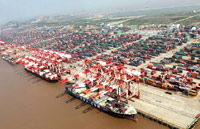
China and South Korea achieved bilateral trade of $229 billion in 2013, compared with $6 billion in 1992, representing growth of over 36 fold. When completed, the China-Korea FTA will help foster a unified market between the two countries with a combined total population of 1.35 billion and GDP of $11 trillion.
This agreement covers 17 areas such as goods, services, e-commerce, government purchasing and investments. Each side would remove tariffs on at least 90 percent of items. Within 20 years, China would eliminate tariffs on 91 percent of trade items and 85 percent of imports ($137.1 billion), while South Korea would eliminate tariffs on 92 percent of trade items and 91 percent of imports ($73.6 billion).
Complementary areas of the two countries' industries led to structural differences in their exports, even though most of the bilateral trade is electronics. For China's exports to South Korea, electronics, base metal and machinery are the top three subcategories in terms of trade volume, accounting for 37.5 percent, 12.8 percent and 9.8 percent of total 2013 exports to South Korea, respectively.
For South Korea's exports to China, electronics, optical devices and machinery are the top three subcategories, accounting in 2013 for 42 percent, 12.9 percent and 8.6 percent, respectively.
A further breakdown of subcategories reveals the technology gap between the countries. A large proportion of electronics exported by China to South Korea were low-end integrated chips, telephones and controllers, while those exported from South Korea to China were high-end integrated chips, signal devices and semiconductors.
What this means is that electronic subcomponents South Korean firms bought were used to manufacture high-end electronic devices and then sold to customers in China. There is a similar pattern for machinery manufacturing-South Korea is at a higher level on the value-added ladder and exports complete machines to China, while China exports parts and subcomponents to South Korea.
Given the current average tariff levels in South Korea and China of 8 percent and 4.1 percent, respectively, waiving tariffs for 90 percent of all products traded following the FTA will further boost their bilateral trade and investment. It will benefit China's low-end electronics sector, further contributing to its penetration in the South Korean market. Lower tariffs will also further strengthen the price advantages of steel and non-ferrous metals exported from China.
The two sides also pledged to continue negotiations on a negative list for services and investment. A negative list is a list of items to which a pact will not apply, the idea being to apply it to everything else.
The bilateral currency agreements the two countries signed in July consist of direct trading between the renminbi and Korean won, a new renminbi settlement center in Seoul, renminbi bond issuance in South Korea, and 80 billion yuan of the Renminbi Qualified Foreign Institutional Investor quotas in South Korea. This program enables yuan held outside of China to be invested in the country's securities.
A new renminbi clearance center will be established in Seoul, with the Bank of Communications taking the role of renminbi clearing bank. South Korean companies are encouraged to issue renminbi bonds. These four arrangements are helpful in promoting trade settlement with agreed upon currency and in developing offshore markets.
Despite high bilateral trade, renminbi settlement represented only 0.9 percent of total trade between China and South Korea in 2013. The renminbi has been used increasingly in trade settlement in the past five years. In the first quarter of last year, up to 18 percent of China's trade value, equivalent to 1.09 trillion yuan, was settled in renminbi, significantly up from 14 percent in the last quarter of 2013 and only 1 percent in 2009. The percentage could rise significantly in coming years with the rise in renminbi trade settlement.
Major South Korean commercial banks such as Woori Bank, Industrial Bank of Korea, Shinhan Bank, and the policy bank, Korea Development Bank, have set up branches across China. The main beneficiaries of China-South Korea currency agreements in the financial sector will be China's commercial banks with a global presence, such as Bank of China, ICBC and Bank of Communications. Their South Korean investment banking business is expected to expand at a faster pace, supported by the establishment of an offshore renminbi settlement center and issuance of renminbi bonds in Seoul. The issuance of renminbi bonds was previously handled in Hong Kong since there was no market for renminbi bonds in South Korea.
For example, South Korea's largest food company, CJ Corporation, issued 1.1 billion yuan in three-year dim sum bonds in Hong Kong in June 2011. It was the first South Korean firm issuing renminbi bonds. A new offshore renminbi bond market in South Korea would enable South Korean firms with a high level of activity in China to reduce their cross-border financing costs and contribute to offshore renminbi products. Seoul is likely to be the fourth renminbi bond offshore market, following Hong Kong, London and Singapore.

Copyright 1995 - . All rights reserved. The content (including but not limited to text, photo, multimedia information, etc) published in this site belongs to China Daily Information Co (CDIC). Without written authorization from CDIC, such content shall not be republished or used in any form. Note: Browsers with 1024*768 or higher resolution are suggested for this site.
License for publishing multimedia online 0108263 Registration Number: 130349