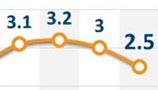
The economic data of Jan 20 showed that, on a quarterly basis, the slowdown of China's economy was interrupted in the fourth quarter of 2014. However, for the year as a whole, GDP growth slowed from 7.7 percent in 2013 to 7.4 percent last year, slightly below the official target of 7.5 percent, the first time this has happened since 1990.
The economic slowdown was especially visible in industry, particularly heavy industry, which was jolted by the real estate downturn and where the impact of the slowdown on corporate activity and profits is amplified by falling output prices.
Activity and price developments in light industry and the service sector were more favorable. Indeed, we (at Royal Bank of Scotland) saw further rebalancing of the pattern of growth in 2014. As the share of the secondary (industrial) sector fell 1.3 percentage points to 42.6 percent of GDP, the service sector's share increased 2.1 percentage points to 48.2 percent, even though the rebalancing on this dimension was less rapid in real terms.
The relatively favorable growth of the comparatively labor-intensive service sector supported the labor market. With real service sector GDP growth edging down from 8.3 percent in 2013 to 8.1 percent last year, new urban job creation - the government's preferred labor-market indicator - was 10.7 million, exceeding the target of 10 million. Migrant employment growth - a good indicator on the vibrancy of the urban labor market - picked up slightly in the fourth quarter of last year, after an earlier slowdown.
The relatively good labor market performance through 2014 was an important reason why China's leadership remained relatively restrained with regard to macroeconomic stimulus and a reason the leadership thought it acceptable for growth to slightly miss the growth target in 2014.
Inflation faces downward pressure because of falling prices of raw commodities on global markets and overcapacity in China's industry, although the likelihood of a pernicious deflationary spiral is not high.
Economic growth is likely to remain under downward pressure in the first half of 2015, affected by continued real estate weakness. In spite of measures to stimulate housing sales taken in the second half of last year, a real estate recovery is not likely any time soon. Although low raw commodity prices should support margins in industry, corporate investment momentum will probably not improve much either in 2015, given the weak demand prospects and overcapacity in several sectors.
Other growth drivers remain broadly intact, though. Infrastructure investment should continue to be supported by policymakers' reliance on such investments to support growth, although the implementation of the new local government debt framework does pose downside risks. Consumption should continue to benefit from a solid labor market and low inflation, while the outlook for exports is reasonable.
Key risks to the outlook include a more pronounced global monetary and exchange rate upheaval, weaker global trade growth and, in China itself, a more pronounced downturn in real estate, lower infrastructure investment following the implementation of the local government debt framework, and jitters in financial markets on the back of credit events.
Policy support will be needed to achieve GDP growth of close to 7 percent in 2015 - the likely growth target for this year - but policymakers will remain reluctant to move toward major, high-profile stimulus measures in line with their emphasis on "the new normal", instead of stimulus. On the fiscal front, while infrastructure investment will remain a focus this year, there is no major stimulus in the pipeline.
On the monetary front, calls for policy to support growth and contain borrowing costs will be balanced with the need to rein in the rise in leverage and financial risks. The People's Bank of China has largely continued to implement "targeted" monetary policy measures instead of high-profile measures such as reserve requirement ratio (RRR) or further interest rate cuts. Earlier this week, the PBoC increased relending to financial institutions that serve agriculture and small companies. Another factor holding back an RRR cut has been large inflows into the equity market in recent months, in part fuelled by margin trading, although measures announced last Friday by the China Banking Regulatory Commission and China Securities Regulatory Commission to rein that in seem to have had a major dampening impact on the stock market and may make an eventual RRR cut more likely.
The author is chief China economist at the Royal Bank of Scotland.

Copyright 1995 - . All rights reserved. The content (including but not limited to text, photo, multimedia information, etc) published in this site belongs to China Daily Information Co (CDIC). Without written authorization from CDIC, such content shall not be republished or used in any form. Note: Browsers with 1024*768 or higher resolution are suggested for this site.
License for publishing multimedia online 0108263 Registration Number: 130349