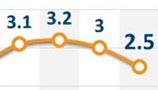
Manufacturing labor costs in China will continue to rise steeply at 12 percent annually until 2020, according to a new report, but the wage increases will not be matched by similar rises in productivity, casting a shadow over the future competitiveness of the world's largest manufacturing base.
New data from HSBC Holdings Plc and Markit Economics showed a flash Purchasing Managers' Index at a seven-month low of 49.5 for December, just below the dividing line between expansion and contraction at 50. That compared with the median estimate of 49.8 in a Bloomberg News survey.
A separate report from the Economist Intelligence Unit, a global business consultancy, meanwhile, also showed on Tuesday that China's annual earnings grew at 11.9 percent from 2001 to 2012, and it is very likely to continue at that rate from 2013 to 2020.
The growth projection places China in a strong position compared to developed economies, but not against some of its developing rivals.
In 2012, average manufacturing wages in China were $2.1 per hour, compared with $35.7 in the United States, and eight years later, Chinese workers could still be earning just 12 percent of their US counterparts, the EIU report said. By then, average labor costs in China would still be 35.2 percent of those in Brazil, 55.2 percent of Mexico's and 75 percent of Turkey's, said the EIU report, titled Still Making it.
Serious competition, however, could be coming from Vietnam, India and Indonesia.
In 2012, China's average wage was 147 percent higher than Vietnam's but by 2019 that could have jumped to 177 percent.
Another recent survey, from Japan External Trade Organization, also claimed that the average wages of workers in Shanghai were 319 percent higher than their counterparts in Hanoi. Commenting on the JETO statistics, the Chinese Academy of Social Sciences said China's wages are unlikely to continue rising as fast as they have in recent decades.
One of the reasons for the varying projections might be the different data sources used in the different studies. The EIU's official source is the National Bureau of Statistics while the JETO survey relied on its own figures.
The EIU said that one of the failings of the NBS figures was a lack of data from enterprises based in towns and villages, which employ a considerable proportion of China's manufacturing workers.
Given that workers there and in private firms are paid less than those in State-owned enterprises, the NBS data could be criticized for overvaluing real wages, which the EIU said it had tried to compensate for.
Tom Rafferty, an economist with the EIU, said the basis for projecting the same wage growth rate over the next seven years is that although overall economic growth has slowed, the country's labor shortage will deepen and the government is likely to encourage better standard compensation levels.
He said that one certainty is that the fast rise in wages over the past few years has not been matched by the equal growth in productivity, which is worrying economists.
The EIU report noted that China saw a surge in productivity in the early 2000s following its entry into the World Trade Organization and State-owned enterprises reform.
But it said growth has slowed dramatically since 2005 and wage growth outpaced the gain in productivity in four of the five years between 2008 and 2012.
"China will continue its manufacturing story, only if it sorts out how to lift its productivity," said Rafferty. "That requires it to enhance the efficiency of its workforce, climb up the value-chain, and introduce more innovation."

Copyright 1995 - . All rights reserved. The content (including but not limited to text, photo, multimedia information, etc) published in this site belongs to China Daily Information Co (CDIC). Without written authorization from CDIC, such content shall not be republished or used in any form. Note: Browsers with 1024*768 or higher resolution are suggested for this site.
License for publishing multimedia online 0108263 Registration Number: 130349