 |
|
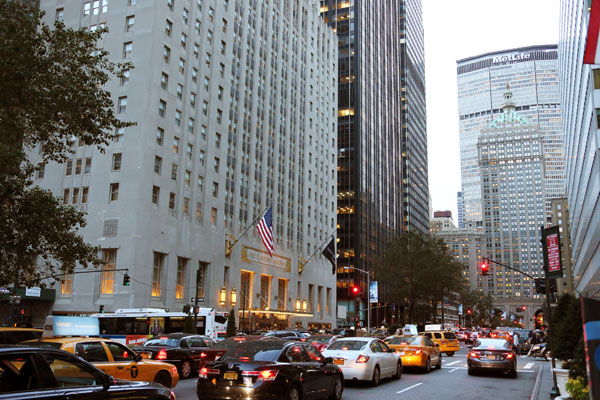
The Waldorf Astoria is pictured at 301 Park Avenue in New York on Oct 6. Hilton Worldwide Holdings Inc said it would sell its flagship Waldorf Astoria New York hotel to a Chinese insurance company for $1.95 billion, one of the highest prices per room ever paid for a US hotel. Guan Liming for/China Daily |
It's the most ever paid for a New York City hotel: $1.95 billion for the Waldorf Astoria. Is the price right? Will it set a new bar for prices paid by Chinese investors? Liu Lian reports from New York
 |
Beijing-based Anbang Insurance Group made a big splash last month when it agreed to buy New York City's iconic Waldorf Astoria hotel for $1.95 billion from Hilton Worldwide Holdings Inc, the largest sale ever of a US hotel.
When the Blackstone Group – Hilton's majority shareholder – was approached by potential bidders a few months ago, sources said valuation experts put an estimate of $1.2 to $1.3 billion on the property. The sources declined to be identified by name. Blackstone declined a request for comment.
Did privately held Anbang, China's eighth-largest insurer, overpay for the Waldorf? What does the deal mean for future Chinese investments in the US real estate market? And could the swarm of Chinese real estate deals announced in New York over the last two years experience the same fate that happened to the Japanese real estate binge of the 1980s?
Banks tend to be on the conservative side when it comes to property valuations, said Michael B. Margolis, a partner at Blank Rome law firm and based at its Los Angeles office. "Their interest is more focused on protecting the bank's loan rather than assessing opportunities looking up for an asset," he said.
"In general, foreign investors – no matter who they are – Chinese, Japanese or from South America – are more likely to overpay for property or buy properties that underperform," said Fernando Ferreira, associate professor of real estate at the Wharton School. "Real estate is very local. You really need to know the market block by block. Almost by definition, no local investors have less knowledge or do worse about the local market than foreign buyers."
Anbang also has committed to a major renovation of the hotel, which may ratchet up to $400 million to $500 million, according to sources who asked not to be named. That, would bring the total acquisition tab to approximately $2.5 billion.
"Considering the brand recognition and the quality of the asset, I definitely think the Waldorf is a fair value in terms of what they are paying," said Marisha Clinton, director of research of capital markets at New York - based Jones Lang LaSalle (JLL) Property Consultants. It's a matter of supply and demand, she said.
'Unique opportunity'
"The Waldorf is a unique opportunity, not only because it's a five-star luxury hotel that encompasses an entire city block in Midtown Manhattan, but also because the project involves redeployment and repositioning of the asset," said Daniel Lesser, president and CEO of New York-based LW Hospitality Advisors. "The mere fact that it's a scarce opportunity is going to put upward pressure on value evaluation."
Gabriel R. Hungerford, a senior research analyst at Los Angeles-based CBRE Global Research and Consulting, called the Waldorf "one the most-prized pieces of real estate properties in modern American history."
"It's really one of the most stable investments they can make," he said. "Anbang is mostly likely motivated by diversification and capital preservation rather than purely by returns."
The Wall Street Journal calculated that Anbang is paying about $1.4 million per room. Margolis said Anbang is paying a little bit higher, but not a great deal higher than paid for other first-class properties.
By comparison, in January of this year Starwood Hotels & Resorts Inc sold the 207-room St. Regis Bal Harbour Resort in Miami for $213 million to Qatar-based Al Rayyan Tourism Development Company, making the per room rate approximately $1.03 million.
The Standard Hotel in lower Manhattan's Meatpacking district was purchased in February for more than $400 million by a group of investors, which represented at least $1.2 million a room.
The Plaza Hotel, another trophy in Manhattan, was bought by Indian billionaire Subrata Roy, head of property empire Sahara Group, for $2 million per room in 2012, according to hotel data tracker STR Analytics. The Sultan of Brunei recently acquired the hotel's mortgage, according to a source who asked not to be identified and who declined to give the amount of the mortgage.
To some observers, the Waldorf deal recalled Mitsubishi Company's $2 billion purchase in 1989 of Rockefeller Center, another New York landmark. The building complex was valued at $6 billion when acquired and fell to $1.5 billion when Mitsubishi exited the deal six years later, said Ferreira.
Other acquisitions in the Japanese real estate binge of the 1980s included the Tiffany building, Universal Studios and Columbia Records. All were subsequently sold at great losses.
The fallout from the Japanese meltdown two decades ago warrants caution for Chinese investors, experts said.
"I think most deals we saw before in real estate by Chinese companies were priced at the upper end," said Thilo Hanemann, director of research on cross-border investments for the Rhodium Group, "People have said that they cannot make a lot commercial sense of the evaluations."
"The Chinese and the Japanese period only looked the same on the surface. The Chinese government over the past 20 to 25 years has built up enormous financial strength and enormous financial reserve. And its policy is now to diversify and encourage outbound investment. The Waldorf deal is a good example of how the policy is implemented," said Daniel M Cashdan, head of investment banking at HFF Securities LP.
"The Chinese are not only buying landmark buildings. They are also doing developments, and investing not only in first-tier but second-tier cities," he said, "the Chinese investors are coming to the US with a much broader approach which will make the total results safer."
"The Japanese spree was really hindered by the flowing of the US economy, of the recession in the early 1990s. Their fall was not necessarily as a result of bad investments," said Hungerford.

Copyright 1995 - . All rights reserved. The content (including but not limited to text, photo, multimedia information, etc) published in this site belongs to China Daily Information Co (CDIC). Without written authorization from CDIC, such content shall not be republished or used in any form. Note: Browsers with 1024*768 or higher resolution are suggested for this site.
License for publishing multimedia online 0108263 Registration Number: 130349