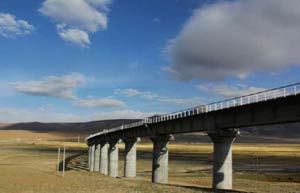
While these huge infrastructure projects were much-heralded by administrators, I couldn't help thinking that it is the solar heaters and other everyday utilities like water, electricity, television and Internet that are making the real difference in people's lives here.
Of course, during press trips you are always going to be presented with villagers who are happy with their lot. But I noticed, beyond these adult faces, smiling, happy children wandering into view, dressed in warm clothes, carrying decorated lunch boxes - a far cry from the tents and huts that their older relatives experienced growing up.
Back in Lhasa, another thing I noticed was the water. In Beijing, bottled or drinking water is the norm. Here I could drink ice-cold water from the tap.
A lot of Tibet's ongoing environmental measures are subtle. As our hosts touted the ban on heavy-polluting factories and imposition of strict logging laws, the souvenirs I bought were packaged simply in a red fabric pouch and others were wrapped in paper - there wasn't a plastic bag in sight.
That fact escaped me until I was back in Beijing, during an interview with Zhang Yun, a professor at the China Tibetology Research Center, which is devoted to the academic study of the autonomous region and all aspects of its life. Lhasa banned the use of non-biodegradable plastic bags in 2005, and the result, Zhang said, is a city free of the "white stuff", as locals call the bags.
"We visited Taiwan last year, and their standards were also very, very high, almost European-like. It's an area that I think we here in Beijing can do much, much better. We can learn from Lhasa," he says.
Tibet's environmental rules are in sharp contrast to the outside image of China, where air and water pollution regularly make international headlines. Beijing is learning that pollution cannot continue unabated as it is damaging China's economic attractiveness globally and increasing the government's healthcare costs.
In addition to a national strategy of tree planting and commitments to limit coal use, China has banned highly polluting industries from its southwestern parts. In Tibet alone, Beijing says it invested more than $3.5 billion in 2012 in ecological and environmental initiatives.
The economy there is concentrated on agriculture, Tibetan medicine, utilities and, of course, tourism, which has exploded in recent times. The numbers are staggering: In 2012, 10.6 million tourists visited Tibet, driving revenues to 12.6 billion yuan ($2.1 billion), a rise of 30 percent from the previous year. Retail sales jumped 16.3 percent as a result.
Commercialization is everywhere. A family of Tibetan herders recently paid the equivalent of $3,500 to operate at a scenic spot along the highway. They charge visitors for horse rides, photos, and even the use of the bathroom, which costs 1 yuan.
Villagers in Apei told me they have around 20,000 tourists staying a year.
Zhang said the majority of those involved in tourism are ethnic Tibetans, meaning the money arriving from outside stays there, supporting local cultural initiatives. One of those is at Tibet University in Lhasa, where free education in the Tibetan language is offered.
Zhang added, however, that academics are concerned about the ever-rising level of commercialism, and its impact on Tibet's cultural preservation.
"To say we are destroying Tibetan culture is ludicrous," he added, "but there has definitely been an impact.
"We must find a solution. Foreign researchers we interact with agree this is a challenge, and we are all looking for the best solution."
The author is a journalist from the Vancouver Sun, a Canadian newspaper. The views do not necessarily reflect those of China Daily.
 |
 |
|
|
|

Copyright 1995 - . All rights reserved. The content (including but not limited to text, photo, multimedia information, etc) published in this site belongs to China Daily Information Co (CDIC). Without written authorization from CDIC, such content shall not be republished or used in any form. Note: Browsers with 1024*768 or higher resolution are suggested for this site.
License for publishing multimedia online 0108263 Registration Number: 20100000002731