Government sets out wide-ranging energy reform measures including curbing coal consumption
As China is now the world's largest emitter of carbon dioxide, there is talk that it is considering setting an absolute cap on such emissions from 2016.
 |
 |
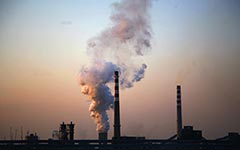
The Action Plan for Controlling Atmospheric Pollution, issued by the State Council in September last year, listed 10 measures to improve the management of air pollution. By and large, the haze that envelops many parts of the country is due to high-energy use dominated by coal.
While the government measures are far reaching, other concrete measures have been proposed, including controlling energy use, speeding up the replacement of coal and stepping up the supply of clean energy. Replacing coal with other energy sources could greatly help reduce carbon dioxide emissions.
The government has proposed total energy consumption control. A recent policy also foresees reducing coal consumption in the regions of Beijing-Tianjin-Hebei, the Yangtze River Delta and the Pearl River Delta by 2017. These highly developed regions have been chosen because they are highly motivated to run cleaner economic structures, and they have greater tolerance for increased spending on energy as coal is replaced.
Proposed total energy consumption control will affect GDP growth, the structure of the energy industry, industry in general and energy pricing. The growth in energy demand will slow. Over the past 30 years, the ratio of GDP growth to the rise in primary energy consumption in China has been about 1 to 0.6 but has fallen to 1 to 0.5 over the past 10 years.
That ratio is expected to fall further, to 1 to 0.4, over the next 10 years, reducing the dependency of economic growth on energy. In general, slower growth in energy demand can be explained by the economic slowdown, structural industrial adjustment toward reduced energy-intensive growth and higher energy costs due to the cleaning-up of the air.
China's coal-dominated energy structure will be adjusted in favor of clean energies. The authorities are being tough on curbing coal consumption to reduce the share of coal in primary energy to 65 percent by 2017. This could be easily achieved, as the share of coal was 65.7 percent last year, and over the past three years the proportion of coal in primary energy consumption has fallen 1 percent a year.
One principal aim of the air pollution clean-up is coal substitution. In 1978, just 610 million tons of coal were used. By last year, the number had soared to 3.61 billion tons, accounting for 49.3 percent of the world's total consumption.
The path to substituting coal is clear - natural gas in the short term and other clean energy sources in the medium to long term. Natural gas as a share of primary energy consumption was just 5.9 percent last year. But China is raising its incoming natural gas supplies, among others through a recent gas deal with Russia for38 billion cubic meters.
Data from the China Center for Energy Economics Research indicates that coal consumption may peak by 2020 at an estimated 4.2 billion tons. But the timing of the peak will depend on factors such as government determination to ensure cleaner air, clean energy developments, implementation of a carbon tax, energy pricing reforms and, especially, coal gasification (also supported by the 10 measures under the Action Plan) and coal liquefaction development.
Curbing coal consumption and the expected consumption peak are particularly favorable for a cap on CO2 in the coming years. If that peak came in 2020, with the expected growth of nuclear power and renewable energy, a CO2 emissions peak could be safely expected.
China's energy pricing reforms will be accelerated. In fact, there are no significant technical challenges to clearing away the country's air pollutants. But one key issue is how to pay for it. At present, coal substitution and clean energy development could be achieved through higher energy costs.

Copyright 1995 - . All rights reserved. The content (including but not limited to text, photo, multimedia information, etc) published in this site belongs to China Daily Information Co (CDIC). Without written authorization from CDIC, such content shall not be republished or used in any form. Note: Browsers with 1024*768 or higher resolution are suggested for this site.
License for publishing multimedia online 0108263 Registration Number: 20100000002731