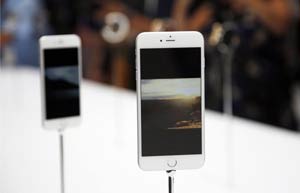
Fans are desperate to lay their hands on the larger-screen iPhone 6, thanks to Apple's "hunger marketing". Analysts are busy debating which of the phones giants - Apple, Samsung or Xiaomi - leads the Chinese market. But too few people spare a thought to environmental damage caused by cell phones.
Indeed, smartphones are great innovative gadgets, but they also entice people to change even phones that are as good as new, and thus worsen the already serious environmental pollution. Theoretically, a cell phone can be used for eight years, but in practice one lasts 15 months on average in China, according to D.Phone.
From production to disposal, cell phones, even those made by big brands like Apple and Samsung, pollute the environment. A study by the Ecology Center of Ann Arbor, Michigan, and ifixit.com showed that each of the 36 dissected phone models contained at least one of the following toxic elements: lead, bromine, chlorine, mercury and cadmium. And these toxic elements are linked to birth defects, impaired learning and other serious health problems.
China, the largest phone-making country and smartphone market, should be alarmed by the environmental damage caused by cell phones. So there is no reason to celebrate the "good news" that last year China produced about 1.46 billion cell phones, about 81.1 percent of the total global output, and 340 million smartphones were sold in the country - a figure that is expected to cross 400 million this year.
In fact, Apple's production chain best illustrates the urgency for China's manufacturing sector to climb up the global value chain. Apple products are designed in the US, assembled in China and sold across the world. And while Apple takes away the lion's share of the profits, Chinese workers can barely manage to keep their pots boiling and the environment ends up paying the heaviest price.
More than once Apple's suppliers in China, Foxconn and UniMicron, have faced serious charges for polluting rivers by dumping factory wastes in them. Also, some environmental groups have alleged that highly contaminated water, blackish green in color with an overpowering odor, has been dumped both from Foxconn and UniMicron plants into nearby rivers, which flow into the Yangtze and Huangpu rivers. Moreover, in 2011, Apple admitted that 137 workers employed by its suppliers had been disabled because of pollution-related diseases they contracted. And in June this year, a Shanghai-based company that supplies components to global giants like Apple and Samsung, was charged for causing serious heavy metal pollution.
It is pollution from such electronics factories that has, according to some estimates, left 25 to 60 million acres of China's arable land contaminated with heavy metals.
Besides the stage of production, how to dispose is also an acute challenge. Discarded cell phones form a large percentage of e-waste. Official data show that by February this year China had about 1.24 billion cell phone users, many of whom owned two or even three phones, and about 100 million phones are discarded every year.
China still lacks an efficient system to recycle e-waste, and researchers have found that workers in the e-waste dumps suffer from inflammation and stress because of the toxic air, which could cause heart disease and cancer, and even damage their DNA. Besides, toxic chemicals found in the soil in and around e-waste recycling sites in China are 10 to 100 times higher. Worse, a United Nations report says that developed countries export most of their e-waste to developing countries, and China is a main destination.
It may take the authorities a long time to strengthen supervision on production of e-products, and to enact specific laws and regulations to curb the dumping and effects of e-waste.
Before that, however, consumers could play a significant part in reducing environmental pollution: if buying a new cell phone is not an absolute necessity, they should think twice before laying their hands on a new model, even if it is iPhone 6.
The author is an editor with China Daily.
 |
 |
| Apple's new devices have different look, feel | Samsung takes a bite out of Apple with Note 4 |

Copyright 1995 - . All rights reserved. The content (including but not limited to text, photo, multimedia information, etc) published in this site belongs to China Daily Information Co (CDIC). Without written authorization from CDIC, such content shall not be republished or used in any form. Note: Browsers with 1024*768 or higher resolution are suggested for this site.
License for publishing multimedia online 0108263 Registration Number: 20100000002731