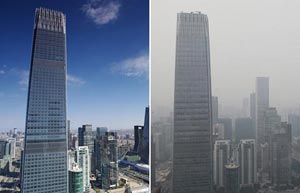
As the smog problem in Beijing continues, though less intense than last winter, companies like Coca Cola China are offering "pollution hazard pay" to expatriates in the city. Such extra pay highlights the perceived problems of living in Beijing that include pollution, traffic and food safety.
These problems are worrying, but some byproducts of China's industrialization process. Hopefully, China will address the problems by enforcing laws and regulations, raising public awareness about environmental protection, educating people about the importance of a healthy diet, and cultivating a culture of sustainable development.
But strange as it may sound, some issues are evolving into opportunities. For example, China's notoriety in food safety sensitizes people toward food sources, though such awareness is dearly bought. In the United States, people do not always read the fine print, including cautionary notes, on food labels because food safety is taken for granted thanks to the Food and Drug Administration. I don't know which is worse, assuming all food is unsafe until proven safe (as in China) or assuming all food is safe until you hear on National Public Radio (in the US) that there is a recall for certain contaminated food products.
Giving expats a bonus for enduring living conditions in a city would be an affront to local employees, as McKinsey Asia Chairman Gordon Orr wrote in one of his recent blog posts. In addition, there are plenty of "perks" for living in Beijing or other cities in China, which would make it unnecessary to offer extra incentives. Here are a few:
China is still a land of opportunities with a steady influx of international workers. It is doubtful that any of them came with a "hazard pay" dangling in front of them. Money made in China, in yuan, has the potential of appreciating. By the time an expat leaves in a few years, his or her savings in yuan will exchange into more dollars or euros. When I left China a decade ago, 8.3 yuan fetched you one US dollar; today only 6.2 yuan can do that. Coupled with financial benefits is the relative low cost of living.
Getting around in China is affordable and easy. Public transportation is developing at a shocking speed. The high-speed trains are highly impressive and have made travel in the country very easy. A high-speed train ride from Beijing to Shanghai takes about 5 hours, often less than flights that require security checks, layovers and stressful rides to and from the airport.
This is a convenience I miss most in the US, where a family trip within the same state (such as Texas) may demand too much time - two to three days' drive if one goes to Houston from the northern part of Texas - or a lot of money for flying the whole family with no discount for children, 25 dollars for each checked-in bag, and no real meals other than small bags of pretzels or salted peanuts. High-speed trains are a boon in comparison.
China is also a rather safe place to work in. Though untoward incidents are reported at times, most big cities in China are fairly safe, even at night. More importantly, China is also a friendly place for expats. As an expat in China you get to learn a different culture, which is important to lead an interesting, enriched and productive life.
Living in Beijing is above all a career choice. Those who want to go will go anyway. Eventually, people are driven by their own motives to work in any place. Let the supply and demand of the job market do its work.
That being said, if companies want to offer hazard pay for pollution, by all means they are welcome to do so. Having some precedents may also open the door to living in other "hazardous" places. In the US state of Kansas, for example, employees should be compensated for living with tornado hazards; in Texas for hails, in California for earthquakes, in New York bitter winters, and in other states for one or all of the above. In the old days this was called choosing your poison.
The author is a US-based instructional designer, literary translator and columnist writing on cross-cultural issues.
 |
 |
| Top 10 cities with worst smog in China |

Copyright 1995 - . All rights reserved. The content (including but not limited to text, photo, multimedia information, etc) published in this site belongs to China Daily Information Co (CDIC). Without written authorization from CDIC, such content shall not be republished or used in any form. Note: Browsers with 1024*768 or higher resolution are suggested for this site.
License for publishing multimedia online 0108263 Registration Number: 20100000002731