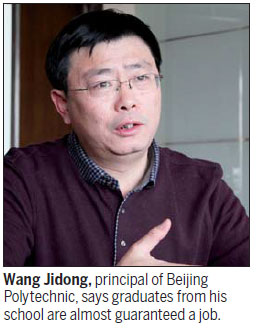
The principal and senior lecturer, Wang Jidong, says over a three-year course in the automotive school, students learn general mechanical maintenance or specialized manufacturing skills with company-specific equipment.
At 6,000 yuan (about $1,000, 700 euros) per year for tuition, the fee is roughly the same for a university degree.
Wang says the difference between the types of learning institutions is that while university graduates (with an average starting wage in Beijing of 4,746 yuan) will likely earn more, vocational school graduates are almost guaranteed a job.
"Across the board, more than 90 percent of vocational school graduates in China find a job relating to their major," he says. "Even when times are hard, 80 percent find a job."
About 60 of the students are currently training to work for Mercedes Benz. Provided they pass their exams, they will all have employment with the company in China, earning 1,800 yuan as an intern in the first year, and 3,500 yuan upon confirmation.
"Traditionally, Chinese think vocational schools are inferior to universities," says Wang. "But to turn into a high-end manufacturing nation, we need to cultivate our skills and talents. We need more vocational education if we are going to compete with Germany and Japan."
In a workshop classroom, Zhao Zhihao, 19, is learning basic lathe and turning work by getting his hands dirty.
"I'm happy with the salary I'll make after graduating," he says. "My teacher told me that after working for Mercedes Benz for a few years, I could become a senior mechanic, then an engineer."
His teacher, Ling Hong, chimes in.
"If you make chief engineer, your salary is as high as that of a vice-president of a company."
She says in many growth sectors, practical rather than academic skills will better serve young people seeking employment, especially with the sheer number of university graduates now flooding the jobs market.
"Having a university degree does not distinguish you from others," she says. "Students who graduate here have more advantages (in some sectors) than those that sometimes have two degrees."
Kam Wing Chan, professor and demographer with the University of Washington, agrees China needs more vocational training.
"As China's industry moves up the value chain, it will need a lot of technical workers," he says. "For those not going to college or even high school, and about half of China's children still do not make it to high school, they will need vocational training to be able to meet the demands of a modern economy."
Zeng Xiangquan, head of the school of human resources at Renmin University of China, says Premier Li and the government are right to be pushing vocational education reform.
"China is desperately in need of practical talents, since there's a shortage of skilled workers," he says. "For example, China can't do the welding when building an aircraft carrier, and it costs 600,000 yuan to train such a worker to do this in Germany. China is in need of skills more than science."
While Zeng strongly encourages vocational training for more students, he says over the long term, university graduates still have greater scope for better pay and advancement over the course of their career.
"Their lifetime income curves are different, which means that there's more upward mobility for graduates," he says.
The central government last year created about 13.1 million new jobs, and Premier Li has pledged to create at least another 10 million this year.
At the same time, in 2013 about 35 percent of the nation's record 6.99 million college and university graduates initially struggled to find jobs, according to survey released by Beijing data firm MyCOS.
There are jobs, but education needs to be more targeted to ensure student qualifications meet demand, Liu at Foxconn says.
He cites one example where a young university graduate tried for a position as a manufacturing worker with Foxconn, and was turned away.
"He had no advantage compared with the less-educated laborers," Liu says.
Foxconn employee Zhang Caixia, 21, began work with the company in Shenzhen two years ago after graduating from high school in Jiangxi province.
She now makes 2,500-3,800 yuan per month.
"I feel you can be successful without going to university," she says. "I don't think a degree matters that much, although if my work demands it, I'd think about getting one."
Xie Wenjia, Sun Xiaochen and Zhao Xinying contributed to the story.

Copyright 1995 - . All rights reserved. The content (including but not limited to text, photo, multimedia information, etc) published in this site belongs to China Daily Information Co (CDIC). Without written authorization from CDIC, such content shall not be republished or used in any form. Note: Browsers with 1024*768 or higher resolution are suggested for this site.
License for publishing multimedia online 0108263 Registration Number: 20100000002731