|
||
|
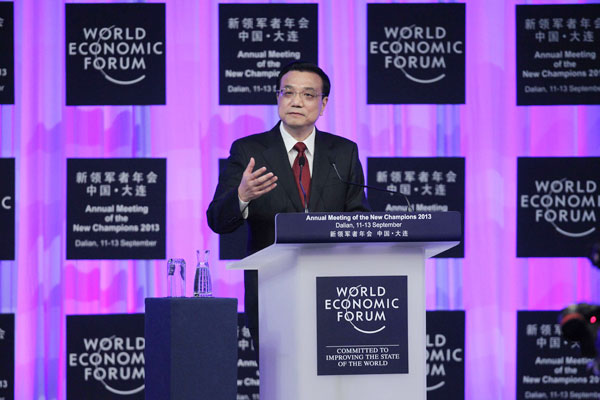
The vessel of China's economy will break waves Editor's note: China must push forward economic transformation and structural reform to achieve sustainable and healthy growth, Premier Li Keqiang said in a keynote speech (quotable quotes) at the opening ceremony of the World Economic Forum Annual Meeting of the New Champions 2013, or "Summer Davos", in Dalian, Liaoning province. China Daily reporters interviewed economists, experts and company executives home and abroad, who share their views on Li's speech and the Chinese economy.
|
||
|
In his passionate keynote speech, Premier Li used the unique platform of the Summer Davos Forum to address three major issues on China's role in the global economy: growth, innovation and global governance. Li underlines that the fast growth of the Chinese economy is a miracle in world economic history; even a sustained growth of 7 percent is still far higher than today's growth rates of other major economies; a slowing down of the Chinese economy appears only natural. China will remain the engine of the world economy. (Read more) -----Ulf Henning Richter Assistant professor at the Nottingham University Business School China |
||
|
Premier Li has been discussing innovation in a specific context. Premier Li assured the world on China's determination to adopt and continue innovative policies to pursue steady and smooth economic growth. We will see innovation in transforming the government function from centralized to become more localized aiming to stimulate the creativity of market players. In the market economy, markets should continue to play a leading role but are regulated to some extent by government in order to correct market failures or to promote social welfare. The decentralization or transformation of government function should serve the needs of the market in order to truly improve government efficiency, eventually to achieve a streamlined administration and optimized government functions. Innovation in opening up China wide to the world is also on Premier Li's agenda, more specific examples are to steadily opening up the financial market, railway, and telecommunication market to the world. The Shanghai free trade zone is a solid evidence of China's determination of gradually opening up China wide to the world. (Read more) -----Qingfeng Wang Scholar at the Nottingham University Business School China |
||
|
It is clear Premier Li wants the market to take more responsibility. He wants to give more freedom to the market participants and less to the government. If he is successful in doing that, to allow the market and businesses to be more innovative, more entrepreneurial, then the result could create more opportunities. There are still opportunities (in China's economy), some in rural areas. In the last 30 years, China spent a lot of resources on the coastal cities, in the tier-1 cities. But if you go to tier-3, tier-4 cities, they are still vastly underdeveloped. That, to me, presents opportunities. Second, China has a lot of opportunities in its services. I think China lacks good services. The way we do things is called broad-brush - it looks good from afar, but you look closer, you see cracks. We didn't pay sufficient attention to details in the last 30 years, likewise in services. That's why Chinese customers are never happy, because services are poor. To me, that's an area of frustration, but at the same time poses an area of opportunities. We can steer the economy toward providing better services, those that create employment, those that do not drive up inflation, and those that make people happy... With good services, they don’t just make people happy, they actually allow you to improve efficiency and productivity, which are definitely good for the economy. -----Johnson Chng Partner at A.T. Kearney, and managing partner at Greater China, A.T. Kearney |
||
|
In his presentation [at the WEF], Premier Li found a sensible balance between providing comfort about the ability of the Chinese economy to continue to grow and focusing on China’s broad structural reform agenda. I agree with Premier Li that China's macroeconomic fundamentals are sound enough to withstand shocks, deal with financial risks and continue to grow—not anymore at 10 percent per year, but at around 8 percent in the coming years, moderating to around 7 percent by 2020. Li rightly focuses, in his presentation and in his work on economic policy, on structural reforms. It is good to see that there seems to be a reasonable degree of consensus on how to move forward on financial and monetary reform. I hope that such a consensus can also be found on other essential reforms, such as institutional reforms to delineate more clearly the state and the market, leveling the playing field between SOEs and other companies and, to achieve the "new type of urbanization" that Prime Minister Li mentioned, fiscal reforms to give local governments the resources and incentives to provide public services to migrants. -----Louis Kuijs Chief China economist at RBS |
||
|
The premier's speech signals his determination to deepen structural reform. "The policy stance of Premier Li has been consistent, emphasizing restructuring, promoting transformation and stabilizing growth," Liu said. "This is the right choice, when compared with stimulus investment or easing monetary policy." -----Liu Yuanchun Associate dean of the School of Economics at Renmin University of China in Beijing |
||
|
The driving forces behind China's long-term growth will come from several areas. The government has decided to focus on upgrading industries and moving beyond manufacturing by boosting the role of consumption and the service industry, which will release "tremendous" opportunities. Due to urbanization, China will see 300 million more people moving into cities in the next 20 years, driving domestic demand across a broad spectrum of industries. "We are encouraged that the leadership is cutting down on red tape and making business easier," McKinstry said, adding that this practice, such as scrapping taxation on small businesses, will help promote entrepreneurship and growth. "In addition, the Chinese people's ingenuity and hard work will provide a strong workforce to support growth." -----Nancy McKinstry Chief executive officer of Wolters Kluwer in the Netherlands |
||
|
Li has reiterated on different occasions that the current growth pattern is unsustainable and that rebalancing is key. "Rebalancing from investment to consumption is an endeavor in the long run, after the process of industrialization is accomplished." By refocusing its industrial policy, China of course also risks to relocate its overcapacity problem just to more advanced sectors. "For that too, the decision makers in Beijing have already found as solution: more exports of manufactured goods." This entails a major push for free trade agreements, an effort to position Chinese companies favorably along the international supply chains, better branding, and to assist small and medium large companies to join the scramble for new markets. -----Jonathan Holslag Professor of international politics at Vrije Universiteit Brussel and a fellow at the Brussels Institute of Contemporary China Studies |
||
|
The nation should not worry about short-term growth, as the rebound will continue. She forecast that the economy will grow by 7.6 percent this year. "More growth potential will be released through urbanization and industrialization," Wang from UBS said. "But in the long run, the government will face pressure from production overcapacity and the increase in non-performing loans." ----Wang Tao Chief economist in China at UBS |
||
|
Li seeks to dispel international concern over China's growth prospects. He is confident regarding China's structural shift through reform, rather than pump-priming. Compared with Abenomics and Likonomics and you can find the differences. The essence of Abenomics is monetary and fiscal stimulus. Li, however, refrained from stimulus. Likonomics in essence is "economics of reform." Now the key is how to implement his vision. Shanghai's free-trade zone is a "shop window" to monitor China's future economic reform. You can imagine what will take place in China by observing Shanghai's pilot measures. ----Gary Liu Deputy executive director of the China Europe International Business School Lujiazui International Finance Research Centre |
||
|
I hope Premier Li will also confront the issue of how to move from a big production country to more high-end value chain. Invest more in R&D and innovation and develop more high-end products. This will of course create more competition for companies I represent. But this kind of competition is healthy and I think this is what China needs to do. ----Per K.Bakkerud Managing director of Haldor Tops?e, a Danish catalysis company |
||
|
"Premier Li's message of modernization through continued reform and further opening-up will have a profound impact on China's healthcare market –further driving innovation and more personalized products that deliver greater value for Chinese consumers. This economic effect will likely further be amplified where such innovation encourages the rapid adoption of technology. Cigna understands very well the close relationship between health and productivity – for this reason we believe that investing in a healthy workforce as a social good is the foundation for sustainable growth." ----Dr. Andrew G. Murray SVP of Strategy & Business Development, Asia Pacific & Middle East, Cigna |
||
|
Premier Li outlines a clear and pragmatic vision "It makes sense that Premier Li would offer hope that China will rebalance its economy, given the emphasis since the 18th Party Congress and the two sessions on sustained growth and reform. Specifically, China will have to rebalance away from inefficient investment-driven growth and move toward faster consumption rates. His speech sets the stage for major reform, particularly by fighting entrenched interests and inertia in local governments, State-owned enterprises, the export sector and even the financial system itself. The conference in Dalian allowed Li to reassure foreign investors and markets that China is sincerely committed to managing continued economic reform and growth." -----Jon Taylor Professor of political science at the University of St. Thomas in Houston, Texas |
||
|
Premier Li outlines a clear and pragmatic vision for sustaining economic growth and addressing the massive and complex social and economic issues confronting China. The Bay Area Council is proud to be partnering with China on expanding trade, investment and economic cooperation between our two countries and, as Premier Li describes, exploring "new ways to open China to the outside world." -----Del Christensen Chief of Global Business Development, Bay Area Council |
||
|
China skeptics have again talked about the "China Crash" syndrome. They have expressed economic growth in China is unbalanced. They are concerned over excessive debt and related fears of a fragile financial sector; property bubble collapsing; and the presumed lack of progress on economic rebalancing. As the world's second-largest economy, the sustainability of China's economic growth is a key element of global growth. China is committed to rebalancing its economy because the old China model of producer-biased growth model is no longer sustainable. China is facing the crucial stage of transformation. The challenge for China is an increasingly greater role to market forces through continued liberalization and reduced government involvement. The government recognized these challenges and has outlined many of these reform directions and policy objectives in recent announcements. Many studies have suggested the new critical mass of reform measures on further restructuring the Chinese economy is already taking place. The fundamental factors on underpinning growth and rebalancing in China will remain supportive and help mitigate the costs of the old model of high investment. What China needs is specific policy measures, and timely and focused implementation. It is imperative for China to continue with these reform policies to ensure greater economic and social stability. These measures would strengthen China's integration into the global economy with major implications both for China and for the world. -----Stanley Kwong Managing director/term professor, China Business Programs, School of Management, University of San Francisco |
||
|
The centerpiece of Premier Li's reform is to define boundaries between markets and government. The government will withdraw from certain areas where market and society can be of greater benefit. Li's governing philosophy should not be summarized by "short-term policies", such as de-leveraging and refraining from large-scale stimulus. -----Tang Jianwei Senior manager at Bank of Communication |
||