Comments
  Print
Print  Mail
Mail  Large Medium Small
Cao Wei, 34, feels lucky to have his son's company.
His 7-year-old son always does his homework in the lobby of the building where his father works as a gatekeeper since the 8-sq-m basement is too small for a desk.
High housing prices in Beijing dwarf his and his wife's income, about 3,500 yuan ($563) per month.
"I don't expect to buy an apartment in Beijing, but we don't want to move back either. We plan to live in Zhengzhou (capital city of Central China's Henan province) after my son goes to college. I have two sisters there," Cao said.
His son goes to a public primary school nearby, but Cao wonders if the capital city will relax its education policy to allow his son to attend the university entrance exam.
China has about 200 million migrant workers and most of them, like Cao, were born in the late 1970s or the 1980s. With little or no farming experience, they have no plans to return to rural life.
Urbanization has been highlighted by China's new leadership as a driving force for economic development.
Many believe enabling migrant workers and their families to settle down and live full city lives is the most urgent priority for promoting urbanization.
Premier Li Keqiang once stressed that "people are the core issue of urbanization".
Feng Kui, a researcher at the China Center for Urban Development under the National Development and Reform Commission, said it mainly refers to the urbanization of migrant workers.
The commission and some other ministries are working on mapping out a national plan to promote the country's urbanization.
Media previously touted urbanization will push for about 40 trillion yuan ($6.45 trillion) investment in the coming 10 years.
"Urbanization will promote productive investment, boost consumption and the real estate industry, but it should be market-led investment with guidance from the government," said Feng.
Major investors will be private and foreign enterprises and individuals, instead of the central and local governments, he said.
From an economic perspective, the demand unleashed from the acceleration of urbanization will be enormous and the identity transfer of the migrant workers will boost internal demand.
An urban dweller consumes as much as three times that of a person in a rural area.
But the significance to society, "putting people first", is more important, said Feng.
Migrant workers don't have a hukou (household registration), which also prohibits them and their children from access to social welfare like medical care, pensions and education.
"The unequal and unfair treatment, caused by the household registration system, should no longer be tolerated," Feng said.
A detailed action plan should be put in place as soon as possible, said Feng.
Creating more jobs for migrant workers and helping them merge into city life will be one of the most vital parts of urbanization.
China's rate of urbanization passed 50 percent in 2011. Urban residents accounted for 51.27 percent of the population in 2011, up 1.32 percentage points from 2010.
Experts involved in the drafting said China's first national plan for promoting urbanization may be launched in the middle of the year, with supporting measures to be announced in the second half of the year, and that will help boost domestic demand and infrastructure investment, and form more city clusters.
Apart from the NDRC, about 10 central government departments such as the Ministry of Housing and Urban-Rural Development and Ministry of Human Resources and Social Security all got involved in the issue, said sources.
Led by Xu Xianping, vice- minister of the NDRC, a research group made up of officials from these ministries conducted a special investigation on how to transfer migrant workers into urban dwellers in Shanghai, Jiangsu, Zhejiang, Anhui and Guangdong.
The Yangtze River Delta attracted about 44.9 million migrant workers and Guangdong province has about 26.7 million migrant workers.
In 2010, about 72 percent of migrant workers in Guangdong were below 30 years of age, and about 74 percent only have an education level of junior high school or below.
The situation in the Yangtze River Delta is almost the same, about 70 percent with an education level of junior high school or below.
Many cities have relaxed their household registration system, but the threshold remains high for most migrant workers. For instance, Yiwu, a city in Zhejiang province, has announced that migrant workers with an education level of senior high school and an average housing of 10 square meters in particular locations could settle down there, but the two standards rule out most migrant workers.
Yiwu has 1.5 million migrant workers, only one-tenth of them graduated from high schools and only a few of them could afford housing in the city, which has reached about 10,000 yuan per square meter.
Turning the migrant workers into city dwellers will take some time, Hou Yongzhi, head of the development of strategy and regional economy of the Development Research Center, the State Council's policy think tank, told China Daily.
"Some think the hukou system has hindered the move of transforming migrant workers into city dwellers. It's part of the reason. But the root of the issue lies in the insufficient capability of the government in providing public services," Hou said.
"The government must guide the flow of population and it can't be completely relaxed. If we allow labor to flow free at this stage, China may encounter the same situation faced by Latin America in their process of development," said Hou.
"China must explore its own way. One day China's urbanization rate may reach 75 percent, but it still has about 25 percent of its people in rural areas, which equals about 400 million people, more than the total population of the United States. So the structure of China's urbanization will be different," he said.
lanlan@chinadaily.com.cn
(China Daily 06/06/2013 page26)
 China Post issues stamps to celebrate Children's Day
 Live streaming boosts zongzi sales
 Big Data Expo opens
 Smart sharing washing machines available in Shanghai
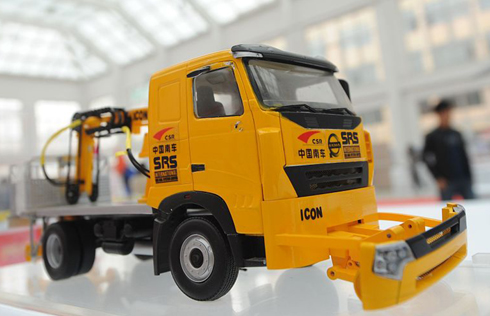 Innovative designs highlight industrial design week
 Smart tech to shake up delivery industry
 Chinese youths showcase innovative talents at tech competition
 Butterfly wings to inspire new solar power technology

Copyright 1995 - . All rights reserved. The content (including but not limited to text, photo, multimedia information, etc) published in this site belongs to China Daily Information Co (CDIC). Without written authorization from CDIC, such content shall not be republished or used in any form. Note: Browsers with 1024*768 or higher resolution are suggested for this site.
License for publishing multimedia online 0108263 Registration Number: 20100000002731