Comments
  Print
Print  Mail
Mail  Large Medium Small
Urbanization cannot do without industrial development. Or these people will end up jobless. That's the fourth issue I'm going to talk about. Let the industrial development lead the urbanization drive. In this way, our rural residents can find a job in the city. They are lured to a city by job vacancies created during industrial development, not just for the sake of becoming urban citizens or simply out of the blue. They need a job to live in the city. That's why we should develop industries in the first place. On the other hand, based on the situation in Ningxia, I think financing channels also matter a lot. Why so? You see, it's safe to say that a government-led model has been shaped in the urbanization drive. But the truth is, urban development needs a virtuous cycle. A well-functioning city with sound development should be market-oriented in the first place, while guided by the government. So I think we should figure out an appropriate financing model. Many people are actually working on it these days. Issuing the Quasi-municipal Bond, for example, may be a viable option. We should think outside of the box to seek a multi-channeled financing model. So, urbanization covers various issues including industrial development, financing model, and system adjustment. To be specific, I summarized five aspects, namely system, planning, management, industries, and financing. They all need to be "in place" for an orderly and virtuous urbanization model, in a bid to make cities more livable. That's what we call "a good urbanization model", which can avoid problems that have popped up in other countries worldwide. Some of these problems, of course, have already surfaced in China's urbanization drive. An example which I'm sure you know is that cities in China have ended up in the same pattern. From a birds' eye view, it's pretty difficult to tell a city from another because they have no uniqueness. You have a strong sense of déjà vu even when in a different city. Meanwhile, if you want to travel or attend a business meeting or stuff like that, it makes no difference that you choose a city over another. So I think we really should make a change. Urban planning should be different from city to city. And that's where the big draw comes from. If a city is not much different from another, you will be disappointed to have that déjà vu like "I've seen this before" or "why should I be here in the first place?" Such uniformity is not what we want. So I think we should take it seriously.
Besides, some cities have been intentionally over-developed.
Urbanization has a natural process, which includes the voluntariness of the migrants and the absorptive capability of the city. I think the key to urbanization development is to not apply too much artificial power during the urbanization process.
However, to some extent, it is right for government to play a guiding role and it is also important for the government to implement policies to develop infrastructures. But we can not intentionally exaggerate the government's behaviors and obsessively transform rural residents to urban residents. I think this is also an eye-catching issue during our urbanization process.
Another issue that I think we have to pay attention during urbanization is the development of public services. Such as the education dilemma of migrant workers' children in cities. People are arguing about this, why has this pop up to be a problem?
It is the imparity of the education system that leads to this issue.
By right, the kids are coming to cities by following their parents, and their parents work in cities and join as members of the industry workers' group. Then their children are supposed to go to school like what normal city children do.
But why are they being treated in different ways?
Some policies, like the household registration system, have stirred this issue. So we have to improve the public services to lighten rural residents' pressure.
 China Post issues stamps to celebrate Children's Day
 Live streaming boosts zongzi sales
 Big Data Expo opens
 Smart sharing washing machines available in Shanghai
 Innovative designs highlight industrial design week
 Smart tech to shake up delivery industry
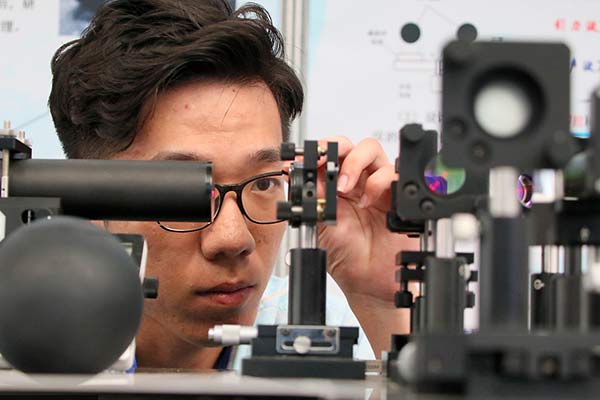 Chinese youths showcase innovative talents at tech competition
 Butterfly wings to inspire new solar power technology

Copyright 1995 - . All rights reserved. The content (including but not limited to text, photo, multimedia information, etc) published in this site belongs to China Daily Information Co (CDIC). Without written authorization from CDIC, such content shall not be republished or used in any form. Note: Browsers with 1024*768 or higher resolution are suggested for this site.
License for publishing multimedia online 0108263 Registration Number: 20100000002731