Comments
  Print
Print  Mail
Mail  Large Medium Small
|
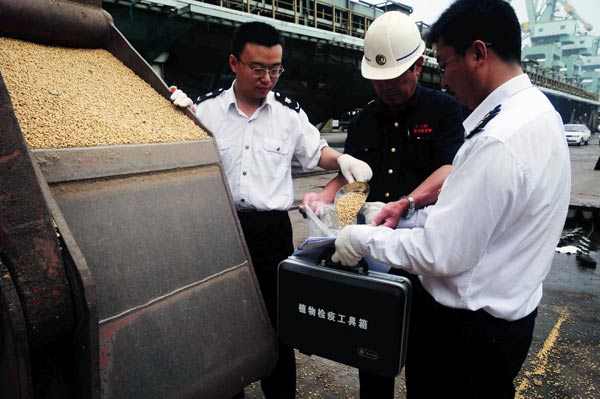 The quarantine officers inspect imported soybeans in Rizhao, Shandong province. China's edible oil imports also rose 9 percent year-on-year to 5.98 million tons in the first three quarters of 2013. [Photo / China Daily]
|
United States soybean exporters are boosting sales to China's edible oil and feed market as many Chinese companies have turned to cheaper US soybeans in the past three months while avoiding potential shipping delays from South America.
China had bought 26 million metric tons of soybeans from the US as of Tuesday for the 2013-14 market year (September 2013 to August 2014).

The orders, mainly from September through December, were about 4.5 million tons higher than China's soybean imports from the US for the entire 2012-13 market year, the US Soybean Export Council said Tuesday.
Jim Sutter, CEO of the council, said attractive US soybean and shipping prices over the past three months have encouraged feed and edible oil companies such as Yihai Kerry, Cargill Investment (China) Ltd and China National Cereals, Oils and Foodstuffs Corp to whet their appetite for US soybeans this year.
"Even though the South American market has entered its soybean-selling season, it is still facing logistics difficulties to deliver soybeans. This has formed a big concern for Chinese companies looking to import their soybeans," Sutter said.
The US soybean price was around $641 per metric ton on landed basis in the last marketing year, and now it is about 10 percent lower than the same period last market year.
Soybeans are widely used in China for cooking oil and animal feed. China's soybean imports rose by 11.2 percent to 58.4 million tons in 2012 from a year earlier, according to the General Administration of Customs.
"China's rising demand for soybeans is mainly driven by a change in people's dietary habits. They have shifted away from having mostly grains on their plates to having more oil and meat," said Shen Guiyin, deputy director of the research center of rural economy of China's Ministry of Agriculture.
Kevin Hoyer, vice-president of the American Soybean Association, said food consumption is a reflection of economic success. The most obvious is China's fast modernization pace of livestock and the food supply chain.
"The demand for soybean meals, edible oil, and soybean-based fish and hog feed will provide many opportunities for the US soybean exports. We have seen lots of potential in these sectors," Hoyer said.
China's edible oil imports also rose 9 percent year-on-year to 5.98 million tons in the first three quarters of 2013, according to the General Administration of Customs, which indicates the country's widening gap in edible oil supply and its increasing dependence on the world market for soybean and oil consumption.
Each Chinese resident consumed an average of 18.5 kg of edible oil in 2012, compared with 11 kg in 2001. Pushed by the fast pace of urbanization, the China National Grain and Oils Information Center forecast that this figure is expected to rise to 23 kg between 2017 and 2022.
Zhang Xiaoping, director for China at the US Soybean Export Council, said it is difficult to increase China's soybean output within a short period because farmers in the Northeast cannot get more land or convert land grown for other yields such as corn and rice. With rising farming equipment prices and limited arable land, the cost of raising domestic output is fairly high.
"Restricted by the disparity of weather and climate conditions, Chinese farmers are having a hard time converting existing crops to soybean fields in other parts of the country. Therefore, China is importing soybeans from the US and South America, where the cost of growing soybeans is lower," Zhang said.
Chinese farmers currently plant non-genetically modified varieties, and their per-hectare production is about half that of the genetically modified ones grown in the US, Brazil and Argentina. In the meantime, domestically grown beans produce less oil than imported ones.
Soybeans are grown in 29 states in the US, where about 55 percent of its soybean production is exported. Biotech soybean production accounted for 94 percent of 30 million hectares in 2012. In the meantime, non-biotech soybeans are grown primarily for the food export markets at a premium cost.
 China's industrial production growth softens in Nov

Copyright 1995 - . All rights reserved. The content (including but not limited to text, photo, multimedia information, etc) published in this site belongs to China Daily Information Co (CDIC). Without written authorization from CDIC, such content shall not be republished or used in any form. Note: Browsers with 1024*768 or higher resolution are suggested for this site.
License for publishing multimedia online 0108263 Registration Number: 20100000002731