Comments
  Print
Print  Mail
Mail  Large Medium Small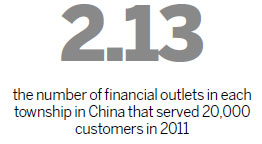
There is a need to explore ways to use innovative technology to leapfrog traditional barriers to bringing formal financial services to China's large under-banked population.
Despite the huge strides made in China to socially and economically include citizens and lift them out of poverty, roughly 36 percent of China's population remains underserved by formal financial institutions, according to a 2011 World Bank study.
Many of these people do not have a bank account at a formal financial institution. While 36 percent may not sound like much, data from the National Bureau of Statistics in China indicate that it represented 485 million people of the Chinese mainland population in 2011, which is larger than the populations of the United States and Russia combined.
A primary reason that people - in China and worldwide - remain financially underserved is because it's difficult for financial institutions to provide services such as bank branches in a business-sustainable way to remote and rural villages and towns.
Such populations miss out on the benefits of basic financial services, such as the ability to save and protect their money, use payment services and acquire credit and insurance. They also miss out on the security, reliability and convenience of electronic payments, such as credit, debit and prepaid cards that are linked to bank accounts.
They are left to conduct their day-to-day activities in cash.
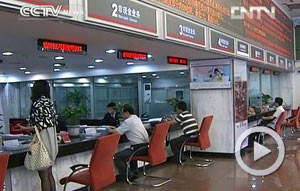
As of the end of last year, 47 percent of Chinese residents lived in rural regions. Chinese statistics for 2011 show that, on average, there were merely 2.13 financial outlets in each township in China that served an astounding 20,000 customers, reflecting a sharp contrast in the supply of and demand for affordable financial services.
This isn't something that's unique to China. A 2010 Financial Access Initiative report estimates that 2.5 billion people - nearly one-third of the world's population - do not have an account at a formal financial institution and rely strictly on cash for living.
More problematic, 2010 research from Barclays Global Intelligence Series indicates that not having access to formal financial services reinforces the cycle of poverty.
But the advent of mobile technology has enabled new branchless banking solutions that can provide affordable services to the unbanked (economists call this "financial inclusion") in areas traditional financial services have yet to penetrate.
As mobile use continues to rise, branchless banking solutions that use mobile money have emerged as a way to extend secure, convenient and affordable financial services to people outside the traditional banking system.
Financial inclusion can bring many benefits, such as an ability to save, send, receive and borrow money securely, conveniently and reliably without having to travel long distances or use intermediaries.
Mobile money programs free people from having to carry and safeguard large amounts of cash, which can be lost or stolen, and can also give people access to credit, which can allow them the ability to invest in a farm, small business, education and other services for themselves and their families.
Mobile money offers a fast, simple, convenient, secure and affordable way of transferring money using a mobile phone. Instead of receiving cash, money is transferred electronically from one mobile account, backed by a mobile network operator and a financial institution, to another. The funds are stored on a password-protected mobile phone.
The funds can be used to buy goods and services at a store, or can be transferred to another person who also has a mobile money account. Mobile money funds can also be withdrawn for cash as needed, a little like visiting an ATM in other parts of the world.
China is poised to reap the benefits of mobile money solutions. The Ministry of Industry and Information Technology reported that as of the end of November 2012, there were more than 1.1 billion mobile phone users in the country - 82 percent of the population.
The penetration rate of mobile phones in rural China keeps increasing. By the end of 2010, the rate reached 90 percent, based on a 2011 survey by Ericsson called Communications of Rural Consumers.
Such conditions establish a favorable environment to reach China's under-banked, noted Hannes Van Rensburg, founder and chief executive officer of Fundamo, a Visa company, in a speech at the Rural Mobile Payment Forum earlier this week.
As part of Visa and one of the leading mobile money financial service platforms in the world, Fundamo helps to bring secure financial services to rural and developing parts of the world. Such services are being rolled out in other nations where there's high penetration of mobile phones, but a great number of people with little or no access to bank accounts.
For example, in Indonesia, local Bank Andara is using Fundamo's technology to extend access to micro-credits to people in remote areas through mobile phones.
In Nigeria, where 70 percent of the population does not have an account at a formal financial institution, according to 2011 World Bank data, the First Bank of Nigeria is using Fundamo's technology to offer FirstMonie, a cross-network mobile money service that gives millions of Nigerians the ability to send and receive money using their mobile phones to others on different mobile networks.
And in more than 10 countries in Africa, Fundamo's platform is powering mobile money programs by MTN, one of the largest mobile network operators on the continent. In Uganda, MTN Mobile Money gives local fishermen a way to conveniently buy supplies and sell fish using only their mobile phones.
China has a tremendous opportunity to extend much-needed banking services to those in rural and remote areas and now we have the right technology and environment to achieve this. But for initiatives like these to be successful, local market conditions should allow for international companies to invest more and expand domestically.
Such services not only have the power to transform daily life, but also spur economic growth as new payment products and services offer secure, convenient and reliable ways to store, protect and use funds and reduce shadow-market activity.
The author is Country Manager, Visa China.
Copyright 1995 - . All rights reserved. The content (including but not limited to text, photo, multimedia information, etc) published in this site belongs to China Daily Information Co (CDIC). Without written authorization from CDIC, such content shall not be republished or used in any form. Note: Browsers with 1024*768 or higher resolution are suggested for this site.
License for publishing multimedia online Registration Number: 20100000002731