Economy improving in China's west region


Lack of innovation and scientific structure still issues of concern
China's western region has become a growth engine for the country's slowing economy, but experts warn it has an unscientific industrial structure and a shortage of innovation.
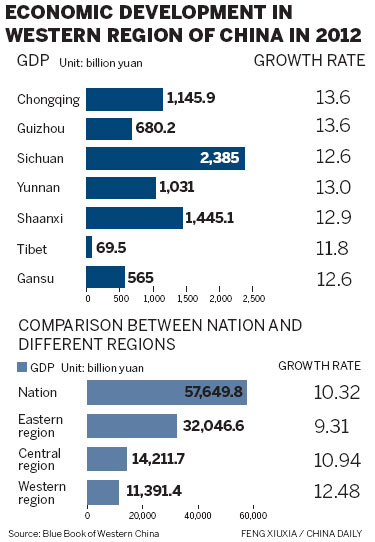
In 2012, the region's gross domestic product increased by 12.48 percent year-on-year, much faster than in the eastern and central parts of the country and 2.16 percent more than the national average, according to a report on the development of the western region released on Sunday.
The report also said the GDP of the western region accounted for 19.75 percent of the nation's total, an increase of 0.38 percent from a year earlier, helping the region further narrow its gap with the eastern region in economic development.
Experts warned, however, that despite achievements in the region's economic growth and improvements in local education, environment and people's livelihoods after more than 10 years' of development, the region is still relatively undeveloped .
"The unreasonable industrial structure, shortage of innovation and international talent and a lower level of marketing are major problems that need to be solved soon," said Yao Huiqin, deputy director of the Center for Studies of China's Western Economic Development at Northeast University.
Yao said the western region is still in an accelerating period of industrialization. Compared with the eastern and central regions, the economy of the west is still highly dependent on investment rather than updated technology and improvements in market competition.
"Secondary industries - such as mining, power, manufacturing and construction - still account for more than half of the GDP of the west, while the development of the service industries remains limited at 36.5 percent," she said.
Chen Dongsheng, director of China Regional Economics Studies, is also concerned at the simple mode of development.
"The current development mode of most of the cities in the western region is either copying the experience of the eastern region or repeating similar projects. Once the investment decreases or slows, the economy of the western region will be in danger," said Chen.
"So far, many governments of western regions are burdened with debts and with huge regional financial risk because of excess capacity in several industries. Take the real estate industry for instance: A real estate bubble has already emerged in several second- and third-tier cities in the west, which rang alarm bells for the rest of the cities that bet on real estate as a development engine."
He warned that cities should heed the lesson and take the necessary measures to control the speed of development to prevent financial difficulties.
With the complicated international and domestic economic situations, the method by which the central government supports the development of the western region may also change. In the long run, the western region needs to rely on self-development to cultivate sustainable industries and attract professionals, he added.
Zhang Junkuo, vice-director of the Development Research Center for the State Council, said the central government should give the western region preferential policies to help it become part of the international economy and encourage investment in the region.
China launched the Western Development Strategy in 2000 to help the western half of China catch up with the east.
The strategy covers: Gansu, Guizhou, Qinghai, Shaanxi, Sichuan, and Yunnan provinces; the Guangxi, Inner Mongolia, Ningxia, Tibet, and Xinjiang autonomous regions; and Chongqing. The region accounts for 71.4 percent of mainland China's area, but only 28.8 percent of its population.
- DHL setting its sights on China's western regions
- Clean water plan for schools in western regions
- Promoting FDI in central, western regions is priority
- Western regions expected to be pillar of recovery
- Spike in land abuse cases in China's western regions
- Western region's economy growing faster
- Ningxia blazes trail for opening-up of western region
- CSRC aims to boost listings from western region