Comments
  Print
Print  Mail
Mail  Large Medium Small
China should set different energy-reduction targets for regions with different energy intensity, a report by the International Low-carbon Economy Institute said on Friday.
"China has made a commitment to reduce energy consumption per unit of GDP by 16 percent by the end of 2015. But it is not fair to ask different provinces to commit to the same target," said Zhao Zhongxiu, director of the ILEI, which was jointly established by the University of International Business and Economics in Beijing and the University of Nagoya in Japan.
To set a reasonable target for various provinces, the report considered regional responsibility and reduction potential.

The former is decided mainly by each region's total energy consumption, and the latter is gauged by the region's current energy consumption per unit of GDP, energy consumption per unit of industrial output, and its energy structure.
During the 11th Five-Year Plan (2006-10), energy reduction targets were set by each province, and the central government then negotiated the target with each province.
The central government would lower the target if it did not consider it to be realistic, or raise it if it thought it was not ambitious enough.
The report classified the 31 regions in the Chinese mainland into five categories, each with a corresponding obligation.
The top category, including Beijing, Tianjin, Shanghai, Jiangsu, Shandong, Guangdong and Zhejiang, all developed regions, should set 18 percent energy reduction targets by the end of 2015; the second category, including Hebei, Shanxi, Inner Mongolia autonomous region, Henan and Liaoning, all resource rich or energy intensive regions, should cut energy consumption by 17 percent by the end of 2015, the report suggested.
For developed regions, energy consumption reduction should mainly rely on adjusting the economic structure by raising the share of service industries and enhancing the added value of traditional sectors.
For resource rich and energy intensive regions, as energy intensive industries are expected to account for the majority of their economy in the long term, the main objective is to improve energy efficiency through technological upgrading.
Even so, experts admitted the enormous difficulty of meeting the energy reduction commitment.
Bai Quan, a researcher with the Energy Research Institute under the National Development and Reform Commission, and a co-author of the report, said that in order to meet the 16 percent reduction target, China must reduce its energy consumption per unit of GDP by 3.5 percent annually between 2011 and 2015.
But in 2011, China cut energy consumption per unit of GDP by 2.01 percent and in 2012 by 3.6 percent. This means that in the following three years, annual reductions of at least 3.84 percent must take place to realize the final target, which is a severe challenge.
In 2009, China pledged to reduce its carbon emissions by 40 to 45 percent by 2020, and increase the share of renewable energy to 15 percent of total energy consumption.
Provincial-level governments also have difficulties in breaking down the target at the sub-provincial and county levels, and for different economic sectors, experts said.
"In practice, it will be very difficult to distribute the target fairly. For example, a county in Henan province consumes huge amount of coal because a major State-owned power plant is located there.
Xiao Xuanwei, a researcher with the Development Research Center under the State Council said, "in theory it should share a corresponding energy reduction responsibility. But it may argue that it only consumes a small share of the electricity and a majority is consumed by other regions."
The report also cautioned that it may takes 20 to 30 years for China, the world's largest carbon emitter, to have blue skies once again.
 HK's new cruise terminal receives luxury liner
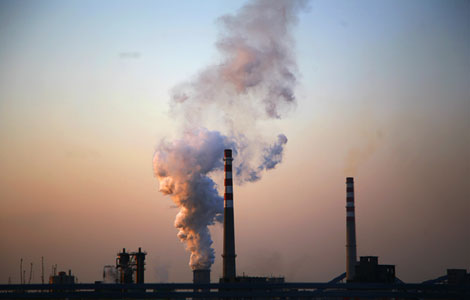 Future points to carbon trading
 Seafood businesses flounder amid spending cut
 Equities slump amid slow-growth estimates
 Auto show opens with much fanfare in Xi'an
 Sunnylands summit fuels Chinese tourism interest
 'Palace on wheels' on sale for $3.13m in Dubai
 Fortune smiles on Chengdu as forum concludes
Copyright 1995 - . All rights reserved. The content (including but not limited to text, photo, multimedia information, etc) published in this site belongs to China Daily Information Co (CDIC). Without written authorization from CDIC, such content shall not be republished or used in any form. Note: Browsers with 1024*768 or higher resolution are suggested for this site.
License for publishing multimedia online 0108263 Registration Number: 20100000002731