Surplus workers in rural areas will be 'zero' this year


|
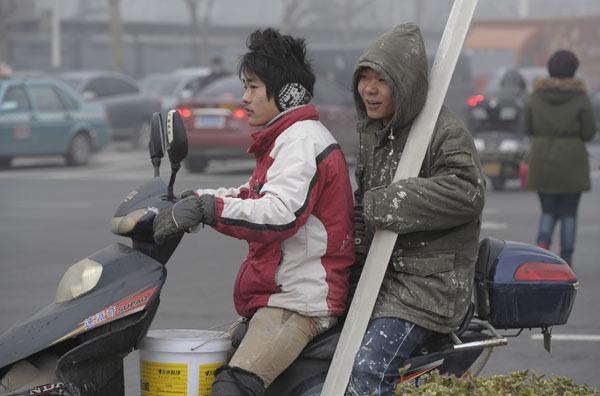 Two migrant workers at a construction site in Nanjing, Jiangsu province. According to Zeng Xiangquan, dean of the School of Labor and Human Resources at Renmin University of China, three phenomena will become "normal" in coming years in China: Enterprises will find it increasingly difficult to hire people, wages will continue to rise and there will be a growing mismatch of job seekers' skills and employers' demands. [Photo/Provided to China Daily]
|
China's surplus labor from rural areas is projected to drop to zero in 2013, an expert who has participated in a World Bank report told China Daily.
The projection followed a statement from the National Bureau of Statistics in January that last year the nation's workforce fell by 3.45 million to reach 937 million, the first time that the absolute number of China's working-age population has declined.
The timing was also three years earlier than the World Bank had previously expected.
Zeng Xiangquan, dean of the School of Labor and Human Resources with Renmin University of China, said his study, as a part of the Word Bank project, suggested that China's rural surplus labor would shrink to zero in 2013, leaving no extra labor for cities.
The continuous flow of cheap labor into the cities is a major force that drove the nation's rapid economic growth in the past three decades.
"The China Institute of Employment Research Index declined sharply from 2.6 in 2008 to 0.69 by the end of 2012. The index is extremely low in some particular areas, such as babysitters, which is as low as 0.2," said Zeng.
The CIER Index, released by Renmin University of China, is the ratio of number of job seekers to the number of jobs available. The higher the ratio is, the more competitive the jobs are.
The result, according to Zeng, is three phenomena will become "normal" in coming years: Enterprises will find it increasingly difficult to hire people, wages will continue to rise and there will be a growing mismatch of job seekers' skills and employers' demands.
"These phenomena will not be temporary but permanent," Zeng warned.
A distinct feature of China's labor shortage is that what it is really short of is young workers. Their numbers started shrinking in 2006, said Zeng.
A low fertility rate and rising tertiary education attendance are major reasons for the decline of young rural people joining the labor market, Zeng said.
A large number of migrant workers in their 40s and 50s used to leave the cities as job opportunities became rarer for them.
But as younger workers become increasingly rare, many employers in the past few years have dropped the previous requirement that recruits should be less than 35 years old.
Many academics and policy consultants have called for an increase in the retirement age to negate the impact of the shrinking number of young workers. Dai Xianglong, the former national social security fund chairman, has suggested raising the retirement age gradually so that in 25 years China's retirement age for men will be raised to 65 years and for women 60.
At present, male employees in China's public sector have to retire at 60 and female employees have to retire at 55.
A survey by the National Bureau of Statistics showed the average age of China's migrant workers grew from 34 in 2008 to 36 currently. The percentage of workers more than 40 years old grew from 30 percent in 2008 to 38.3 percent in 2011.
Lu Ming, an economics professor with Shanghai Jiao Tong University, said what worries him most is that the latest round of wage increases is the result of insufficient labor supply, rather than the result of a rise in productivity.
"A healthy scenario is that people want to increase their salaries or find a more fulfilling job so they go to college and receive more training. This helps them to enhance their skills and improve their productivity," Lu said. "Currently that doesn't seem to be the case in China."
Zhu Haibin, chief China economist ar JPMorgan Chase, said that although China's labor pool has started to shrink, the number of people working in non-agriculture sectors still only accounted for 65 percent of the total labor force in 2011. The same figure in Japan reached 90 percent in the 1970s. This means that China's modern industries could still absorb a considerable amount of labor from the farming sector.
Zeng, also stressed that the prediction of a declining surplus of rural labor is based on the precondition that there is no technological advance in China's agricultural sector and that the free trade in rural land continues to be prohibited. If agricultural technology could advance and rural land become fully tradable, many more rural residents could be liberalized and move to cities, he said.
"Why is the free trading of rural land difficult to push forward? It is because the perception still lingers that land is farmers' lifeblood, their last resort," Zeng said. "But if they can get access to social security equal to that of urban residents, they can sell their land and move to cities with no worries."
But Li Xunlei, chief economist with Haitong Securities, said even if the free trading of rural land is allowed and the agriculture sector is modernized, it would be insufficient to address the income disparity between rural and urban areas.
"Land in rural areas, like the land in urban areas, has different prices in different locations. Once rural land becomes tradable, its price would fall. Only those living close to cities would benefit to any large degree," said Li.
He cited examples from developed countries such as Japan and the United States, where highly modernized agriculture failed to attract young people. The only way to improve the attraction of the countryside is by extensively subsidizing rural residents.
"The outstanding growth of China's industry is based on taking advantage of rural area's resources, including its labor and land. It is time for China's industry to repay the rural areas," Li said.