Strong marine economy to spur urbanization, modernization of coastal regions
As land resources dwindle and the world's population grows, the contradiction presented by human survival and development versus resources and the environment has become increasingly stark. The ocean is thus likely to become a more frequent source of resources.
As one of the largest developing countries, China has gradually stepped up the development of those resources. China has a sea area of about 3 million square kilometers, about one-third of its land area, other water bodies of 380,000 sq km and a coastline of about 18,000 km.
Since the country's reform and opening-up more than 30 years ago, the marine industry has grown rapidly. In 1979 it had turnover of 6.4 billion yuan ($1.03 billion; 790 million euros), it exceeded 1 trillion yuan for the first time in 2003 and jumped to nearly 3 trillion yuan in 2008. In 2011 it was worth 4.557 trillion yuan.
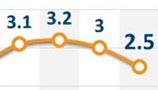
In 2011 the country's marine economy grew 16.1 percent, compared with GDP growth of 10.1 percent. In 2001 the marine economy contributed 8.58 percent to GDP; 10 years later the figure was 9.7 percent. It is clear, then, that the marine economy has become a new source of economic growth.
From the structural perspective, the number of major marine industries has risen to 13 from the initial seven, and the industrial structure has improved.
In 2003 primary industry still accounted for about 28 percent of the marine economy, secondary industry 29 percent and tertiary industry 43 percent. In 2011 primary industry accounted for 5 percent, secondary industry 48 percent and tertiary industry 47 percent.
Over the period of China's 11th Five-Year Plan (2006-10), major marine industries grew, and their output rose from 880 billion yuan to 1.55 trillion yuan, with annual average growth of 12.1 percent.
In all that, traditional marine industries maintained their rapid development. Output of marine fisheries grew 10.5 percent a year on average, marine transport grew 6.1 percent, shipbuilding 25.4 percent and the sea salt industry 25.4 percent.
The results in emerging marine industries were more spectacular: offshore oil and gas exploration, 14.3 percent; coastal tourism, 13.1 percent; marine engineering, 21.5 percent; marine chemical industry, 25.1 percent; marine biomedicine, 18.9 percent; marine mining, 50.7; percent; marine power, 44.8 percent; and seawater utilization, 24.1 percent.
From the perspective of regional economics, with the fast development of the eastern coastal area a coastal blue economic belt has formed from north to south. The three marine economic zones of the Bohai rim region, Yangtze River Delta and Pearl River Delta have become the engines for China's blue economy, accounting for 88 percent of the total.
The development of the marine economy has in turn driven local economic growth and urbanization, industrialization and modernization of the coastal region.
From the perspective of resources development and science and technology, the scale and strength to exploit marine resources continue to grow.
Last May the sixth-generation semi-submersible CNOOC 981 went into service in the South China Sea. It was the first independent deep-water oil drilling by a Chinese company, marking a substantial step in the country's deep-sea oil industry.
However, China's marine economic development still faces problems: the growth model needs to be changed, the issue of resource and environmental constraints needs to be tackled and mechanisms to ensure sustainable development need to be improved.
The government's determination to develop the marine economy means the sector is entering an important development stage and is becoming a new engine for economic restructuring.
Looking to 2020, China's strength in the marine sector will improve significantly, the way the industry is set up will have improved, the marine economy will enjoy more sustainable development, and it will further drive economic development of the coastal region. That all augurs well for China becoming a maritime power.
Han Limin is the associate dean of the Institute of Marine Development, Ocean University of China. Zhou Haixia is a researcher at the institute.


Copyright 1995 - . All rights reserved. The content (including but not limited to text, photo, multimedia information, etc) published in this site belongs to China Daily Information Co (CDIC). Without written authorization from CDIC, such content shall not be republished or used in any form. Note: Browsers with 1024*768 or higher resolution are suggested for this site.
License for publishing multimedia online 0108263 Registration Number: 130349