Welcome as it is, increased consumer spending is only one factor in a tricky economic balancing act
Chinese consumption is an important driver of economic growth, and an increasingly key source of sales and earnings for local and international businesses.
From a commercial point of view, selling goods and services to Chinese consumers is a top strategic goal. But from a macroeconomic standpoint, the dynamism of the Chinese consumer sector in the years ahead is a more nuanced phenomenon, linked closely to the complicated process of rebalancing China's economic model.
We do not know yet if the rebalancing will be well ordered and managed, or result in a more disruptive downturn in investment and credit that would also threaten household spending. How should we think about these contradictory perspectives?
Let's first look at the topic of consumer spending the way that businesses do. Since 1990, consumer spending in China has grown at an annual average real rate of 8 percent.
The average disposable income of Chinese households has gone up 10 times to a little more than $3,500 (2,648 euros), doubling between 1990 and 2000, and rising three to four times since 2000. That is about $10,000 for a family of three, where the child is of working age.
The consulting group McKinsey reckons that per capita disposable income will double again by 2020.
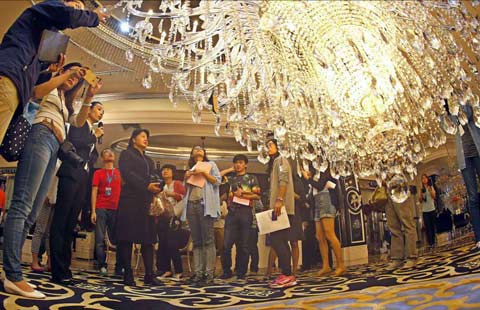
With rising incomes, urbanization and sophistication, discretionary expenditures on automobiles and other luxury goods, the cost of housing, transport and leisure has risen sharply. Luxury goods have been a particularly lucrative source of business for European and American producers, with many now deriving a third or more of their sales from China's consumers. This sector is undoubtedly a pointer to the way that Chinese consumption patterns will evolve in 2013 and for the next several years.
Discretionary spending, which accounts for about 40 percent of urban households' consumption, is widely expected to be the fastest growing component. Spending on clothing, healthcare, household goods and housing and utilities is expected to expand in line with income, while spending on food will grow more slowly.
Younger consumers already spend less on food and more on discretionary items than their elders and will be the key drivers of spending on luxury and communications goods, recreation, education and transport. But we should not overlook China's gray consumers, who will become an increasingly potent force.
China is already the fastest ageing country, and in the next several years we will see the numbers of over-65s increase, and China's working-age and youth populations plateau and then decline.
And we should not ignore the growing importance of some second and third-tier cities, which may triple their share of mainstream consumers to about 30 percent in the next decade.
But, as suggested earlier, there is another important, macroeconomic way to look at Chinese consumption prospects. Even though Chinese consumers have hardly been shy and retiring over the past 20 years, the growth in consumption has been consistently slower than the growth in GDP, whereas the increase in investment spending has been higher.
The cumulative effect has been to propel investment so that it now accounts for about 50 percent of GDP, compared with 40 percent in 2000. The share of consumption has fallen steadily over this period to around 35 percent of GDP. China's lowly consumption share is also exceeded significantly by other emerging countries, such as Malaysia, Indonesia, Brazil and Turkey.
The implications of this imbalance between consumption and investment are profound. It is worth noting that some analysts and commentators dispute these numbers, and a cottage industry has grown up to try and identify under-reported or mis-measured household consumption, especially as this applies to housing, social infrastructure spending and healthcare.
According to some estimates, China's consumption may be nearer to 53 percent than 35 percent of GDP. If that were true, there would be no need for rebalancing or changing the economic model and things could carry on blissfully as they are.
The reclassification of some investment spending as consumption is a good debating point for statisticians, and flatters the consumption data, but it is speculative, and does not really stand up to scrutiny.
The downtrend in the consumption share of GDP fits that of the share of wages and salaries in national income. And however you classify investment, it still has to be paid for as a substitute for current consumption. In practice, it has been financed increasingly by recourse to credit creation, and reports about the deteriorating investment returns, cash-flows and debt service capacity of local governments and other corporate borrowers reflect real concerns, not made-up stories. So we are back to rebalancing, and the question is what will happen to consumption and investment in the process?
Rebalancing is almost bound to result in slower economic growth - slower than the 7.5 to 8 percent rate to which the economy has returned momentarily. But if this growth rate persists, and investment spending growth slows from 15 percent to, say, 5 percent a year, consumption growth will have to accelerate from 8 percent to an unprecedented 12 percent per annum.
This seems very unlikely to happen, even though some important changes are underway. Since 2008, access to primary healthcare has improved significantly, especially in rural areas, and the government has introduced universal health insurance. Government pension schemes have been expanded and made more flexible for those changing jobs, and a major social housing program is underway.
On the other hand, the mechanisms that would transfer resources from the State and companies to households and allow consumer spending to strengthen further do not yet exist, and if they were created, they would doubtless have some negative consequences for the economy. For example, higher wages dent corporate profits and investment, and higher interest rates and a stronger exchange rate benefit consumers but damage the debt servicing and commercial prospects of state-owned enterprises and private companies.
The government would have to implement difficult political reforms to the financial sector to bring to an end artificially low borrowing costs for firms, and to the hukou system that restricts urban migrants' access to social benefits. It would have to reform the system of corporate governance to allow SOEs and other state entities to pay larger dividends to the government, which in turn could use the funds to boost household incomes.
It is certainly true that investment spending has been slowing down, allowing the contribution of consumer spending to GDP growth to rise to 57 percent in the first three quarters of 2012. This is an encouraging development, but it has occurred in the context of a slight weakening in aggregate consumption growth to 7.7 percent and a slowdown in overall GDP growth. And that is the point: rebalancing is happening, but not the way most people think.
At the turn of the year, the rundown in inventory investment appears to have ended and there is a new initiative to boost investment in rail and power networks. The rotation of Party officials in local governments, accompanying the leadership change, is liable to lead to an initial flurry of new investment projects. But these trends cannot persist without further aggravating the imbalances and misallocation of resources that now mar the Chinese economy. The bottom line is that the prices of land, water, energy, labor, money and capital have to rise to drive resources out of investment-heavy activities into consumer-heavy ones. This is not so much an economic, as a political reform agenda.
Extrapolating consumption trends, therefore, is now a questionable exercise. There are only so many workers who can transfer from rural areas to urban factories. You can only join the World Trade Organization once. There is a limit to how high the investment share of GDP can rise without bringing about a collapse in investment returns. Rapid population ageing is chipping away at Chinese growth potential. And the role of the government, state banks and SOEs is no longer appropriate for an economy that is becoming richer, more complex, and in need of greater competition and innovation.
There is little doubt that Chinese consumption growth will continue to impress, but the status quo of China's economic model threatens instability, and a structural shift in the model is liable to result in solid, but perhaps slower consumption growth than is widely expected.
George Magnus is an independent consulting economist, former chief economist at UBS, and author of The Age of Ageing, and Uprising: Will Emerging Countries Shape or Shake the World Economy?


Copyright 1995 - . All rights reserved. The content (including but not limited to text, photo, multimedia information, etc) published in this site belongs to China Daily Information Co (CDIC). Without written authorization from CDIC, such content shall not be republished or used in any form. Note: Browsers with 1024*768 or higher resolution are suggested for this site.
License for publishing multimedia online 0108263 Registration Number: 130349