China is the largest Internet market in the world and digital entertainment continues to grow exponentially, according to Spotlight on China, a report released by Ernst & Young on China's media and entertainment (M&E) industry.
"The largest M&E companies in the world certainly understand that their global strategy has to have China front and center because it has an extremely promising market with vast digital adoption," said David McGregor, Asia-Pacific media and entertainment leader for Ernst & Young.
|
 |
|
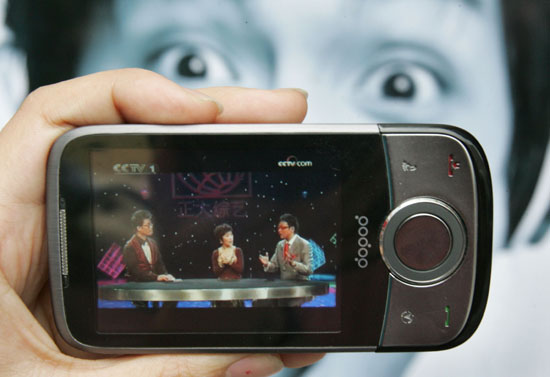
A man demostration a TV program broadcast via a smartphone. Digital media is revolutionizing the way the Chinese use the media and entertainment industry. [Photo/China Daily] |
Digital media is revolutionizing the way the Chinese use M&E. The rapid adoption of connected devices and wireless broadband access is driving fundamental shifts in how China's youth in particular use content.
China had 350 million online video viewers as of June 2012, more than half of whom used some form of social media.
"There are a lot of digital platforms introduced to provide Chinese people with entertainment experiences. It is a trend in the M&E industry in China," said Peter Chan, Greater China media and entertainment industry leader at Ernst & Young.
The report showed that the compound annual growth rate for China's M&E industry between 2010 and 2015 is estimated to be 17 percent, which is significantly higher than the overall forecasted economic growth of the country.
However, tough competition comes along with the rapid growth of digital media. As such, content providers need to differentiate their content and distributors need to focus on acquiring customers and then finding new ways to monetize them.
"Companies cannot underestimate the importance of culture in China because an understanding of the cultural nuances across geography, age and income level is essential to win the loyalty of Chinese customers," said Chan.
Advertisers are particularly eager to reach these digital adopters. By 2015, online advertising could comprise nearly one-third of the advertising market.
The 50 most valuable Chinese brands are the most progressive in terms of placing advertisements on all kinds of digital screens including mobile phones, personal computers and tablets, according to Millward Brown, a leading global research agency specializing in advertising, marketing communications, media and brand quality.
For content companies in the M&E industry, a digital strategy offers new monetization opportunities to penetrate the Chinese market.
About 76 percent of the top 50 brands used five or more media outlets for advertisement placements in 2011, up about 8 percent year-on-year.
"The first pioneers know multi-screens, like crabs, are tasty after the first bite. But the thing is, the number of crabs is limited," said Sean Shen, general manager of Mindshare, a global media and marketing services company.
Shen appears to be right based on the fact that five leading industries in terms of advertisement investment, including daily cosmetics, food and pharmaceuticals, have seen their budgets shrink. All the advertisers should make full use of every penny of investment at a time of economic slowdown, especially when daily necessity giants such as Procter and Gamble have seen their advertisement investments cut.
"Return on investment is a top priority. With effective integration of screens, brands will still be able to increase their recognition despite tighter budgets," said Tan Beiping, Greater China research and development director at Millward Brown.
There were at least 200 million smartphones in use in China last year, among which 60 million ran on Apple's iOS. The remainder were Android devices. It means that it only took one year for one-third of the 700 million Chinese mobile phone users to go "smart". It is predicted the number of mobile terminals will overtake that of personal computers by the end of 2013 or in early 2014.
"The number of mobile users in China is not as many (per capita) as that in Western countries, which means there is more room to expand the market in the country to get more people into the 'smart' world," said McGregor.
Shan Xiaolei, vice-president and general manager of the multi-terminal business department at PPTV Online TV, said: "The good thing is the mobile phone is good company, something that spends two-thirds of a day with you. Media that accompany people are more valuable to advertisers."
Video clips are now the best seller thanks to the prevalence of screens. According to statistics collected by the advertisement-monitoring platform of the third-party advertising technology company Miaozhen Systems in China, almost 60 percent of advertisement placements included online videos among all the 122 monitored brands from January to July, 30 percent of which resorted to online videos only.
"The budget for video advertisements for this year should include TV, reputation-building media, Internet video and everything related to video," said Chen Yan, chief strategy officer at Focus Media.
A possible trend is advertisements will be placed according to companies' target customers. According to research conducted by China's largest lifestyle-targeted interactive digital media network Focus Media Holding Ltd, the Internet has exerted the most influence on people between the ages of 20 and 25. For those between the ages of 25 and 45, mostly professional workers, outdoor advertisements reach them with higher frequency and better results. But the above two groups are hardly reached by television. People aged above 50 and 60 are the targets of television advertisements.
"Obviously China is a massive market - but not just one market - and a lot of growth will be driven by the tier two and tier three cities as they bring more new customers," said McGregor from Ernst & Young.
It is also seen as advisable that advertisers should further explore the market. "While competition for advertisement resources is intense in first-tier cities, opportunities are ample in second- and third-tier cities. For the key first- and second-tier cities, mobile Internet, reputation-building media as well as Internet TV have also presented opportunities to advertisers," said Zhu Wei, chief executive officer at Miaozhen Systems.
Contact the reporters at yuran@chinadaily.com.cn and shijing@chinadaily.com.cn
Online advertising in China:
China online advertising spending to surge
Web-video advertising revenues up 77.9% in Q3
International advertising companies would do well to learn from their Chinese counterparts
Tencent Q4 video advertising revenues up 70%
China's Internet advertising rakes in 14b in Q3

Copyright 1995 - . All rights reserved. The content (including but not limited to text, photo, multimedia information, etc) published in this site belongs to China Daily Information Co (CDIC). Without written authorization from CDIC, such content shall not be republished or used in any form. Note: Browsers with 1024*768 or higher resolution are suggested for this site.
License for publishing multimedia online 0108263 Registration Number: 130349