Comments
  Print
Print  Mail
Mail  Large Medium Small
While much of Europe and the US continue to be shrouded in a pall of economic gloom, China's progression appears largely unaffected. However, China's economic development is changing, with far more attention being given to domestic consumption and less to exports, which should lead to the emergence of world-class Chinese companies and brands over the next few years.
It is, therefore, extremely encouraging for the future of the Chinese economy to witness HTC, China's pioneering mobile technology provider, enter Interbrand's top 100 global brands for 2011.
Founded in 1997 by Cher Wang, chairwoman, HT Cho, director of the board and chairman of HTC Foundation, and Peter Chou, president and CEO, HTC has established an enviable reputation for innovation. Its name is associated with many of the most popular operator branded devices on the market.
HTC's continued expansion has been so rapid and impressive that it is well on the way to overtaking even the most recognizable Chinese companies such as Haier and Lenovo.
So how has HTC achieved such remarkable success over such a short time?
First of all, HTC has said from the outset its aim of becoming the world's leading, most innovative, supplier of mobile information and communications devices. In addition, HTC's mission involves commitment to developing a "value-adding" business culture with world-class manufacturing and service capabilities.
Of course any company could trot out something similar, but HTC has demonstrated that this is much more than empty rhetoric and that drive, ambition and, above all, self-belief are all integral to HTC's business culture.
Many smaller Chinese companies, with hopes of matching HTC's success, should learn from such a genuinely self-confident and determined approach. HTC does not fear international competition, but instead relishes the fight with unlimited commitment and dedication.
Mission statements can only be turned into something tangible and meaningful with an effective leadership team, but within such a team there is often one inspirational, charismatic individual who stands out most. At HTC that person would be John Wang, the chief marketing officer. He appears to be most responsible for HTC's success with his carefully designed strategy and, crucially, his brand building approach. It is also Wang who, primarily is behind HTC's global expansion.
One of his first initiatives was founding HTC's Magic Labs, an innovation center for creating market-ready, breakthrough products, tangible proof of his commitment to innovation and market orientation.
Surely a contributory factor behind his business success is his tertiary education, which includes an MBA from Harvard Business School and a bachelor's degree in electrical engineering from MIT. Wang, therefore, possesses both technical and business and management knowledge and skills that few business leaders can match.
China's business education, at the top end, has followed the approach taken at the world's leading universities, especially the top US business schools, and we should see more and more business leaders in the Wang mode roll off the university production line. But many more Chinese universities need to catch up and close the gap with those at the top.
Wang began a change in business culture at HTC four years ago with a determined effort at establishing commitment to brand building. HTC's roots are in an engineering company that had an extremely innovative, product-led culture but that lacked consumer-orientation and a focus on technical excellence.
Industry partners and competitors recognized HTC's quality and creativity but consumers did not. Wang saw the need for a transformation in HTC's corporate culture, taking in every employee, and he put HTC's current and potential customers at the center of that culture.
At that time the competition could not have been more fierce. Nokia, Motorola, and Sony Ericson were better known for innovation. LG and Samsung were also making quality products. The iPhone had just gone on the market and all the big industry players had deep, integrated distribution channels, a long heritage and huge marketing budgets.
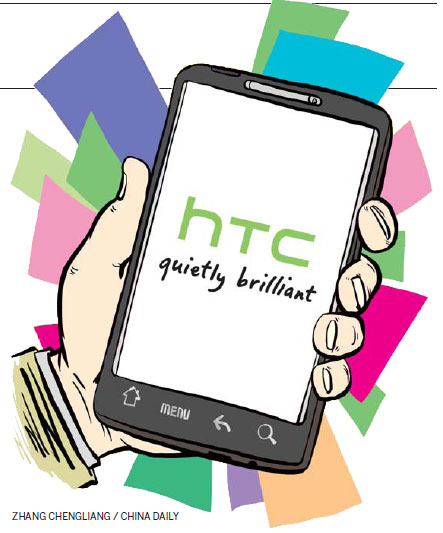
As a result, Wang expertly positioned HTC as "quietly brilliant". He sensed that most of the industry heavy-hitters were perceived by customers as "loud" and "pushy" and "arrogant" as well as a little "confusing". His "quietly brilliant" mantra was designed to stimulate innovation but also guard against complacency and ultimately arrogance. Such a simple yet great turn of phrase has its roots in an overlap between US and Asian culture, where modesty in achievement is most respected. The "quiet guy" is often regarded as more genuine and trustworthy in the US, and the image is typically Asian, too. So, Wang crafted a perfect blend of US and Asian cultural values and then embarked on an infusion across the entire company.
Wang also understood that actions are worth more than words and that "refreezing" or reinforcement of any move to a more customer-oriented culture is essential in any execution strategy. This explains HTC's use of "quietly brilliant moments". For example, an HTC phone will ring more loudly when it is inside the owner's bag, and will reduce its volume when taken out.
We need to look no further than HTC's product portfolio to appreciate just how much innovation drives the entire new product development process. HTC also has a range of mobile multimedia products and services. In particular, HTC is able to boast a rich heritage of device "firsts".
Recognizing changes in consumer lifestyles, HTC aims to develop continually intelligent new devices that empower users on the go, providing more freedom in the way they live their lives.
Another key part of HTC's growth has been the establishment of unique partnerships with key mobile brands, including the leading five operators in Europe, the top four in the US, and many fast-growing Asian operators. It has also brought products to market with industry leading OEM partners and, since June 2006, under the HTC brand.
Furthermore, since launching its own brand 18 months ago the company has also introduced dozens of HTC-branded products worldwide.
So, what next for the HTC brand?
Wang is keen not only to preserve HTC's current success but to ensure that the energy and attitude required to become more and more competitive is ever present throughout the organization. In accordance with a genuine brand-oriented culture, HTC and Wang appear to accept that there is always more to do and that success brings the serious danger of complacency and neglect. Sustainable success is also, quite rightly, regarded as something that emerges over a long time.
Wang also acknowledges that brand development inevitably involves a move to more emotional values.
When consumers want to buy a smart phone today they have many choices. If the HTC brand is to continue to be highly differentiating, Wang understands that this will increasingly not be about the speed of the processor or the quality of the screen. Instead, choosing HTC will entail a highly personal device. Therefore, it is the brand experience that must replace product functionality as the crucial focus of attention. Wang is fully aware of this and of the need for continuous innovation.
China is now firmly placed on the global economic map, but at present all too few of its companies have enjoyed similar success. HTC's elevation in recent years is a role model to other aspiring Chinese companies. If HTC can adopt and implement such a brand-oriented culture and place the consumer at the heart of everything it does, so can other Chinese companies.
The author is a researcher at Nottingham University's School of Contemporary Chinese Studies. The views do not necessarily reflect those of China Daily.
(China Daily 03/02/2012 page8)
 The dying of craft of repairing pans
 Top 10 Chinese companies by revenue in 2015
 Thangka art booms in Regong
 New air route connecting Lanzhou, Urumqi and St. Petersburg launched
 Top 10 global cities in greenfield FDI
 Traditional weaving skill sees revival
 ZTE unveils Axon phone with dual cameras in US market
 6 global navigation apps for Android

Copyright 1995 - . All rights reserved. The content (including but not limited to text, photo, multimedia information, etc) published in this site belongs to China Daily Information Co (CDIC). Without written authorization from CDIC, such content shall not be republished or used in any form. Note: Browsers with 1024*768 or higher resolution are suggested for this site.
License for publishing multimedia online 0108263 Registration Number: 20100000002731