Comments
  Print
Print  Mail
Mail  Large Medium Small
Urban young and more rural societies suffer most: Analysts
In his keynote report to the 18th National Congress of the Communist Party, President Hu Jintao emphasized the importance of increasing individual income in step with the country's overall economic development.
This is the first time that per capita income has been included when mentioning the gross domestic product growth in China in the blueprint for a moderately prosperous society, showing the government's determination to combat social problems brought about by low income levels and wealth inequality.
 |
For young employees from low-income families, living and working in a big city such as Beijing can be frustrating.
Zhang Chaotong, a recent college graduate majoring in English, has just paid off his 24,000 yuan ($3,840) student loans. Besides his full time job at a radio broadcasting station, the 25-year-old also works as a part-time translator, tour guide and English tutor to make ends meet.
"I can make about 100,000 yuan every year if I work really hard but I can't save much money because my family needs help," said Zhang, who comes from Qingxu county, a relatively poor rural area in North China's Shanxi province.
"My parents make about 40,000 yuan every year but most is used to pay for daily necessities and pay off debts and not much is left to spend," he added.
His financial burden might get heavier because his younger brother is currently a senior three student in high school and is planning to go to college next year - the only way to escape poverty in traditional Chinese thinking. Zhang is ready to shoulder the responsibility.
Since the implementation of the reform and opening-up policy in the late 1970s, China has achieved great progress in its overall economic growth. But small increases in average personal incomes and income inequality are now undermining the country's sustainable development.
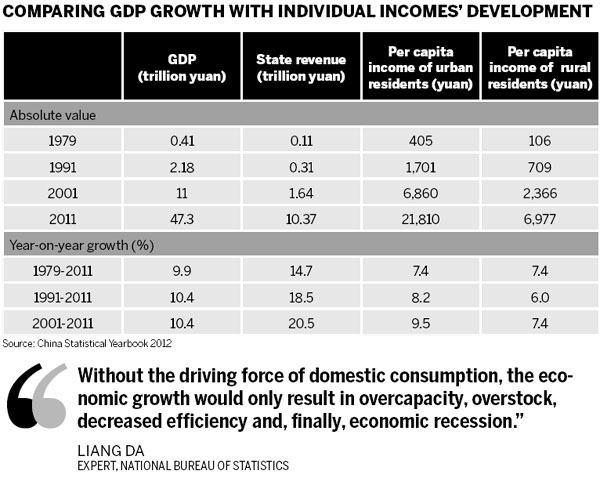
Official statistics show that the average personal income of Chinese citizens has been growing at a slower pace than GDP and fiscal revenue for the past three decades.
Between 1979 and 2011, China's GDP rose from 406.2 billion yuan to 47.3 trillion yuan, with an average annual growth rate of 9.9 percent. By contrast, the per capita disposable income for Chinese urban dwellers in 2011 was 21,810, representing an average annual growth rate of 7.4 percent over the same period.
The per capita income for rural residents in 2011 was a mere 6,977 yuan, less than one-third of the urban income level and only about 15 percent of the world's average level, according to data from the National Bureau of Statistics.
The United Nations suggested that China is one of the most unequal societies in terms of wealth distribution, as China's Gini coefficient - a widely accepted measure of income inequality - has probably reached 0.55, while the international alert line is 0.4.
 |
Experts say that China's low-income level and the widening wealth gap are exerting a negative influence on the country's overall economic development.
"Limited increases in personal income would lead to weak domestic consumption, which is not healthy for sustainable economic development," NBS statistics expert Liang Da wrote in a report.
"Without the driving force of domestic consumption, the economic growth would only result in overcapacity, overstock, decreased efficiency and, finally, economic recession," he added.
But for people with a high-income and sufficient cash-flow, their spending is not necessarily promoting domestic consumption.
"Many of my friends would invest 60 to 70 percent of their income in real estate, equities and so on and the smaller part would be used to improve their quality of life," said Shi Wanlin, senior partner at China's leading law firm, Dacheng Law Offices.
Influenced by previous experience of studying and working in France, Shi considers himself to be a romantic and would spend as much as 70 percent of his 10 million yuan annual income on enjoying life.
"But there is a considerable amount of overseas spending because you can get products of excellent quality at more reasonable prices and usually receive better service," Shi added.
The concentration of capital in a few hands has fostered speculation in the housing market, heating it up over the past few years. As a result, many young people's living standards are compromised with mortgage stress on their shoulders.
Taking Beijing as an example, the disposable annual income per capita for the first half of 2012 was 18,154 yuan. Assuming an average standard apartment in Beijing is 90 square meters and the average price is 22,000 yuan per square meters, a nuclear family would have to cut all their spending and save up for about 20 years to buy it.
Many young people are desperate about being among the lowest echelons of society and self-deprecatingly call themselves diaosi, an online buzzword first coined by single, young men who feel they have dead-end lives.
Usually people in the diaosi category are not good looking and lack influential families and useful social networks to win promotion or bigger wealth.
"This generation is facing tougher competition than we had 20 years ago because the number of college graduates has surged but the labor market did not expand proportionally," said attorney Shi. "What society needs might be a reshuffle in the economic structures."
The widening income gap has been highlighted as a key challenge for China's new leaders. The CPC leaders made it clear during the 18th Party Congress that income distribution reform is needed to strike a balance between efficiency and fairness in both primary and secondary distribution.
"We should improve the way in which income is distributed, protect lawful income, increase the income of low-income groups, adjust excessively high income and prohibit illicit income," said President Hu.
NBS statistics expert Liang Da suggested that five aspects are of vital importance in building a fairer income distribution system, including narrowing the urban-rural gap and tamping down industrial monopolies, accelerating the urbanization rate, offering wider job opportunities, improving the social safety net and increasing public spending in rural areas.
An income distribution system reform plan is expected to be launched by the end of this year, Ministry of Human Resources and Social Security spokesman Yin Chengji said at a news conference last month.
Pan Jiayuan contributed to this story.
 1st annual meeting of AIIB held in Beijing
 Tianjin getting ready for Summer Davos Forum
 Working under the scorching sun
 Venue of 2016 Summer Davos Forum
 Top 10 developing countries for retail investment
 Alibaba's sampling inspection procedures revealed
 Top 10 best employers in China 2016
 Chinese drones gear up for global takeoff

 Synchronized swimmers hope for hometown success in Brazil
 The party's just starting for Cavaliers' triumph
Copyright 1995 - . All rights reserved. The content (including but not limited to text, photo, multimedia information, etc) published in this site belongs to China Daily Information Co (CDIC). Without written authorization from CDIC, such content shall not be republished or used in any form. Note: Browsers with 1024*768 or higher resolution are suggested for this site.
License for publishing multimedia online 0108263 Registration Number: 20100000002731