|
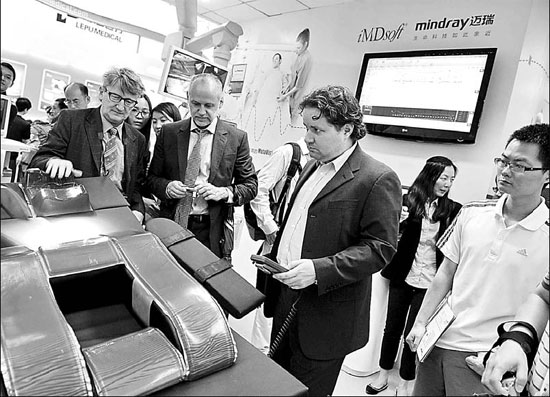
Visitors at a medical equipment trade show in Shenzhen, Guangdong province, look at products on display at Mindray Medical International Ltd's booth. Yu Ge / For China Daily |
Chinese healthcare equipment maker Mindray continues to gain recognition overseas despite some ongoing prejudice, reports Cecily Liu in London
David Yin, managing director of Europe at the Shenzhen-based Mindray Medical International Ltd, recalled that his team's first order from overseas was the result of "an accident".
In 2000, a British company's attention was caught by the "made in China" label displayed on Mindray products at Medica, a trade fair in Germany. The company, which Mindray declined to identify, took the product to a British hospital for a quality assessment and bought it after being assured that it was up to standard.
Mindray is now a large player in the medical devices industry, exporting products to 190 countries and regions.
In 2011, it had $881 million in net revenue, more than half of which was generated overseas.
"We are committed to international expansion, especially in Europe and the United States," Yin said. "These two markets are like two fortresses we have to conquer to become a truly global leader.
"In the process of selling our products to Europe and the US, we learn about their strict standards. These lessons become invaluable for our product development at home."

Yin said Mindray's success in Europe and the US has helped it gain the trust of both domestic customers and customers in other emerging economies, who had often favored Western products in the past.
"Some Middle Eastern and Latin American markets only give medical equipment product registrations if they have already been sold in Europe or the US, which just demonstrates how important it is to have a presence in Europe and the US," Yin said.
Mindray was established in Shenzhen, Guangdong province, in 1991, originally as a trade company that sold medical equipment produced by foreign companies in China.
But the founders of the company, Xu Huang and Li Xiting - who had both worked in the 1980s as engineers at a State-owned maker of medical instruments - had ambitions to have Mindray produce its own medical equipment.
Under that impetus, the company began to invest heavily in research and development and developed its first patient-monitoring device in 1992.
Mindray began to prepare itself for international expansion later that same decade after recognizing that the market for medical equipment was smaller in China than in advanced economies such as Europe and the US, where healthcare is a priority of the public sector. One important step it took toward that end was making sure its products met regulatory standards abroad.
Most of the company's devices and equipment bear the European Economic Area's CE marking, meaning they can be sold in the countries that make up European Union, plus in Iceland, Liechenstein and Norway. Some of its products have also won approval from the US Food and Drug Administration.
Yin said the "accident" in 2000 - the company's first overseas sale - could not have occurred without this preparatory work.
"It demonstrated that we were ready for the foreign market," Yin explained.
Since then, Mindray has relied on distributors to export its products to Europe.
Overseas expansion
Mindray established an office in the US in 2004 and did the same in the United Kingdom two years later. Its network of subsidiaries and representative offices has since been expanded into about 20 countries, including France, Germany, the Netherlands and Spain.
In 2006, Mindray listed itself on the New York Stock Exchange, raising $311 million.

Despite having to compete with international giants such as Philips Healthcare, GE Healthcare and Spacelabs Healthcare, the company has managed to take part in a large number of prominent projects over the years.
One of them has it supplying medical equipment - including patient devices and ultrasound equipment - to Britain's public healthcare system, the National Health Service, or NHS.
"We entered into talks with the NHS around 2006 or 2007, and they had an open attitude about learning about our products," Yin said.
In 2008, Mindray placed a bid to take part in the NHS' procurement system.
"We were assessed as a business holistically, including our product quality, commercial qualifications and after-sales service," he said. "We passed the test and have remained in their procurement system ever since."
Yin said Mindray's chief advantage in Europe isn't the prices it offers, but the quality of its products and after-sales service.
"Most hospitals have a procurement process whereby prices are not made known at first," Yin said.
A hospital, he explained, can arrange a month-long trial period during which a technical assistant and an after-sales assistant teach doctors how to use a device.
"The doctors then rate the equipment," Yin said. "So if six companies enter the first round, only the most highly rated two or three bidders are then given the opportunity to tell the procurement department their product prices.
"That is why we place great emphasis on product quality and innovation," he said. According to the company's website, Mindray reinvests about 10 percent of its annual revenue into research and development and has introduced about eight products to the market in each of the past seven years.
The company now has about 1,550 employees engaged in research and development, a number making up roughly a third of its workforce.
One milestone in Mindray's overseas expansion came with its $200 million acquisition of the New Jersey-based Datascope Corp's patient monitoring business in 2008.
Datascope's R&D centers in Stockholm and in New Jersey became valuable assets. The deal also gave the company a directly employed sales staff in Europe and North America.
Yin said Mindray and Datascope complement each other in Europe.
"Datascope has been in contact with European customers for decades, so they understand customers' needs," he said. "But they couldn't deliver the products needed due to high R&D cost and slow R&D speed.
"Mindray's advantage is the ability to turn R&D results into actual products. For example, if Datascope needs five years to develop a product, Mindray only needs two years to develop the same product."
After the acquisition, Mindray used Datascope's existing connections to arrange visits between its research and development employees in Shenzhen and European clients.
"Datascope's channels function as an introduction through which our R&D team learned more about customer needs," he said.
Prejudice still exists
One obstacle Mindray still must overcome is the prevailing prejudice against Chinese products, Yin said.
"This is particularly a challenge when it comes to customers of developed markets like Europe and the US," Yin said.
"We had to continuously explain to them that Chinese products are not just cheap exports, but because China has many high-tech companies, it has many highly skilled employees. And it has many companies that understand clients' needs and are keen to solve clients' problems."
Yin said he hopes more high-tech Chinese products find success in the European market.
Meanwhile, Mindray has exploited its price advantages to strengthen its presence in developing economies. That has helped it answer the call of its company slogan and put "healthcare within reach", Yin said.
Mindray's ability to understand the needs of customers in developed economies was a point emphasized by Yin during a speech he delivered at the World Medtech Forum Lucerne in Switzerland in September.
"Many European or North American medical devices companies are talking about the whole market shrinking," he said. "But the reality is that only 1 billion out of 7 billion people globally live in developed economies. To offer affordable products for the remaining 6 billion people is Mindray's advantage."
Mindray's expansion into the European market resembles steps taken by other privately owned Chinese businesses, which have been encouraged to go overseas both by commercial opportunities and the Chinese government's policy initiatives.
For example, the Chinese government's 12th Five-Year Plan (2011-15) encourages privately owned businesses to expand internationally.
Yin said that he is glad for the support Mindray has received from the Chinese government over the years, particularly in the protection of intellectual property rights.
"IPR is a key asset for high-tech companies such as Mindray," he said. "We have noticed that China's patent laws have become much more complete and their enforcement much more stringent over the past decade."
Mindray applied for its first patent in 1997 and has so far received more than 1,000 of them. Of those, more than 200 have been secured overseas, Yin said.
"Back in the days when (intellectual property rights) enforcement was poor, no Chinese company dared to invest in R&D," Yin said. "But now many Chinese companies invest heavily in R&D."
"With great support from home, we are committed to invest globally, and we hope our success will improve the image of Chinese products in Europe and beyond."
Contact the writer at cecily.liu@mail.chinadailyuk.com
(China Daily 11/27/2012 page13)


Copyright 1995 - . All rights reserved. The content (including but not limited to text, photo, multimedia information, etc) published in this site belongs to China Daily Information Co (CDIC). Without written authorization from CDIC, such content shall not be republished or used in any form. Note: Browsers with 1024*768 or higher resolution are suggested for this site.
License for publishing multimedia online 0108263 Registration Number: 130349