Rising inflation, commodity prices major threats to emerging markets
It is vital for emerging markets to cooperate better in monitoring cross-border capital flows and reducing the risks of currency exchange-rate fluctuation, a deputy governor of China's central bank said on Monday.
Pan Gongsheng also said the international monetary system should be further reformed to reflect the increasing influence of emerging currencies. This would help reduce global dependence on the dollar and thus avoid US monetary policy from affecting other parts of the world too much.
|
 |
|
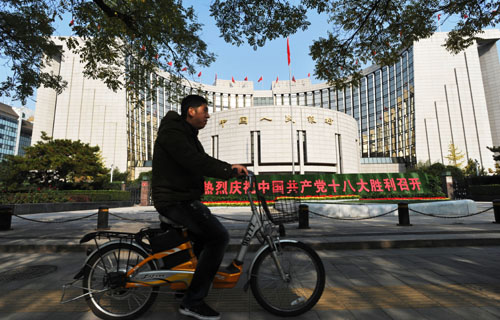
The headquarters of the People's Bank of China in Beijing. A deputy governor at the bank has urged emerging markets to monitor cross-border capital flows more closely. [Photo/China Daily]? |
Pan said increasing volatility of capital flows in and out of emerging economies, including China, have placed great pressure on domestic macroeconomic regulation and financial stability.
"The economic adjustment and recovery is still at a difficult stage. Easing policies of certain developed economies would generate a negative spill-over effect in emerging markets and hinder the global economic recovery," said Pan, deputy governor of the People's Bank of China.
"And inflation would be a threat as commodity prices would rise after a further easing in monetary stance."
Pan was speaking at a forum hosted by the University of International Business and Economics in Beijing.
His remarks came after China witnessed an increase for two consecutive months in banks' yuan holdings for foreign exchange purchases, an indicator of capital flows, and its currency registered its biggest weekly gain in a month last week.
Pan said international supervision over developed countries' policies should be further strengthened.
"Against such a backdrop, it's very important for emerging markets to complete a cooperative framework to better monitor cross-border capital flows and reduce risks of currency exchange rate fluctuation," he said.
In recent years, China has been promoting global use of its currency, the yuan, and the need to make it an international currency, but analysts and international organizations such as the International Monetary Fund have said that a premise for that goal is to open the capital account and make the yuan fully convertible.
Robert Mundell, professor of economics at Columbia University, who is also a Nobel laureate, said some major economies' easing policies, such as the US' third round of quantitative easing, did not affect China much because China's capital flows are controlled.
"If they want to open up the capital account, they could have done it 10 years ago. It's not an issue of QE2 or QE3. But QE3 does have an effect that China would probably move in a direction of letting the yuan appreciate more rapidly."
Jim O'Neill, chairman of Goldman Sachs Asset Management in London, said: "Many investors around the world are watching the PBOC's policy on the exchange rate very closely. Because of the monetary-easing policies in the United States, Japan and Europe, many people think that it would be easy for the yuan to rise significantly if the PBOC allows it.
"I expect the yuan will become more volatile ... in line with China becoming a more developed economy. The yuan exchange rate against the dollar won't be one-way anymore, and it will become a more 'normal' currency."
Danny Quah, professor at the London School of Economics and a former member of Malaysia's National Economic Advisory Council, said it is not a good time for China to accelerate opening up the capital account and making the yuan more convertible, given the large scale of capital inflows into emerging markets after the US announced QE3 in September.
"China has relatively strict capital control and thus won't be much affected by the fluctuation of capital flows," Quah said.
Zhou Xiaochuan, governor of the People's Bank of China, said on Saturday at a conference that convertibility will be the next step in reforming the country's exchange-rate system.
"We are moving in this direction. We need to go further and will have some deregulation."
Li Ruogu, chairman and president of the Export-Import Bank of China, said internationalization of the yuan is not necessarily based on fully opening up the capital account.
Contact the writers at wangxiaotian@chinadaily.com.cn and chenjia1@chinadaily.com.cn


Copyright 1995 - . All rights reserved. The content (including but not limited to text, photo, multimedia information, etc) published in this site belongs to China Daily Information Co (CDIC). Without written authorization from CDIC, such content shall not be republished or used in any form. Note: Browsers with 1024*768 or higher resolution are suggested for this site.
License for publishing multimedia online 0108263 Registration Number: 130349