Washington faces pressure to avoid discouraging potential investors
The US private sector is calling for a consistent political commitment from Washington to clear the way for direct investment from China, which is projected to hit $400 billion by 2020.
The US business community agrees that current setbacks encountered by the telecom companies Huawei Technologies Co Ltd and ZTE Corp will only be temporary, as long as the US government stops sending contradictory signals that might deter Chinese investors in the long run.
In the first three quarters of 2012, Chinese firms completed investment transactions worth $6.3 billion, setting the stage for a record year for outbound investment to the US, according to a latest report compiled by the non-profit group Asia Society and research company Rhodium Group.
Chinese direct investment has the potential to contribute to a more balanced bilateral commercial relationship and the strengthening of US-China ties, said Brenda Foster, president of the American Chamber of Commerce in Shanghai.
Daniel Rosen, Rhodium cofounder, said: More importantly, Chinese investment helps create new jobs in a much more profound way than official statistics show.
Rosen said at least 30,000 people have benefited from new posts set up by Chinese companies in the country. That figure is five times higher than records from government agencies.
But the many problems of Chinese investments in the US are not about how companies manage human resources or deal with supply chains. Instead, they are about the macro-policy environment, Rosen said.
"The past weeks seem to leave people the impression that the US has slammed the door shut for Chinese investors and that we have gone completely overprotective", he said, referring to the Huawei and ZTE cases. A US congressional panel said that the two companies pose a security threat to the US.
Recent friction over Huawei and ZTE's investments in the US reignited debate on whether Washington should use national security as an excuse to bar Chinese investors from contracts and acquisitions in the country.
"I think that ZTE and Huawei should be allowed to bid on these projects," Gary Rieschel, founder and managing partner of Qiming Weichuang Venture Capital Management (Shanghai) Co Ltd, told China Daily. "Obviously, it is a mistake to exclude them."
But the cases don't reflect normal Sino-US economic ties, he noted. "At the very senior level of government as well as business, there has been more collaboration and more engagement than decades ago," he said.
Robert Theleen, chairman and CEO of private equity firm ChinaVest, said the cases are incredibly complicated simply because of the sensitivity of the industry.
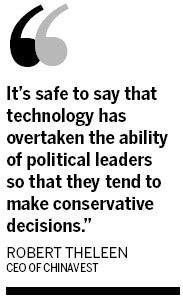
"It's safe to say that technology has overtaken the ability of political leaders so that they tend to make conservative decisions," he said.
Because the IT sector is so important and sensitive, it moves faster than political minds that fail to grasp the strength of it, Theleen said.
But he forecast that these companies would not be easily strained after the initial failure. Instead, they are "going back to the drawing board" right now.
"The CEO of CNOOC (China National Offshore Oil Corp) once told me he would never invest in the US again, after the trial of acquiring oil company Unocal Corp. But just four years later, the company became the largest and the most welcomed investor in the energy sector in the US," he said.
It is a widespread "myth" that the US, more often than not, does not welcome Chinese investment, said Mark Lewis, commercial officer at the US Embassy in Beijing.
The federal government, and the US Department of Commerce in particular, spends a lot of manpower and effort trying to attract foreign direct investment, Lewis said.
Washington has been pushing ahead SelectUSA, a government initiative to remove barriers to new investments. During a project roadshow in Shanghai last October, US Ambassador to China Gary Locke said that through such events, Chinese companies can learn about investment opportunities in the US through workshops and visits.
But Rosen said US leaders need to tread carefully so that they don't cause problems.
"We have seen 600 successful investments so far from China. So you don't really need a lot of government encouragement as this is starting to happen very well," Rosen said.
Policymakers should avoid misunderstanding what the real trends are, Rosen noted. Washington should not think that all investments are Chinese-government related, and Beijing should not deem that the US market is closed.
"The government can make problems. But they can really be the solution," he said.
hewei@chinadaily.com.cn


Copyright 1995 - . All rights reserved. The content (including but not limited to text, photo, multimedia information, etc) published in this site belongs to China Daily Information Co (CDIC). Without written authorization from CDIC, such content shall not be republished or used in any form. Note: Browsers with 1024*768 or higher resolution are suggested for this site.
License for publishing multimedia online 0108263 Registration Number: 130349