As China's economy becomes less dependent on exports, care has to be taken not to let future growth become too dependent on investment.
That's according to Il Houng Lee, the International Monetary Fund's senior resident representative in China, who added that it remains vital to determine exactly what is the best amount of investment for the country, as it changes its economic growth model from an export-driven economy to one more reliant on domestic growth.
Lee said he didn't think there would be a "hard landing" for China in the short term, but he warned of continued risks if the level of investment remains at current level.
He said that despite benefiting from the strong growth by developed countries in the past, as well as strong investment in China, both growth engines have hit problems at the moment and need to be adjusted.
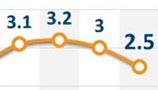
China's economy has become more sensitive to external economic influences, evidenced by recent economic figures, which show growth has slowed for seven consecutive quarters.
Lee said the most pressing need now is to transform the economic model into one less dependent on advanced economies, and more focused on encouraging domestic consumption.
One possible answer for the first challenge is to expand the country's trade within Asia instead of exporting more to advanced economies, he said.
|
|
|
II Houng LEE, IMF's senior resident representative in China |
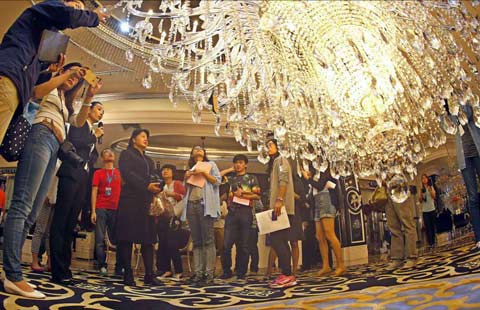
"And China has to lower its reliance on investment. The country has to change its economic model so domestic consumption becomes self-generating," said Lee.
National Bureau of Statistics data show that from 2002, investment's contribution to GDP has continually outpaced that of consumption. But the share of consumption within GDP has grown faster in recent years, increasing by 10.1 percentage points to 51.6 percent in 2011.
In the first three quarters, consumption increased its share of GDP to 55 percent, meaning for the first time in a decade, its contribution is more than investment.
"China needs to reduce its reliance on investment, because the high historical levels have become increasingly difficult for local governments to sustain," Lee added.
State-owned enterprises and local financing vehicles under the control of local governments have accounted for too high a proportion of Chinese investment in recent years. However, Lee said that if investment is cut too quickly, "that too will damage the economy".
During his speech at the 18th National Congress of the Communist Party of China, President Hu Jintao said: "China should firmly maintain the strategic focus of boosting domestic demand, speed up the establishment of a long-term mechanism for increasing consumer demand, unleash the potential of individual consumption, and increase investment at a proper pace, and expand the domestic market."
Lee said three major economic issues exist for China: What should be the country's sustainable level of investment? How can China finance the level of investment in a more sustainable way? And to what extent should the type of investment change to make consumption become more self-generating?
Zhang Changchun, director of the Institute of Investment at the National Development and Reform Commission, said China needs to cut the investment share of GDP.
He added China's high investment levels have their roots in the country's unusually high savings rate, while the reason behind the high savings rate remains the country's insufficient social welfare system.
"If China's economic growth slowed to 5 to 6 percent, that doesn't necessarily mean that the investment ratio will decline correspondingly, or the consumption ratio decline more," he said.
But recent investment levels are unsustainable, he noted.
lanlan@chinadaily.com.cn


Copyright 1995 - . All rights reserved. The content (including but not limited to text, photo, multimedia information, etc) published in this site belongs to China Daily Information Co (CDIC). Without written authorization from CDIC, such content shall not be republished or used in any form. Note: Browsers with 1024*768 or higher resolution are suggested for this site.
License for publishing multimedia online 0108263 Registration Number: 130349