Economic slowdown poses grave threat to regulation of real estate market in China
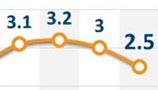
Economic slowdown and a real estate bubble are two lingering threats for the Chinese economy that need quick fixes. Though China has been taking all possible measures to control home prices, the economic slowdown is posing a serious threat to the success of such measures.
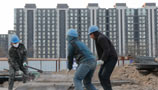
China's rapid economic growth during the past two decades has to a large extent been driven by rapid urbanization. It is a four-way process that is closely interlinked. In the first step, the local government sells more land to realize revenue, while in the second stage the money realized from the land sales along with fresh borrowings are used to create more roads, houses and other urban facilities. After creating these facilities the government attracts private, State-owned and other foreign enterprises to occupy the facilities. In the last stage, the local GDP gets a major lift through taxes, employment and finished products.
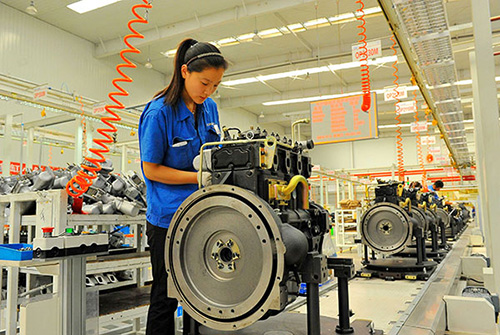
But in the past two years, the strict curbs have affected the entire process and jeopardized enterprises' profit, local governments' revenue, employment and local government debt repayments.
Though such an action needs a quick solution by way of removing the curbs, it may not be that easy, as it carries with it bubble threats to the economy.
From January to June this year, real estate investment growth declined by 16 percentage points and triggered a negative pull on total investment and GDP. Many of the planned indemnificatory apartment investments have been unable to respond to the sudden changes triggered by the economic slowdown.
Such a situation has posed problems for policymakers as they appear to be in a quandary over whether to set aside the economic slowdown problem for now, and focus more on finding solutions to the real estate bubble.
The dilemma for China is easy to understand as it has historically used far too many government projects to drive the economy and administrative tools to intervene in the market-oriented housing trading.
Government projects are the primary source of the housing bubble. Not only have they shrunk the growth space for private enterprises, but also prevented the shift to a consumer-centric growth pattern rather than the present investment-driven form. They have also forced the issue of more money, most of which flowed into the gray market. They have also caused a government-controlled inefficient financial system that created more gray income and bubbles rather than an efficient industry.
Administrative commands can affect the investment demand temporarily, but they cannot solve the problems of bubbles in the long run. In fact, they just delay the inevitable solution to the problems.
The problem with housing prices in China can be classified under four categories: land, banks, developers and buyers. The first two were dominated by government behavior and are key to solving the housing bubble problems. But the government has mostly focused on the latter two, which are dominated by market behavior.
In fact, the fundamental driving forces behind the rise in housing prices is the land supply mechanism (which does not match the market demand), the substantial easing of the monetary policy and the negative real interest rates.
In the short term, in order to prevent other problems from accumulating, China should hold on to the strict regulations on real estate and bear the cost of economic slowdown. China should tolerate a fixed-asset investment decline, GDP growth rate decrease, possible recessions in some industries and so on. To help alleviate both problems, indemnificatory apartments should be built on a bigger scale and regulated under stricter rules.
In the long term, some major reforms are also necessary:
Urbanization of land reform to increase land supply, such as reform on lands for indemnificatory apartments, on houses with limited property rights and on empty apartments.
Private capital reforms to give private enterprises entry rights to run financial businesses.
Fiscal revenue and expenditure reform to help change the economic growth pattern and change the role of the government.
Income distribution reform to limit gray income expansion and improve purchasing power of common people.
The author is a lecturer at the Management School of Shanghai University and a research fellow at the China Europe International Business School Lujiazui International Finance Research Center. The views do not necessarily reflect those of China Daily.
(China Daily 10/19/2012 page7)


Copyright 1995 - . All rights reserved. The content (including but not limited to text, photo, multimedia information, etc) published in this site belongs to China Daily Information Co (CDIC). Without written authorization from CDIC, such content shall not be republished or used in any form. Note: Browsers with 1024*768 or higher resolution are suggested for this site.
License for publishing multimedia online 0108263 Registration Number: 130349