China's medical equipment industry appears to be developing in a way that is similar to what information technology went through 20 years ago, said a managing director of a leading Chinese equity investment firm.
Certain large operations will benefit from technological innovations and will stand out in the near future.
"It (technological innovation) will prove to be a driving force that in 10 to 20 years results in a batch of great Chinese medical equipment enterprises that will be similar to today's large IT companies such as Lenovo Group, Huawei Technologies Co Ltd and ZTE Co," said Ouyang Xiangyu, managing director of Legend Capital, a Chinese equity investment firm and a subsidiary company of Legend Holdings Ltd.
Ouyang said Legend Capital used to seek investment opportunities in the IT industry, which is far advanced in its development. In 2008, though, the investment firm started paying more attention to healthcare, making nearly 20 deals in that industry, including ones involving medical equipment.
As the average age of China's population rises, the country's medical equipment industry has come to offer even greater opportunities, Ouyang said.
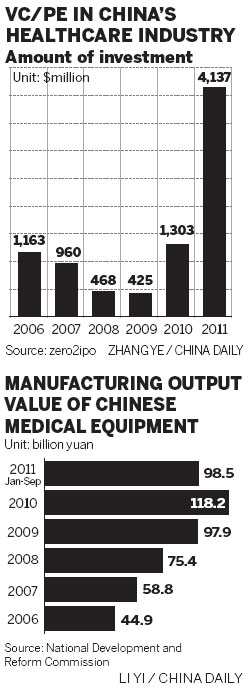
By the end of September 2011, the value of the Chinese medical equipment industry's production had been 98.54 billion yuan ($15.73 billion), up 26.6 percent year-on-year, according to Zero2IPO Research Center.
Many of the industry's products are of low or middling quality and require technological improvement., the center said.
Foreign companies are the main players in China's advanced medical equipment market. They tend to charge high prices, making it difficult for anyone outside a small number of Chinese people to afford their services, and the best healthcare resources are often much more commonly found in large hospitals in economically developed regions.
"We are glad to see that more and more people who have returned with strong experiences in healthcare are starting their own businesses in China," Ouyang said. "They are trying to achieve technological innovations and offer high-quality products with affordable prices to supply the large domestic market that exists for medical equipment."
Ouyang said Chinese medical equipment companies won't be able to make a difference without technological innovation.
"In the beginning, Lenovo Group was similar to many Chinese companies in that it was making an effort to develop trade," he said. "But the difference was that Lenovo Group paid attention to research and development to take its products from being low end to being high-end."
Ouyang said innovations in gene technology could prove to be significant to the healthcare industry, just as the development of the Internet has led to great changes in the IT industry.
Of the deals Ouyang has been involved in, two have been related to gene technology. One concerned the Hangzhou-based Ustar Biotechnologies Ltd on molecular diagnoses and the other the Beijing-based Berry Genomics on prenatal DNA tests. Investments worth tens of millions of yuan went into each in 2011.
Ustar Biotechnologies Ltd was founded in 2005 by scientists from the United States. The company has found a way to diagnose ailments such as tuberculosis and sexually transmitted diseases with the use of a "rapid nucleic acid detection strip", a patented technology.
Diagnosing these diseases usually requires the use of large and expensive equipment in very specific temperature conditions. The work is therefore often performed in professional labs.
"Ustar's technology is developed and we are awaiting a license from the State Food and Drug Administration to put it into commercial use," Ouyang said.
Ouyang said Ustar will sell its diagnostic tools to Chinese hospitals and public health clinics, especially in remote regions where good diagnostic equipment is difficult to find. The price of each product developed by Ustar is only a few dozen yuan.
"Most infectious diseases originate from poor places where advanced diagnostics are scarce, which leads to the mismanagement of diseases," said You Qimin, founder and CEO at Ustar Biotechnologies Ltd. "After 10 years of research and development, Ustar's products offer customers distinctive benefits."
"Ustar is expected to be listed in six to eight years. We are being patient about investing in healthcare. We say they (healthcare companies) are like wine; the longer they are stored, the better taste they have and the higher their value," said Ouyang.
"Technological innovation plays an important role in the long-term development of a medical equipment company, and we have gone from being a follower to a market leader in the past 13 years, " Li Guoqiang, a director at Lepu Medical Technology Co Ltd, a leading Chinese enterprise specializing in high-tech medical devices.
Li said the US-based Johnson & Johnson used to be a market leader in the interventional cardiology industry but exited it last year. Lepu was another industry leader, conducting research on and developing the most advanced non-drug coated heart stents, as well as completely biodegradable ones.
"The main players in the industry in China are foreign companies and there are a few domestic ones," Li said. "If our technologies get ahead, we may alter the market share."
"Paying attention to technological innovation is an important strategy for a healthcare company, especially in the medical equipment industry. Companies should also apply for patents to protect themselves and compete with players both at home and abroad," said Fang Min, an executive director at global private equity firm Warburg Pincus LLC.
Fang said many Chinese companies are not familiar with patent protections, a situation that will change greatly in 10 years.
By the end of 2015, China's medical equipment market will have a value of $53.7 billion and will show a compound growth rate of between 20 percent and 30 percent, according to the Beijing-based consultancy S&P Consulting Inc.
caixiao@chinadaily.com.cn


Copyright 1995 - . All rights reserved. The content (including but not limited to text, photo, multimedia information, etc) published in this site belongs to China Daily Information Co (CDIC). Without written authorization from CDIC, such content shall not be republished or used in any form. Note: Browsers with 1024*768 or higher resolution are suggested for this site.
License for publishing multimedia online 0108263 Registration Number: 130349