Comments()
  Print
Print  Mail
Mail  Large Medium Small
|
 |
|
An unfinished vessel lies abandoned at a shipyard in Ningbo, Zhejiang province, as a gloomy global shipping market takes its toll on China's ship-building industry, forcing many companies to go bankrupt. But many economists believe the country's potential for growth in domestic consumption can be "tremendous" even though its economic growth has seen a continuous slowdown. [Photo/China Daily] |
Exclusive | John Quelch
Although innovation will be important to boost China's next stage of development, the country still holds "considerable opportunities" that can be tapped just by implementing existing wisdom, said John Quelch, dean of the China Europe International Business School.
The country's room for growth in domestic consumption can be "tremendous" even though its economic growth has seen a continuous slowdown in the last couple of years, raising concerns for its growth prospects.
Quelch, who has done extensive research on China since he moved from Harvard to the Shanghai-based school in 2009, told China Daily that this should not be a time to lose heart, and that better efforts should be made to do the right things for the economy.
His comments came ahead of the upcoming 18th National Congress of the Communist Party of China, which will be held on Nov 8.
Quelch's argument is divided into two parts.
First, that China's level of consumption, in its contribution to total GDP, may not be as lackluster as shown by the official data.
And second, that domestic consumption can be stimulated in various ways, most of them not new, such as building a more extensive social safety net and making income distribution more even.
For the first part of his argument, Quelch noted that official data showed that 37 percent of China's GDP was made up of consumption, a figure much lower than in many emerging economies, let alone countries in the Organization for Economic Cooperation and Development, or OECD.
The figures give the impression that China - despite near double-digit growth in the last couple of decades - still hasn't changed from an investment-driven economy into a consumption-driven one.
But this impression, Quelch noted, is challenged by several economists who argue that a 40 to 45 percent share of consumption "may be closer to the reality" because of certain omissions in the official statistics, particularly related to the value of housing and rents.
Meanwhile, as a large number of personal expenses are counted as business expenses, the service sector is not being measured fully.
In fact, Quelch said, per capita consumption rose significantly over the last 10 years. This is a fact that is often overlooked as the growth in investment was even more impressive.
The other side of the coin, according to Quelch, is that China does have a problem with its social safety net, particularly a lack of a substantial health care insurance program.
Admittedly, the government has been trying to put some measures in place, "but when you think of the expenditure most people have to make when facing a health crisis, the government's programs are minimal", Quelch said.
"Chinese people always save for rainy days. And they're likely to continue to save because health care- related inflation is increasing faster than general inflation," he said.
Besides improving social security coverage, which has been suggested by many economists, Quelch said that the government can also do what it has done traditionally, such as increasing infrastructure spending, injecting money into the economy through wages for people directly and indirectly working on the infrastructure projects.
In addition, the government can also stimulate consumption by adjusting income tax rates, changing the sales tax to a value-added tax, and reducing import tariffs.
The government can also boost domestic demand by creating a more stable and predictable environment for private companies. More private companies mean more competition, which would make the prices for goods and services go down, and would increase consumption, said Quelch.
There are tremendous opportunities to add value, make money and create jobs simply by following these known solutions.
"You don't have to be a Noble Prize winner in physics" to be able to fix the problems in these areas, he said. And none of the solutions require the latest breakthroughs in technology.
As an example, Quelch pointed to China's distribution sector, where the market is still fragmented and the logistics costs are high due to local governments' charges, which in effect are equivalent to "internal tariffs".
Regarding innovation, Quelch pointed out that China's shift to an innovation-led economy is as important as its shift to a consumption-driven economy. But he said that the passive, one-way, and no-questions-allowed teaching style in primary and secondary schools is stifling creativity and imagination, which are the very things needed by an innovation-led economy.
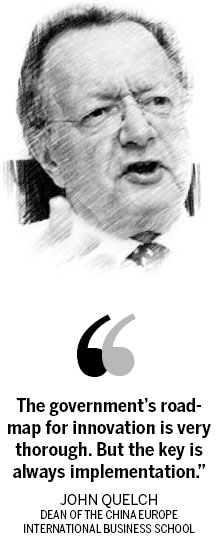
"The government's roadmap for innovation is very thorough. But the key is always implementation," Quelch said "A strategy without implementation is like music without instruments."
However, the 61-year-old professor said that because of the sheer size of China's population, even the flawed education system is able to produce an intimidating number of talented people, which is envied by other countries.
In manufacturing, despite China's rapidly aging population and talk of foreign businesses' relocating from China, Quelch said that he does not think that the country will face challenges.
"There is lots of talk about 'reshoring America' in the election season. But it's very impractical to imagine how Apple Inc can hire 100,000 workers in the US to do what Foxconn does in China," he said.
"It's possible that a company with 100 employees might be able to cut a deal with the state of Alabama that would justify moving jobs back to the US, but for a large company, which also relies on sales in China, it's neither politically sensible nor economically practical to reshore tens of thousand of jobs," Quelch said.
zhengyangpeng@chinadaily.com.cn
Copyright 1995 - 2010 . All rights reserved. The content (including but not limited to text, photo, multimedia information, etc) published in this site belongs to China Daily Information Co (CDIC). Without written authorization from CDIC, such content shall not be republished or used in any form. Note: Browsers with 1024*768 or higher resolution are suggested for this site.
License for publishing multimedia online 0108263 Registration Number: 20100000002731