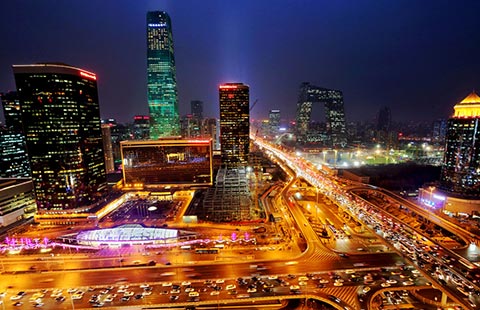
BEIJING -- From an economic viewpoint, deepening urbanization will generate enormous domestic demand and greater market potential that will continue to power growth in the world's second-largest economy.
With the urbanization rate reaching 51.3 percent in 2011, cities and towns have, for the first time, outrun the countryside in terms of population in China, the world's most populous country.
Related reading: China urbanization rate exceeds 50%
Government officials and experts see how ongoing urbanization benefits economic development and people's livelihoods. However, issues facing urban dwellers, including housing prices and unequal access to the education, pension and healthcare systems, are only some of the problems giving rise to public grievances and these problems require solutions.
About 65 percent of China's 1.3 billion people will live in cities by 2030, posing greater challenges in the future, national news magazine Outlook Weekly, which is published by Xinhua News Agency, reported last week.
In a workshop on urbanization held by the government early last month, Chinese Vice-Premier Li Keqiang said that promoting the stable development of urbanization is a long-term strategy and particularly important at this time, as the country's economic growth faces downward pressure.
Senior leaders and ministry officials attending the workshop said urbanization is the inevitable path for China to build a well-off society. Li said that more than 10 million Chinese are expected to migrate to cities annually during the next two to three decades, which will bring about increased investment in public services and infrastructure construction, as well as rising consumption as incomes increase.
He also said that there is still room for further deepening urbanization, as the urbanization rate in China is far below the 80-percent rate seen in developed nations.
State Councilor Ma Kai said that urbanization may adjust the imbalance in the economic structure and improve the quality of economic growth.
The process may also push the modernization of agriculture, promote the careful use of land resources and boost concentrated operation and machinery usage on farmlands, according to the report from Outlook Weekly.
However, the report listed some major problems in urbanization, which include blind construction, water shortages, imbalanced urbanization progress between the country's eastern and western regions, weak contributions to employment, pollution and unequal treatment in public services based on residents' urban or rural identities under the hukou system, or household registration system.
The vice-premier warned that improperly handling these issues could impede urban and industrial development. He urged local authorities to solve urbanization problems, such as those regarding employment, social security and migrants moving to cities from rural regions.
Scientific and strategic planning is fundamental, and this planning also needs to take environmental and ecological protection, population management and cultural protection into consideration.
The vice-premier said that the nation's urbanization should be jointly pushed forward with industrialization and agricultural modernization in a coordinated way.
He said more efforts should be made to balance the development of large cities and small townships, as well as to boost urbanization in western China.
Analysts also said China must conserve resources in its urbanization drive. Government data show that the arable land per capita in China is only 40 percent of the world's average. Per capita water resources in the country stand at 25 percent of the global average, while per capita reserves of oil and natural gas only account for 7 percent of the world's average.
Moreover, sources close to the National Development and Reform Commission, China's top economic planner, said that regional development grouping several cities will be the main focus of China's urbanization in a government plan currently under review.
Meanwhile, coordinated development and complementary relations between cities and neighboring towns will also be an important element in the planning.

Copyright 1995 - . All rights reserved. The content (including but not limited to text, photo, multimedia information, etc) published in this site belongs to China Daily Information Co (CDIC). Without written authorization from CDIC, such content shall not be republished or used in any form. Note: Browsers with 1024*768 or higher resolution are suggested for this site.
License for publishing multimedia online 0108263 Registration Number: 130349