With handsets deeply integrating their services or applications, Internet companies aim to win more mobile traffic. Analysts said that by increasing the exposure of their services to users they get better noticed.
"Applications are key to the future of Internet firms because more of their users access them through smartphones," said Duncan Clark, chairman of BDA China, a consultancy company that follows China's IT industry.
Tencent Holdings Ltd, China's biggest Internet company by revenue, and Chinese Web browser company Qihoo 360 Technology Co fall into the first category. They have teamed up with mobile phone markets to provide mobile phones with their services pre-installed.
|
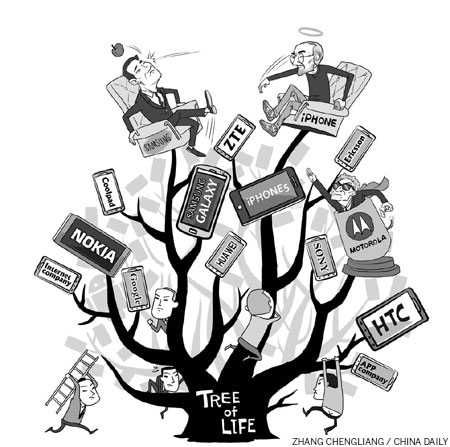 |
E-commerce giant Alibaba Group and Baidu Inc, the largest Chinese search engine, set foot in the industry with their own operating systems, through which the two companies offer their own services.
"Integrating applications into the operating system of smartphones is one way to improve the speed and ease of use necessary to cement their position," Clark said.
Shanda Interactive Entertainment Ltd and Xiaomi Corp go even further by providing their own branded mobile phones, stretching their reach to both software and hardware.
Compared with mobile phone makers, Internet companies take a different approach.
Lei Jun, founder and chief executive officer of Xiaomi, said he doesn't hope to make money by selling handsets but, instead, by providing software and services, a similar approach taken by Apple Inc.
"The hardware is like a platform. The most important thing is to breed software and services on it. Those are the things that truly generate profit," said Lei. However, he said it will take time for Xiaomi to develop into a profitable company.
"If you ask when those investments in Xiaomi will finally pay off, it's much like you asking the same question of Baidu or Tencent just after they went into business," Lei said. He estimated that Xiaomi probably needs five years, similar to Baidu and Tencent, to generate significant profits.
Lei expects the company to have sold more than 5 million Xiaomi handsets by the end of this year, from 3 million over the first half, and to ship more than 100 million smartphones annually for one model by 2016.
The rush into the mobile phone industry came when the number of Chinese people accessing the Internet via mobile devices increased to a record high of 388 million at the end of June, out of a total Internet population of 538 million, according to a report by the China Internet Network Information Center.
Meanwhile, mobile phones have become the most widely used devices to access the Internet, boosted by the increasing popularity of smartphones and a large number of mobile applications, said the report.
"It is a great thing for the market with new companies such as Baidu and Alibaba entering the smartphone industry," said KPMG's Zarrella. Because of the participation of Internet companies, there is more industry innovation. "It is the beginning of the 'innovated in China' era and this is the most exciting thing," she added.
However, Kai-Fu Lee, former president of Google China, said most Internet companies providing mobile phones will see that part of their business fail.
"The two industries (Internet and mobile phone making) are completely different with different DNA," he wrote on his micro blog.
"A company cannot win users if its aim is not to satisfy users' needs but to present its own services. It will also be criticized if it doesn't integrate competitors' services that users like into their mobile phones."
There are questions about how well Internet companies can monetize their mobile services, BDA's Clark added.
C.K. Lu, senior mobile device research analyst at Gartner Inc, said the popularity of local services such as Baidu and Tencent's instant messaving service QQ lessens the advantage of global vendors in promoting their devices with complete Internet experiences in the way that the iPhone uses its iOS operating system. "The era of the ecosystem and cloud in fact helps local vendors to compete with global brands," he said.
Operating system
The widespread use of smartphones in China is poised to ignite a new round of competition among mobile operating systems, although Google Inc's Android system remains dominant at present.

Copyright 1995 - . All rights reserved. The content (including but not limited to text, photo, multimedia information, etc) published in this site belongs to China Daily Information Co (CDIC). Without written authorization from CDIC, such content shall not be republished or used in any form. Note: Browsers with 1024*768 or higher resolution are suggested for this site.
License for publishing multimedia online 0108263 Registration Number: 130349